- Free Consultation 24/7: (813) 727-7159 Tap Here To Call Us


From First DUI to Death Penalty



How Do You Disqualify a Judge in Florida? (2026)


Rewrite/update date: November 2, 2026. Originally published in February 2025.
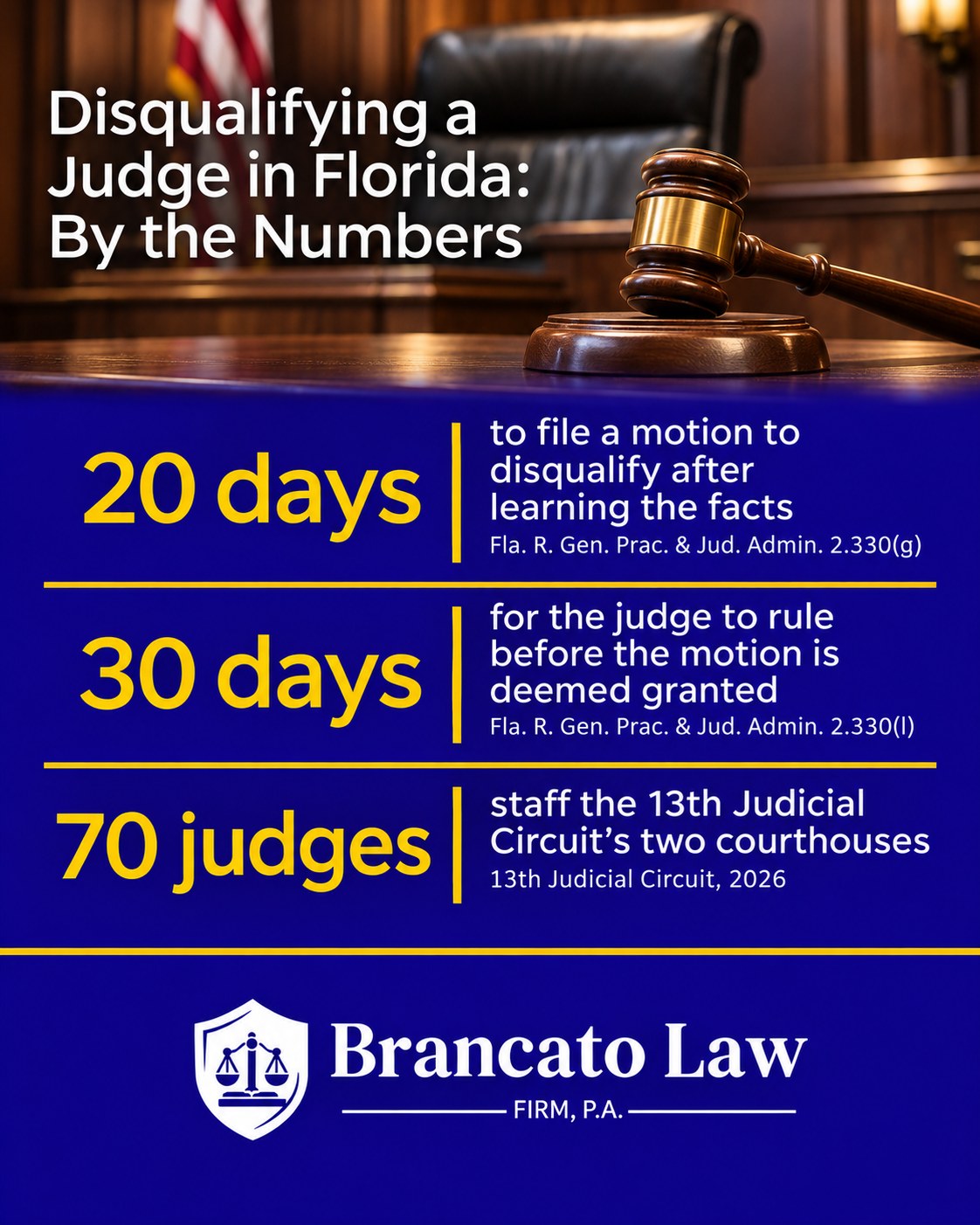
| You disqualify a judge in Florida by filing a written, sworn motion under Florida Rule of General Practice and Judicial Administration 2.330 that states specific facts showing a reasonable fear you will not get a fair trial. The motion must be filed within 20 days after you learn the facts, and it needs a separate certificate of good faith from your lawyer. The judge may decide only whether the motion is legally sufficient, not whether your facts are true, and must rule within 30 days or the motion is deemed granted. Disagreeing with a judge’s rulings is not enough. |
As founder of The Brancato Law Firm, P.A., a Tampa criminal defense firm, and a former Chief Operations Officer of the Hillsborough County Public Defender’s Office, where I oversaw a staff of over 100 attorneys, I have watched disqualification motions win and fail for the same reason: the facts in the motion. Judges do not step aside because a defendant feels uneasy. They step aside when a sworn motion lays out concrete facts that would make a reasonable person doubt the court’s fairness. Our attorneys draft these motions to meet that test and file them inside the deadline.
When can you disqualify a judge in Florida?
You can disqualify a Florida judge when specific facts would make a reasonably prudent person fear not receiving a fair and impartial trial, or when the judge has a listed conflict with the case. Rule 2.330 and section 38.10, Florida Statutes, govern the process. Both the defense and the State can file the motion.
| Ground for disqualification | What it looks like in a criminal case |
|---|---|
| Reasonable fear of bias or prejudice | The judge made comments about the defendant, the defense lawyer, or the outcome before hearing the evidence |
| Prior role in the same case | The judge was the prosecutor, defense lawyer, or a lower-court judge on the matter |
| Interest in the outcome | The judge, a spouse, or a close relative has a financial or other interest in the result |
| Family or close relationship | The judge is related to a party, a lawyer, or a material witness |
| Personal knowledge of disputed facts | The judge learned facts about the case outside the courtroom |
Actual bias is not required. The question is the appearance of bias seen through the eyes of a reasonable person in the defendant’s position. In Hillsborough County, where the 13th Judicial Circuit says its two courthouses are staffed by 70 judges as of 2026, the motion is a tool for a real problem with one judge, not a way to shop for another.
What test do Florida courts use?
Florida courts ask whether the facts alleged, assumed to be true, would place a reasonably prudent person in fear of not receiving a fair and impartial trial. The Florida Supreme Court set out that test in Livingston v. State, 441 So. 2d 1083 (Fla. 1983). In Livingston, a capital defendant in the Second Judicial Circuit swore to years of open hostility between the trial judge and his defense lawyer, including a contempt finding against the lawyer. The Court held the motion legally sufficient, reversed the murder conviction and death sentence, and ordered a new trial before a different judge.
The lesson from Livingston is that the focus is on the defendant’s reasonable fear and its basis. How the judge feels about his or her own fairness does not decide the motion.
What does not count as grounds?
Adverse rulings and loose social connections usually do not support disqualification. Florida courts have said repeatedly that a judge who rules against you has not shown bias by ruling against you. A motion built on complaints about past rulings will be denied as legally insufficient.
Social media is a common question. In Law Offices of Herssein & Herssein, P.A. v. United Services Automobile Ass’n, 271 So. 3d 889 (Fla. 2018), a law firm sought to disqualify a trial judge who was Facebook friends with a lawyer on the other side. The Florida Supreme Court held that a Facebook friendship, standing alone, is not a legally sufficient basis to disqualify a judge, because the label says nothing about how close the relationship is. The Court left room for disqualification when the friendship is close or comes with an additional factor.
What do the cases say about conduct that does require a new judge?
Conduct that shows the judge has sided with one party, in or out of the courtroom, can require disqualification even if the judge believes she can be fair. The clearest recent example is Tundidor v. State, 361 So. 3d 775 (Fla. 2023). In that Broward County capital case, the defense alleged that the judge, still in her robe, left the bench after a different high-profile murder sentencing and hugged members of the prosecution team, including the prosecutor assigned to the defendant’s own case. Two days later, during the defendant’s hearing, the judge and that prosecutor had a personal exchange that the defense believed was commiseration over the other case.
The Florida Supreme Court held that the combination of the courtroom hug and the later exchange would give a reasonably prudent person a well-founded fear of an unfair proceeding. It granted a writ of prohibition and ordered the case reassigned. Two facts, each arguable alone, were enough together. That is why our attorneys document every relevant event, with dates, before drafting the motion.
| Allegation | Result | Case |
|---|---|---|
| Years of open hostility between the judge and defense counsel | Disqualification required; conviction reversed | Livingston v. State, 441 So. 2d 1083 (Fla. 1983) |
| Judge hugged the defendant’s prosecutor in robe, then commiserated with him | Disqualification required; case reassigned | Tundidor v. State, 361 So. 3d 775 (Fla. 2023) |
| Judge was a Facebook friend of the opposing lawyer, nothing more | Not legally sufficient | Law Offices of Herssein & Herssein, P.A. v. United Services Automobile Ass’n, 271 So. 3d 889 (Fla. 2018) |
| Judge served in the unit prosecuting the case while it was pending | Disqualification required; new trial ordered | Davis v. State, 347 So. 3d 315 (Fla. 2022) |
How do you file a motion to disqualify a judge in Florida?
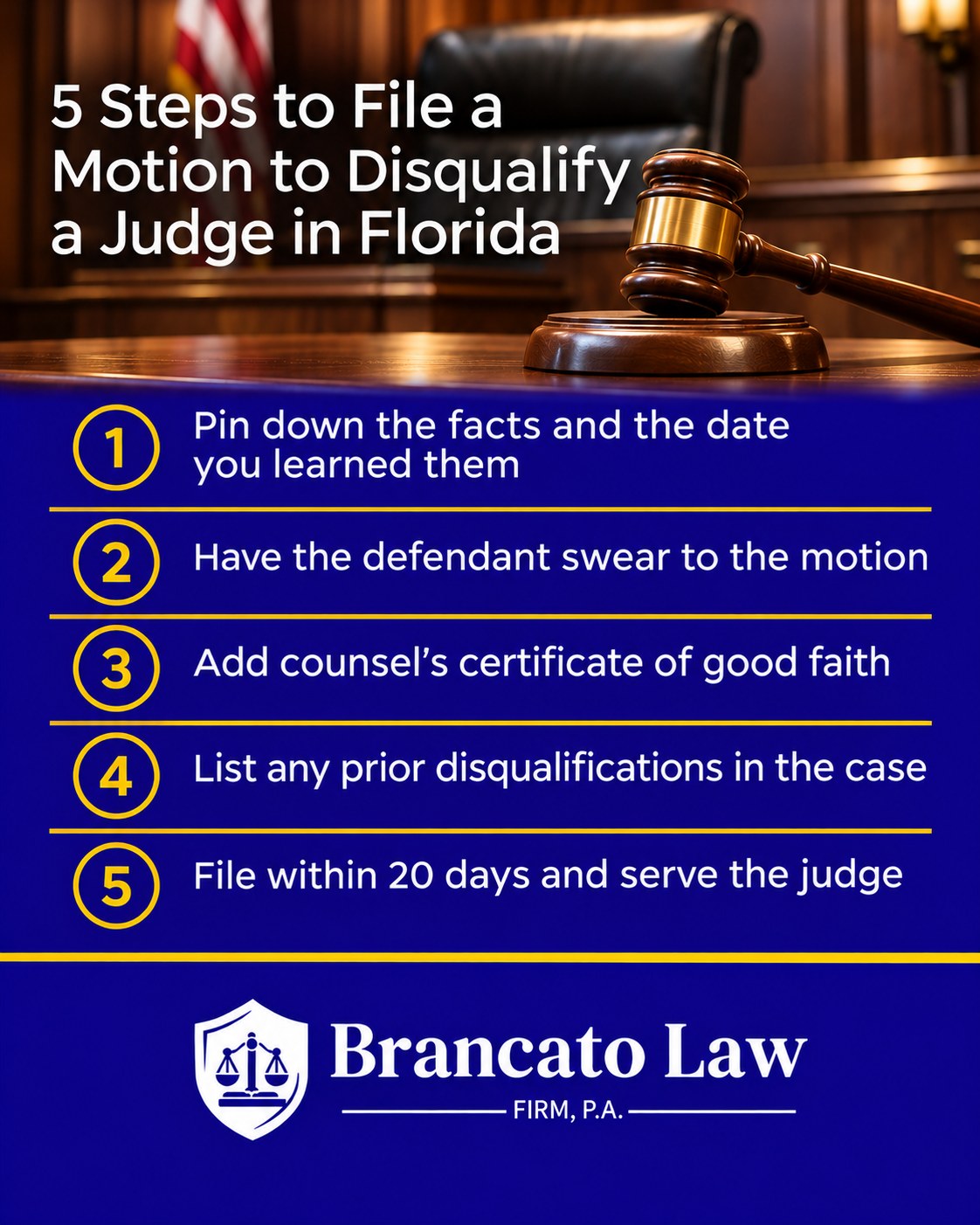
You file a written motion that meets every requirement of Rule 2.330, because a motion that misses one can be denied without reaching the merits. Our attorneys follow these five steps:
- Pin down the facts and the date you learned them. The motion must state the specific facts and the date the defendant or counsel discovered them.
- Have the defendant swear to it. The motion must be sworn to or affirmed by the party, either by signing it under oath or by attaching an affidavit.
- Add counsel’s certificate of good faith. The lawyer must separately certify that the motion is made in good faith.
- List any prior disqualifications. The motion must disclose earlier granted motions in the case and their dates.
- File within 20 days and serve the judge. File with the clerk within a reasonable time, no later than 20 days after discovering the grounds, and promptly serve a copy on the judge. Grounds that arise during a hearing or trial can be raised on the record and must then be put in writing and filed promptly.
| Deadline | What the rule requires |
|---|---|
| Within 20 days of discovering the facts | File the motion with the clerk |
| Immediately, and no later than 30 days after service | Judge must rule; if not denied in time, the motion is deemed granted |
| Within 30 days of the disqualification order | Move to reconsider the prior judge’s rulings, unless good cause allows later |
| During a hearing or trial | Raise new grounds on the record, then file in writing promptly |
What happens after the judge rules?
If the motion is legally sufficient, the judge must enter an order of disqualification and take no further action in the case. If it is not, the judge must deny it. The judge may not argue with the facts in the motion. A judge who disputes the truth of the allegations, rather than ruling on their sufficiency, can create a new ground for disqualification.
After a grant, the case goes to a new judge. In our experience in Hillsborough County, reassignment comes through the clerk’s rotation, so neither side picks the successor. Rulings the first judge made before disqualification stand unless a party moves to reconsider them within 30 days of the order. Timing matters for a second reason: once a judge is disqualified for prejudice, Rule 2.330(i) generally bars the same party from disqualifying the successor on a later motion unless the successor rules that he or she cannot be fair. Your attorney should be sure the first motion is the right one.
What if the judge denies the motion?
If the judge denies a legally sufficient motion, the remedy is a petition for writ of prohibition in the district court of appeal, filed before the case goes forward. For cases in Hillsborough, Pinellas, and Pasco Counties, that court is the Second District Court of Appeal. In death penalty cases, review can go to the Florida Supreme Court, as it did in Tundidor. The appellate court reviews legal sufficiency de novo, without deferring to the trial judge.
Waiting for a direct appeal is risky. In Davis v. State, 347 So. 3d 315 (Fla. 2022), a Polk County murder defendant moved to disqualify a judge who had served in the homicide unit prosecuting his case while it was pending. The Florida Supreme Court agreed the motion should have been granted, but held that on direct appeal an erroneous denial is reviewed for harmless error under section 924.33, Florida Statutes. Davis won a new trial only because the judge had changed jury-selection rulings that could have affected the verdict. A defendant who waits may face a harder test than one who seeks prohibition right away.
Will filing a motion to disqualify hurt your case?
A well-founded motion should not hurt your case, because judges are trained to treat it as a legal question and the rule limits what they can do in response. A weak motion carries more risk: it can strain the courtroom relationship and waste the one motion that the successor rule effectively allows. Douglas J. Glaid’s article in The Florida Bar Journal (October 2000) made the same point decades ago: complaints about rulings have consistently failed, while specific facts about personal bias succeed. Our firm files when the facts meet the test and tells clients plainly when they do not.
For how a felony case moves from arraignment to trial in Tampa, see our guide to the criminal court process in Hillsborough County. If a judge’s conduct arises at a bond hearing, our article on how a bond hearing works in Tampa explains that stage, and our post on contempt of court in Florida covers what happens when a judge accuses someone of contempt.
Frequently asked questions about disqualifying a judge in Florida
How long do I have to file a motion to disqualify a judge in Florida?
You must file within a reasonable time, and no later than 20 days after you or your lawyer learn the facts supporting the motion, under Rule 2.330(g). Our attorneys at The Brancato Law Firm record the discovery date in the motion itself so the State cannot argue the motion is late.
Can a judge be disqualified for being a former prosecutor?
Not for that reason alone, but a judge who worked on your specific case as a prosecutor, or served in the unit handling it while it was pending, should be disqualified. The Brancato Law Firm checks a new judge’s prior assignments against the case history, which is the issue the Florida Supreme Court addressed in Davis v. State, 347 So. 3d 315 (Fla. 2022).
What happens if the judge does not rule on my motion within 30 days?
The motion is deemed granted, and you may ask the clerk for an order reassigning the case. When a ruling is overdue, our attorneys at The Brancato Law Firm move promptly for that order so the original judge takes no further action.
Can I disqualify a judge because the judge keeps ruling against me?
No. Adverse rulings alone are not a legally sufficient ground, and a motion built on them will be denied. The Brancato Law Firm looks instead for facts outside the rulings themselves, such as statements, relationships, or prior involvement, before recommending a motion to a client in our Hillsborough County criminal defense practice.
Can the prosecutor move to disqualify the judge in a criminal case?
Yes. Rule 2.330(b) lets any party, including the State, seek disqualification under the same procedure. When the State files one, our attorneys at The Brancato Law Firm hold it to the same sworn-facts and timing requirements a defendant must meet.
Does a judge being Facebook friends with the prosecutor require disqualification?
No, not by itself. The Florida Supreme Court held in Law Offices of Herssein & Herssein, P.A. v. United Services Automobile Ass’n, 271 So. 3d 889 (Fla. 2018) that a Facebook friendship alone is not legally sufficient, though a close relationship or another factor can change the answer. The Brancato Law Firm investigates the actual relationship before deciding whether the facts support a motion.
For how this fits into the rest of a case, see our guide to each stage of a Florida criminal case.
Talk to a lawyer before the 20-day window closes
The clock on a disqualification motion starts the day you learn the facts, and a late motion can be denied no matter how strong it is. Call The Brancato Law Firm, P.A., founded by Tampa Criminal Defense Attorney Rocky Brancato, at (813) 727-7159. Call us at any hour; our attorneys will review what happened, the dates, and the court file, and tell you whether a motion is the right move. Our firm has Spanish-speaking staff, and attorney Jean-Luc Adrien speaks Spanish, Haitian Creole, and French. Read our guide for Spanish-speaking criminal defense clients in Tampa.

For more about our defense strategies, visit our Hillsborough County Criminal Defense page.
The Brancato Law Firm, P.A.
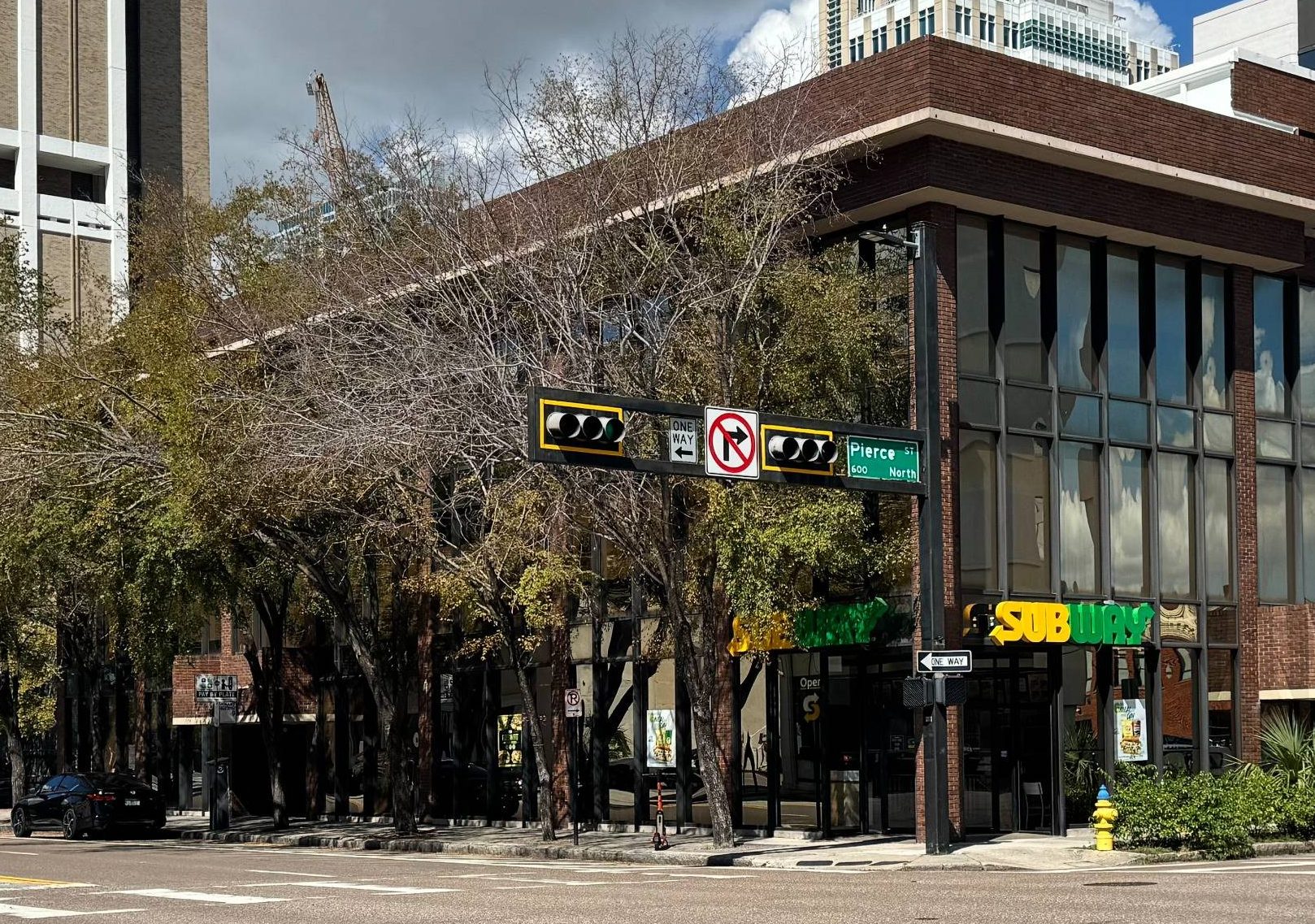
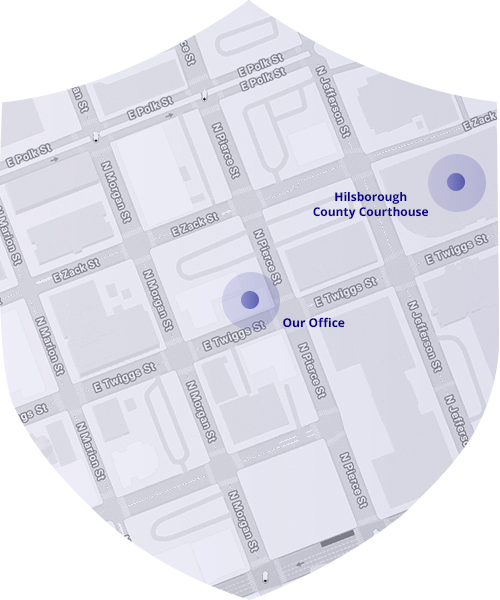
620 E. Twiggs Street, Suite 205, Tampa, FL 33602
(813) 727-7159
Serving Hillsborough, Pinellas, and Pasco Counties
The Brancato Law Firm, P.A. is a Tampa-based criminal defense practice. We are not affiliated with any other Brancato-named law firms.
Visit Us
Tampa, FL 33602
Contact Us Now
Free Legal Consultation (813) 727-7159