- Free Consultation 24/7: (813) 727-7159 Tap Here To Call Us


From First DUI to Death Penalty



Can I Bring My Child to Court?



Fully rewritten and updated October 23, 2026.
You can usually bring a child into a Florida courthouse, because courthouses are public buildings, but many judges do not allow children in the courtroom, and any judge can ask you to take a child out. We recommend arranging childcare for every court date. If you are the defendant in a criminal case, a child in the courtroom is also at risk of watching you taken into custody. If you have no childcare, check the judge’s published courtroom procedures and call your lawyer before the hearing, not the morning of it.
A Florida judge expects the person whose case is called to be ready, focused, and able to speak with a lawyer at a moment’s notice, and a restless toddler makes all three harder. I have watched that play out for more than 25 years in Hillsborough County courtrooms, including as the former Chief Operations Officer of the Hillsborough County Public Defender’s Office, where I oversaw a staff of over 100 attorneys. I’m Rocky Brancato, founder of The Brancato Law Firm, P.A., a Tampa criminal defense firm, and our attorneys plan childcare with clients the same way we plan the hearing itself.
Are Children Allowed in Court in Florida?
Children are allowed in Florida courthouses, but whether they are allowed in a particular courtroom depends on the judge. Courthouses are public buildings, and most criminal hearings are open to the public. Inside the courtroom, though, the judge controls decorum, and Florida’s court rules give the chief judge of each circuit authority to regulate the use of all court facilities under Florida Rule of General Practice and Judicial Administration 2.215(b)(7). Some judges bar children from the courtroom entirely; others allow them as long as they stay quiet.
Every person entering a Hillsborough County courthouse through a public door is subject to search under the 13th Judicial Circuit’s Administrative Order S-2026-047 on courthouse security, which took effect September 22, 2026, and that includes children and anything in a diaper bag. Leave scissors, toy weapons, and anything sharp at home. Our attorneys at The Brancato Law Firm tell clients to arrive at least 30 minutes early, because a security line with a child moves slower.
Why We Do Not Recommend Bringing Your Child to Court
We do not recommend it because the courtroom is the wrong place for a child and the worst place for you to be distracted. There are four practical reasons:
| Risk | What can happen |
|---|---|
| The judge does not allow children | You are asked to leave, your case is passed or reset, and you have to find someone to take your child on short notice |
| Your child becomes restless | The judge or bailiff asks you to step out, and you may miss your case being called |
| You cannot focus | You miss what the judge, the prosecutor, or your lawyer says at the moment it matters |
| You are taken into custody | Your child watches it happen, and officers must find an adult to take your child |
Courtrooms can be frightening for children even on a good day. Depending on the docket, a child may hear details of violent or sexual allegations in other cases, see people in jail uniforms, and absorb the stress you are feeling. Our attorneys at The Brancato Law Firm would rather solve the childcare problem a week early than have a client manage it in the gallery.
What Happens If You Are Taken Into Custody With Your Child in Court?
If you are taken into custody while your child is at the courthouse, officers have to place your child with a responsible adult, and if none can be found, the child can be taken into custody by law enforcement or the Department of Children and Families. Under section 39.401, Florida Statutes, an officer may take a child into custody when the child has no parent, legal custodian, or responsible adult relative immediately known and available to provide supervision and care. That is the outcome every parent wants to avoid.
In a criminal case, custody at the end of a hearing is a real possibility. A judge can revoke a bond after a violation, a sentencing can include jail, and a probation violation hearing can end with the person held. Research shows what witnessing that does to a child. In a 2010 study of 1,869 children in the child welfare system, published in Children and Youth Services Review, Susan Phillips and Jian Zhao found that witnessing a household member’s arrest predicted elevated posttraumatic stress symptoms, and about 1 in 4 children who witnessed an arrest and had a recently arrested parent showed those symptoms (study abstract). If there is any chance of custody at your hearing, our attorneys will tell you in advance so you can plan. Our guide to bond hearings in Tampa explains when release conditions are at stake.
How Many Hillsborough Parents Face This Problem?
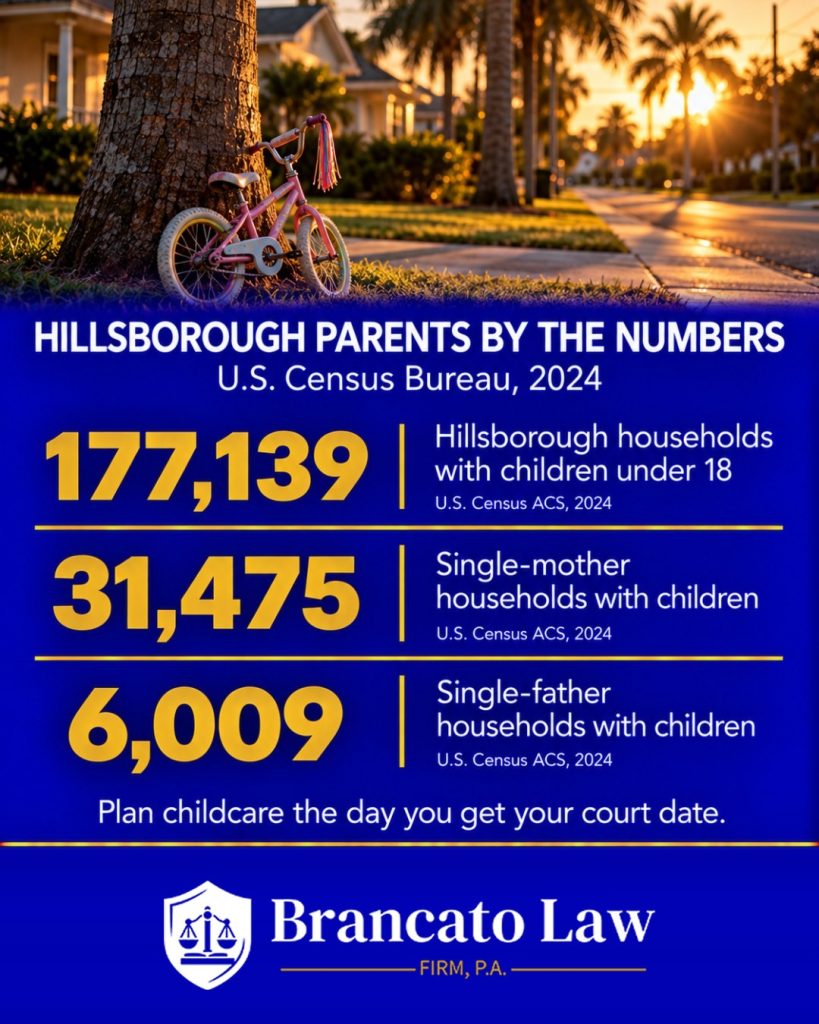
Many. In 2024, Hillsborough County had 177,139 households with one or more people under 18, according to the U.S. Census Bureau’s 2024 American Community Survey 1-year estimates (table DP02). The same survey counted 31,475 households headed by a woman with no spouse or partner present and children of her own under 18, and 6,009 such households headed by a man. Single parents in particular often have no second adult who can take the morning off, which is why The Brancato Law Firm raises childcare at the first meeting about any court date.
How Do I Find Out If My Judge Allows Children?
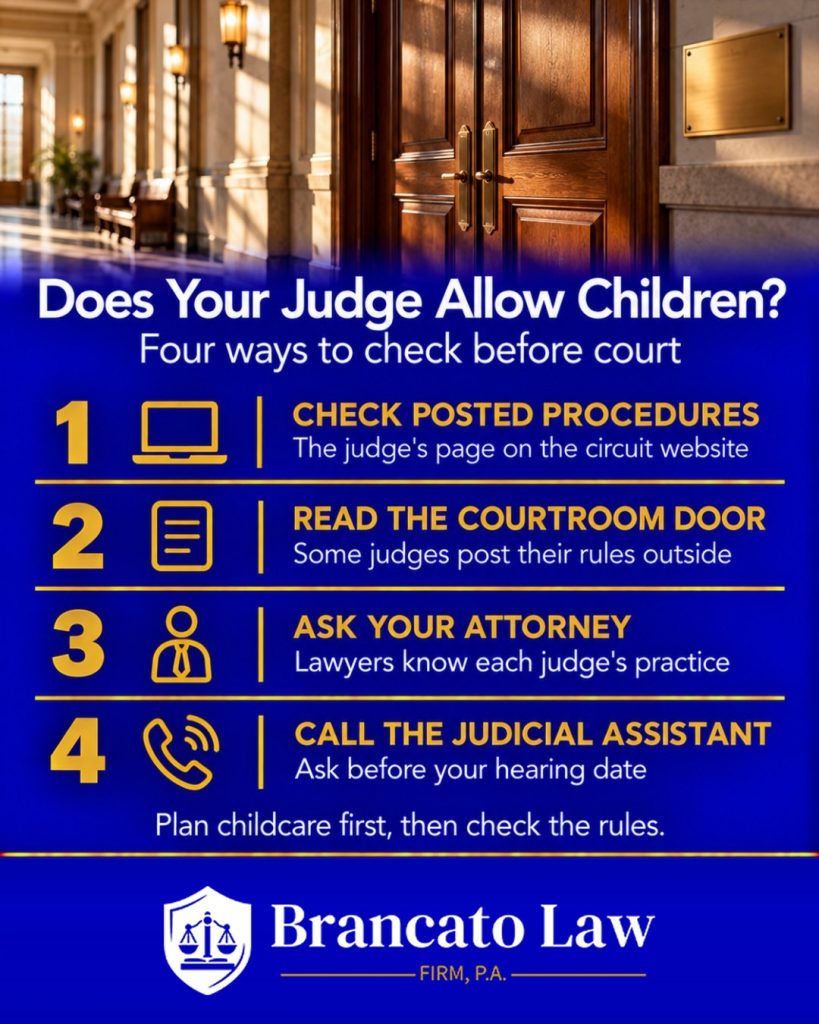
Check the judge’s published courtroom procedures first. Florida Rule of General Practice and Judicial Administration 2.215(f) requires every judge who sets practices or procedures that apply only in that judge’s courtroom to publish them on the circuit’s website. The Florida Supreme Court added that requirement in In re Amendments to Florida Rule of General Practice and Judicial Administration 2.215, 382 So. 3d 592 (Fla. 2023), an order effective January 1, 2024, that the Court said was meant to give litigants transparent and ready access to each judge’s procedures. If your judge bars children, that rule should be posted.
- Find your judge’s division on the 13th Judicial Circuit website (for Hillsborough County) and open the judge’s posted procedures.
- Look for posted rules on or near the courtroom door when you arrive.
- Ask your attorney, who usually knows how a particular judge handles children in the gallery.
- If you have no lawyer and cannot find the answer online, call the judge’s judicial assistant before the hearing date.
I Have Court but No Babysitter. What Should I Do?
Start planning as soon as you get the court date, and call your lawyer if the plan falls through. Missing court is far worse than an awkward morning: under section 843.15, Florida Statutes, willfully failing to appear after release on a felony charge is a third-degree felony, and failing to appear on a misdemeanor charge is a first-degree misdemeanor, on top of the bond forfeiture and a likely warrant. These options usually work:
- Ask a relative, friend, or neighbor to watch your child for the morning; most hearings run a few hours, not a full day.
- Use a drop-in daycare or a babysitter booked for the specific date.
- Check whether your child’s school or daycare offers extended or before-school care that covers the hearing time.
- Tell your lawyer early. Your attorney may be able to ask for a different time, request a continuance, or tell you whether the hearing type allows the lawyer to appear without you.
- Have a backup adult on call who can come to the courthouse and pick up your child if anything goes wrong.
Our attorneys at The Brancato Law Firm ask about childcare when we schedule, so the problem surfaces while there is still time to fix it.
If You Have No Other Choice, How Should You Bring Your Child?
If every option has fallen through and you must bring your child, prepare for a short, quiet stay and an early exit:
- Confirm the judge allows children before you leave home.
- Bring quiet activities: books, coloring supplies, or a tablet with headphones, and nothing sharp that security will take.
- Talk to your child about behavior before you walk in.
- Sit near the door so you can step out quickly.
- Bring a second adult if you can, and have someone on call who can take your child if the judge asks or if you are held.
Dress for court as you would without your child; our guide on what to wear to court covers that in detail.
Can I Bring My Child to Court for a Traffic Ticket?
It depends on the kind of traffic case. For most civil traffic tickets in Florida, you may not need to go to court at all: under section 318.14, Florida Statutes, a person cited for a noncriminal infraction can pay the civil penalty or enter a payment plan within 30 days, which counts as an admission and waives the hearing, and many drivers can elect a basic driver improvement course instead of appearing. If you choose a hearing, the same courtroom rules about children apply.
Criminal traffic charges are different. Driving with a suspended license, reckless driving, leaving the scene, and DUI are criminal cases with required court dates, and our Tampa criminal traffic lawyer page explains how those cases proceed. Our attorneys at The Brancato Law Firm can sometimes handle routine settings so a client does not miss work or need childcare.
Frequently Asked Questions About Bringing Children to Court
Are babies allowed in courtrooms in Florida?
Babies are treated like any other child: the judge decides. The Brancato Law Firm advises parents of infants to plan childcare, because a crying baby is the most common reason a judge asks a parent to step out.
Can a minor attend a court hearing as a spectator in Florida?
Often yes, because most criminal hearings are open to the public, but the judge can limit attendance to keep order or protect a witness. Our attorneys at The Brancato Law Firm check the judge’s posted procedures under Rule 2.215(f) before telling a family whether a teenager may watch.
What happens if I bring my child and the judge does not allow it?
The judge will usually ask you to leave the courtroom and make other arrangements, and your case may be passed, called later, or reset. The Brancato Law Firm can often keep the case moving while a client solves the childcare problem; see our Hillsborough County criminal defense attorney page for how we handle court settings.
Can my child come with me to visit a family member in the Hillsborough County jail?
Jail visitation has its own rules, separate from courtroom rules, set by the Hillsborough County Sheriff’s Office. The Brancato Law Firm explains how to locate someone in custody in our guide to the Hillsborough County jail inmate search.
My child’s school is closed on my court date. Can I bring my child?
A school closure does not change the judge’s courtroom policy, so you still need childcare. Our attorneys at The Brancato Law Firm ask clients to flag school holidays when we schedule so we can plan around them.
Can I appear in court remotely instead of bringing my child?
Sometimes, depending on the hearing type and the judge’s procedures, but you should never assume a remote appearance is allowed. The Brancato Law Firm checks the judge’s posted procedures and, where the rules allow it, asks the court in advance so a client is not marked absent.
For how this fits into the rest of a case, see our stage-by-stage guide to the Florida criminal case process.
Talk to a Tampa Criminal Defense Attorney About Your Court Date
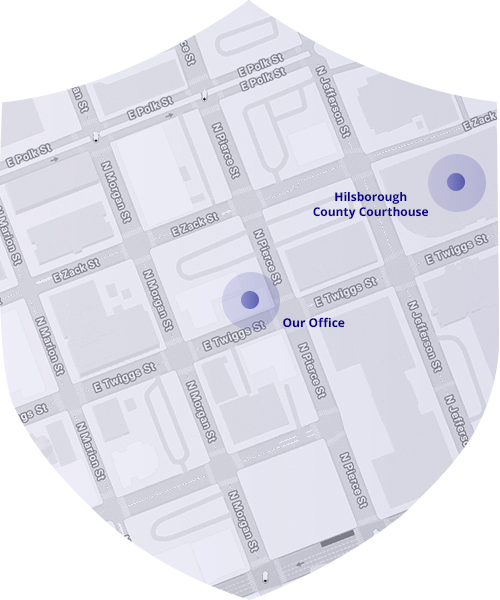
Tell us your court date and your childcare situation, and we will build a plan around both. The Brancato Law Firm, P.A., founded by Tampa Criminal Defense Attorney Rocky Brancato, can be reached at (813) 727-7159; call before your court date, not on the morning of it. Call us at any hour; our office is two blocks from the courthouse. Our firm has Spanish-speaking staff, and attorney Jean-Luc Adrien speaks Spanish, Haitian Creole, and French. Read our guide for criminal defense in Spanish and Haitian Creole in Tampa.
For more about our defense strategies, visit our Hillsborough County Criminal Defense page.
The Brancato Law Firm, P.A.
620 E. Twiggs Street, Suite 205, Tampa, FL 33602
(813) 727-7159
Serving Hillsborough, Pinellas, and Pasco Counties
The Brancato Law Firm, P.A. is a Tampa-based criminal defense practice. We are not affiliated with any other Brancato-named law firms.
Visit Us

Tampa, FL 33602
Contact Us Now
Free Legal Consultation (813) 727-7159