- Free Consultation 24/7: (813) 727-7159 Tap Here To Call Us


From First DUI to Death Penalty



Intoxilyzer Not Properly Maintained? What It Means for a Florida DUI (2026)


Updated October 22, 2026
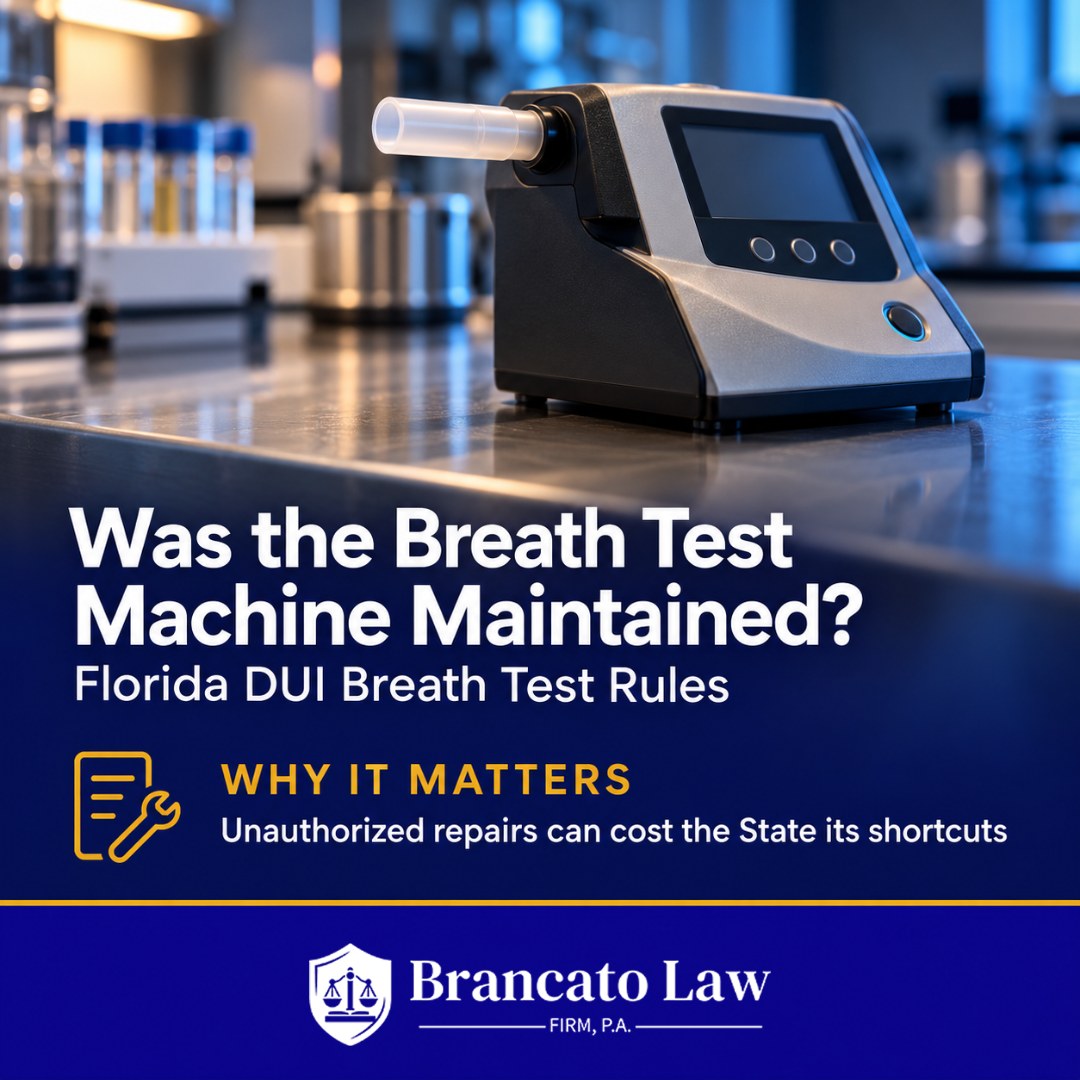
If the Intoxilyzer used in a Florida DUI was not inspected, maintained, or repaired the way FDLE’s rules require, the State can lose the legal shortcuts that make a breath result easy to admit and powerful at trial. Under section 316.1934, Florida Statutes, and State v. Donaldson, 579 So. 2d 728 (Fla. 1991), the State must show the test followed FDLE-approved methods on a properly inspected machine. In State v. Kilburn, 418 So. 3d 275 (Fla. 2d DCA 2025), the State lost those presumptions because the machine had an unauthorized repair. FDLE changed its rule on July 1, 2026, but tests on machines repaired before that date are still judged under the old rule.
A breath test result looks like a number on a printout, but the law treats it as the end of a chain of records: monthly inspections, annual inspections, repairs, operator permits, and a 20-minute observation period. Our attorneys request that chain in every DUI case. I’m Rocky Brancato, founder of The Brancato Law Firm, P.A., a Tampa criminal defense firm, a member of the National College for DUI Defense, and a former police academy instructor. When one link in the chain is missing, the State’s best evidence can lose most of its weight.
What does Florida law require before a breath test can be used?
Florida law requires the State to prove the breath test was performed substantially according to methods approved by the Florida Department of Law Enforcement (FDLE), by an operator with a valid permit, on an approved instrument. That requirement appears in section 316.1932, Florida Statutes and section 316.1934, Florida Statutes.
The Florida Supreme Court spelled out the foundation in State v. Donaldson, 579 So. 2d 728 (Fla. 1991). Before breath results come in, the State must present evidence that the test was performed substantially according to approved methods, with an approved machine, by a qualified operator, and that “the machine itself has been calibrated, tested, and inspected in accordance with” the regulations “to assure its accuracy.” The court allowed “minor deviations,” such as storage location or “absolute timeliness of periodic inspection,” as long as there is evidence the machine remained accurate.
When the State meets that foundation, it gets two advantages. Under section 316.1934(2)(c), a result of 0.08 or higher “is prima facie evidence” of impairment. Under section 316.1934(5), the breath test affidavit comes in “without further authentication” and is “presumptive proof of the results,” as long as it lists, among other things, “the date of performance of the most recent required maintenance on such instrument.”
What FDLE rules govern Intoxilyzer inspection and repair?
FDLE’s breath testing rules are in Chapter 11D-8 of the Florida Administrative Code. Florida’s approved instruments are the CMI Intoxilyzer 8000 and Intoxilyzer 9000 under Rule 11D-8.003. The requirements that matter most in a defense review are below.
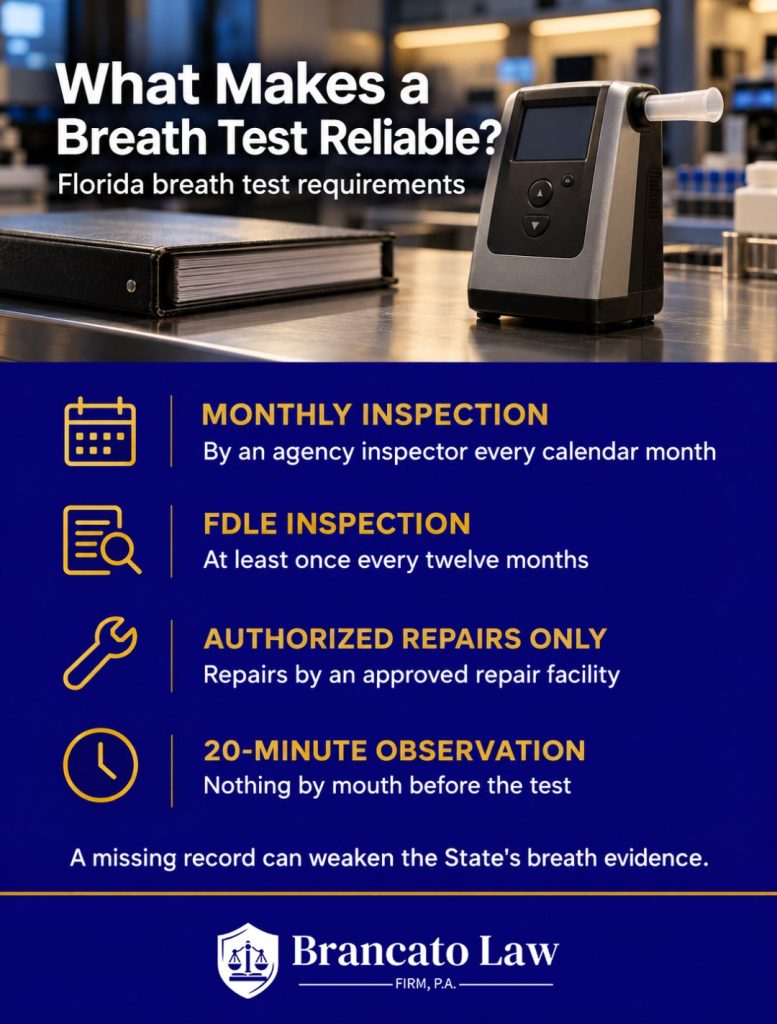
| Requirement | What the rule says | Rule |
|---|---|---|
| Agency inspection | Each evidentiary instrument must be inspected by an agency inspector “at least once each calendar month” | 11D-8.006 |
| FDLE inspection | FDLE must inspect each instrument “at least once every twelve months,” and again after any repair before it returns to evidentiary use | 11D-8.004 |
| Who may repair | An “Authorized Repair Facility.” Since July 1, 2026 that includes FDLE; before then it did not | 11D-8.002(13) |
| Opening the machine | Only authorized repair facilities or FDLE may remove the top cover | 11D-8.007(1) |
| Observation period | The subject must not have taken anything by mouth or regurgitated for at least 20 minutes before the test | 11D-8.007(3) |
| Valid test | Two breath samples within 15 minutes, with results within 0.020 of each other, or a third sample | 11D-8.002(12) |
Each of these leaves a paper trail. Agency inspections are recorded on FDLE/ATP Forms 39 and 40, and the operator’s test is recorded on the Breath Alcohol Test Affidavit, Form 38. When those records are missing, late, or inconsistent, the State’s foundation weakens.
What happened in State v. Kilburn?
In State v. Kilburn, 418 So. 3d 275 (Fla. 2d DCA 2025), three Sarasota County DUI defendants were tested on the same Intoxilyzer 8000. Before their tests, a sheriff’s deputy reported to FDLE that the machine’s breath tube was “leaking and broken and in need of repair.” An FDLE inspector removed the top panel, disconnected an O-ring and wires attached to an electronic chip, and replaced the tube.
The county judge ruled that replacing the tube was a repair, that FDLE was not an authorized repair facility under the rule then in effect, and that the tests therefore were not in substantial compliance with Chapter 11D-8. The Second District agreed and denied the State’s petitions. The court wrote, “It is apparent that the replacement of the breath tube constitutes a repair,” and held that “Unauthorized repair is not a minor deviation from the Department’s rules.” A footnote explained that FDLE had been removed from the repair-facility definition in 2015 “because the Department only performs maintenance on the breath test instruments and does not perform repairs.”
The precise result matters. The order did not bar the breath results outright. It blocked the State from using the section 316.1934 affidavit and the statutory presumptions, which left the State to try to prove the machine’s reliability the traditional way, with scientific testimony. In most DUI cases, that is a much harder road. Because the Second District hears appeals from Hillsborough, Pinellas, and Pasco Counties, Kilburn is binding in every county our firm serves.
Did the July 1, 2026 rule change undo Kilburn?
Partly. FDLE amended Rule 11D-8.002(13) effective July 1, 2026. The definition of “Authorized Repair Facility” now begins “the Department, the breath test instrument manufacturer, or an entity authorized by the breath test instrument manufacturer.” FDLE is back in the definition, so a repair FDLE performs after that date is not unauthorized for the reason the Kilburn court relied on. The same amendment changed FDLE’s inspection interval from once “each calendar year” to “at least once every twelve months.”
The amendment does not say it applies to earlier repairs. Tests run on instruments that FDLE repaired before July 1, 2026 still fall under the old definition, which is the Kilburn rule. For DUI cases from 2025 and early 2026 that are still pending, our attorneys check each instrument’s repair history for exactly this issue. FDLE also still must inspect a machine after any repair before it goes back into evidentiary use, so the post-repair inspection record remains a target under either version of the rule.
How accurate is a breath test compared with a blood test?
Breath and blood alcohol do not track each other perfectly. In a study of drinking drivers, A.W. Jones and L. Andersson, Variability of the Blood/Breath Alcohol Ratio in Drinking Drivers, Journal of Forensic Sciences (1996), found that the ratio between blood and breath alcohol varied from driver to driver, with 95% of drivers falling between about 1,981 and 2,833.
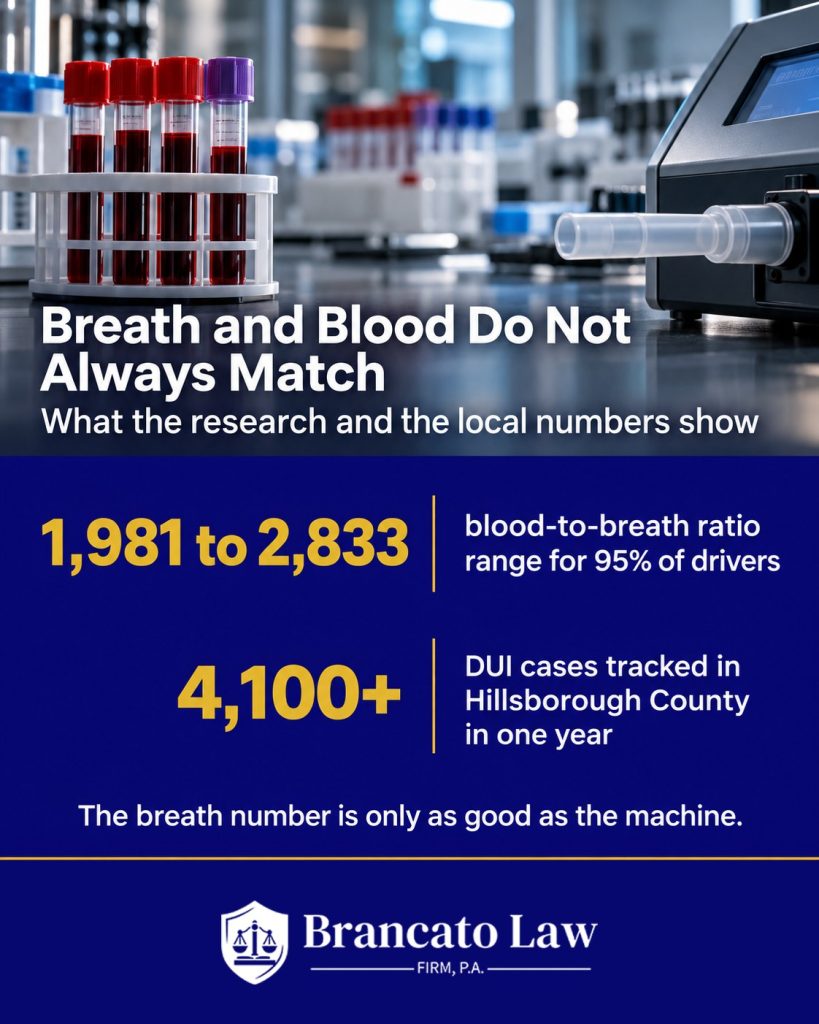
Florida law handles that variation by defining the limit directly in breath, 0.08 grams of alcohol per 210 liters, under section 316.193, Florida Statutes. The practical effect is that the breath number depends entirely on the instrument working correctly on that day. That is why the inspection and repair records are worth fighting over. In Hillsborough County, where the MADD court monitoring program tracked more than 4,100 DUI cases from October 2024 through September 2025 according to FDOT’s FY2025 Highway Safety Annual Report, a single instrument can be used for a large number of arrests.
How do our attorneys challenge an Intoxilyzer result?
Our attorneys challenge an Intoxilyzer result by auditing the instrument, the operator, and the test, then holding the State to Donaldson. You can learn more on our Tampa DUI lawyer page. The audit usually covers:
- The instrument’s history. Monthly agency inspections, the most recent FDLE inspection, every repair, who performed it, and the post-repair inspection.
- The affidavit. Whether it lists the most recent required maintenance date and matches the inspection records, as section 316.1934(5) requires.
- The operator. Whether the officer’s breath test operator permit was valid on the test date.
- The 20-minute observation. Body camera and jail video often show whether the officer actually watched the client, or was filling out paperwork while the client burped, coughed, or put something in their mouth.
- The two samples. Whether the results fell within 0.020 of each other, and why a third sample was or was not taken.
- The witnesses. In Hillsborough County, the Sheriff’s Office runs a Central Breath Testing unit, and its operators and agency inspectors are often the witnesses in a breath challenge. We depose them when the records do not line up.
Courts continue to refine these issues. In Sanchez v. State, No. 3D24-0231 (Fla. 3d DCA Sept. 10, 2025), the court held that an officer who maintains the Intoxilyzer and serves as records custodian gives lay testimony, not expert testimony. In State v. Repple, No. SC2024-1088 (Fla. Dec. 30, 2025), the Florida Supreme Court held that a city officer may request the implied consent breath test at a breath testing facility outside the city. Knowing where these lines are drawn tells us which challenges are worth filing.
Our firm has also won DUI cases without the breath test being the deciding issue, including a not guilty verdict on DUI and resisting where scene video showed no impairment, and a commercial driver’s license reinstated on appeal after a DHSMV suspension. Those results are on our case results page. Past results do not guarantee future outcomes.
Frequently asked questions about Intoxilyzer challenges in Florida
Can a breath test be thrown out in Florida if the machine was not maintained?
It can be kept from carrying its statutory presumptions, and in some cases excluded, when the State cannot show substantial compliance with FDLE’s inspection and repair rules. The Brancato Law Firm requests the instrument’s full inspection and repair history in every breath test case so that issue is never missed.
What was the Kilburn breath test case about?
State v. Kilburn, 418 So. 3d 275 (Fla. 2d DCA 2025), held that FDLE’s replacement of a broken breath tube was an unauthorized repair under the rule then in effect, so the State lost the statutory presumptions for three DUI tests. Our attorneys at The Brancato Law Firm check whether any machine used in a client’s case was repaired before July 1, 2026, when FDLE changed the rule.
How often must an Intoxilyzer be inspected in Florida?
An agency inspector must inspect each instrument at least once each calendar month under Rule 11D-8.006, and FDLE must inspect it at least once every twelve months under Rule 11D-8.004. The Brancato Law Firm compares those dates with the date of the client’s test, because a gap can undermine the State’s foundation.
What is the 20-minute observation period for a breath test?
Before the test, the subject must not have taken anything by mouth or regurgitated for at least 20 minutes, under Rule 11D-8.007(3). Our attorneys at The Brancato Law Firm review the jail and body camera video minute by minute to see whether the observation actually happened.
Should I refuse a breath test in Florida?
Refusing has its own consequences, including a license suspension and possible criminal penalties for a second refusal, so it is not a simple choice. The Brancato Law Firm explains the tradeoffs in our post on breathalyzer refusal in Florida, and we defend refusal cases with the same scrutiny as breath test cases.
Can I get the maintenance records for the Intoxilyzer used in my case?
Yes. The inspection, maintenance, and repair records for a specific instrument can be obtained through discovery, subpoena, and public records requests. The Brancato Law Firm gets those records early, because they often decide whether the breath result can be challenged at all. See also How to Challenge Field Sobriety Tests in Tampa.
Talk to our DUI attorneys about your breath test
Instrument records can take weeks to collect, and the license challenge must be filed within 10 days of the arrest. The Brancato Law Firm, P.A., founded by Tampa Criminal Defense Attorney Rocky Brancato, will request the Intoxilyzer records, review the observation video, and file the license challenge on time. Call (813) 727-7159. You can call us at any hour. Our firm has Spanish-speaking staff, and attorney Jean-Luc Adrien speaks Spanish, Haitian Creole, and French. Read about our Spanish and Haitian Creole criminal defense services.
For more about our defense strategies, visit our Tampa DUI Defense page.
The Brancato Law Firm, P.A.
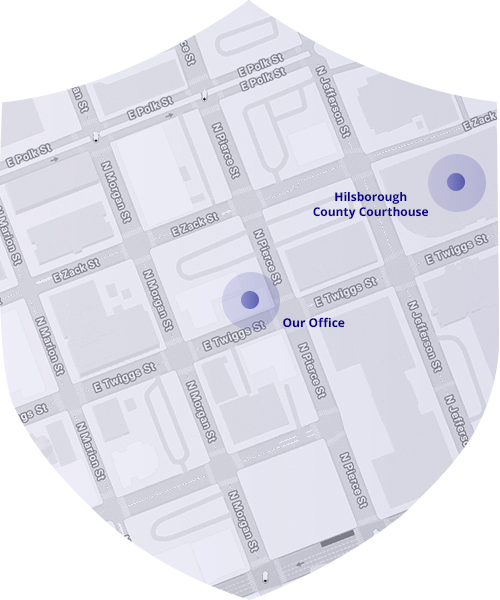
620 E. Twiggs Street, Suite 205, Tampa, FL 33602
(813) 727-7159
Serving Hillsborough, Pinellas, and Pasco Counties
The Brancato Law Firm, P.A. is a Tampa-based criminal defense practice. We are not affiliated with any other Brancato-named law firms.
Each case is unique, and past results do not guarantee future outcomes. This article is general information, not legal advice.
Visit Us
Tampa, FL 33602
Contact Us Now
Free Legal Consultation (813) 727-7159