- Free Consultation 24/7: (813) 727-7159 Tap Here To Call Us


From First DUI to Death Penalty


How to Challenge Field Sobriety Tests in a Tampa DUI (2026)


Updated October 22, 2026
Field sobriety tests are challenged in Florida in three ways: by attacking the officer’s legal basis to request them, by showing the exercises were given or scored wrong, and by limiting how the State describes them in court. Florida courts treat the walk-and-turn and one-leg stand as lay observations, not scientific tests, and an officer generally may not tell a jury the driver “failed.” The horizontal gaze nystagmus eye test is treated as scientific evidence and needs an expert foundation before it comes in. Weak roadside evidence is one of the most common reasons a Tampa DUI is reduced or dismissed.
Most DUI arrests in Tampa are decided by what happened in the five minutes after the driver stepped out of the car. As a former police academy instructor, I know how officers are trained to give and score these exercises, and how often the roadside version falls short of the training. I’m Rocky Brancato, founder of The Brancato Law Firm, P.A., a Tampa criminal defense firm, and a member of the National College for DUI Defense. Our attorneys review every second of roadside video in a DUI case, because that is where the State’s case is usually weakest.
What are the three standardized field sobriety tests?
The three standardized field sobriety tests are horizontal gaze nystagmus (HGN), the walk-and-turn, and the one-leg stand. They were developed for the National Highway Traffic Safety Administration (NHTSA), and NHTSA’s training manual describes them as the only field sobriety tests for which validated clues have been identified. Anything else an officer asks a driver to do, such as reciting the alphabet or touching a finger to the nose, has no validated scoring at all.
| Exercise | What the officer looks for | NHTSA arrest criterion |
|---|---|---|
| Horizontal gaze nystagmus | Three signs in each eye, six total: lack of smooth pursuit, nystagmus at maximum deviation, onset before 45 degrees | Scored out of six clues |
| Walk-and-turn | Loses balance during instructions, starts too soon, stops walking, misses heel-to-toe, steps off the line, uses arms, improper turn, wrong number of steps | Two or more clues |
| One-leg stand | Sways, uses arms for balance, hops, puts foot down | Two or more clues |
The clue lists and arrest criteria above come from the NHTSA-funded A Florida Validation Study of the Standardized Field Sobriety Test (S.F.S.T.) Battery (Burns and Dioquino, 1997), which was conducted with the Pinellas County Sheriff’s Office.
How accurate are field sobriety tests?
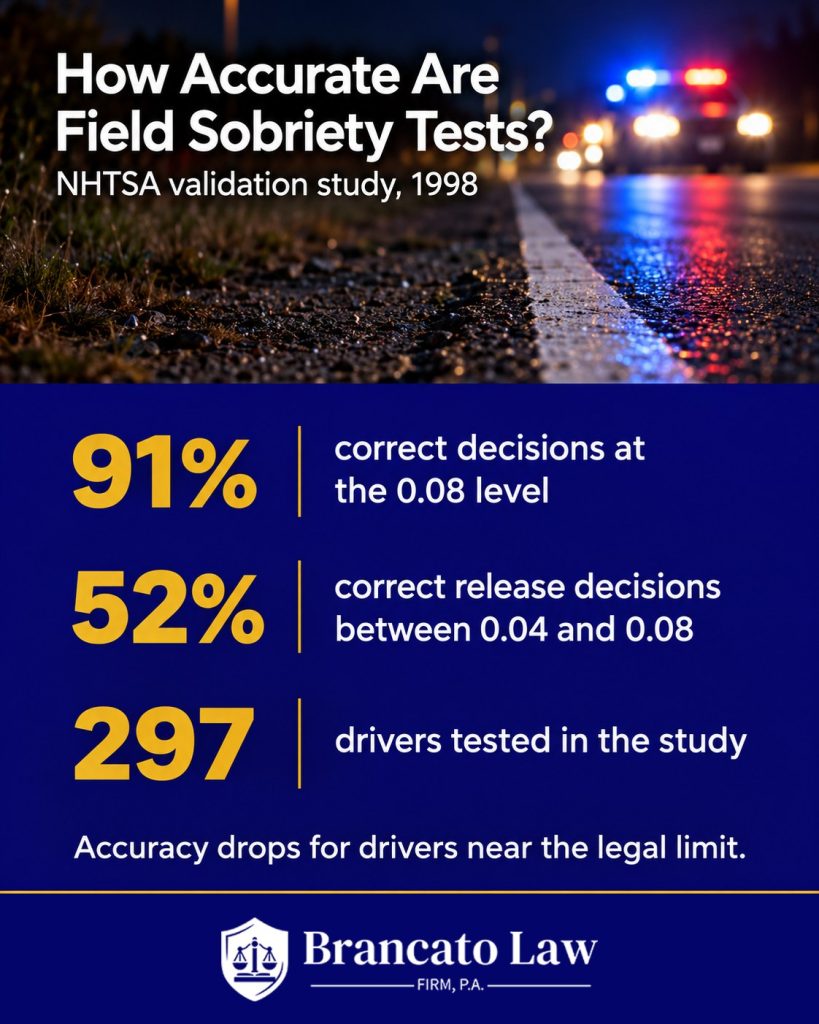
Field sobriety tests are less accurate than most jurors assume, especially near the legal limit. NHTSA’s main validation study, Stuster and Burns, Validation of the Standardized Field Sobriety Test Battery at BACs Below 0.10 Percent (1998), tested 297 drivers with San Diego police. At the 0.08 level, officers using all three exercises were correct 91% of the time. That number drops in the range where most contested cases sit. For drivers between 0.04 and 0.08, the officers’ decisions to release were correct only 52% of the time.
Independent researchers have questioned even those figures. A 2005 article in the Journal of Forensic Sciences, Statistical evaluation of standardized field sobriety tests, re-analyzed the San Diego data and concluded that accuracy depends heavily on blood alcohol level and is “much lower than” the 91% originally reported. The tests appear best at identifying drivers who are well above 0.08, not drivers near the line.
Real roadsides make the problem worse. The validation studies were run under controlled conditions. A shoulder on Interstate 4 at 1 a.m., with traffic passing, headlights flashing, uneven pavement, and a nervous driver in dress shoes, is not a controlled condition. Injuries, inner-ear problems, age, weight, and footwear all affect balance.
Do I have to do field sobriety tests in Florida?
No statute requires a driver to perform field sobriety exercises. Florida’s implied consent law, section 316.1932, Florida Statutes, covers breath, blood, and urine tests after a lawful arrest. The roadside exercises come before arrest and are outside that statute.
Refusing has consequences, though. In State v. Taylor, 648 So. 2d 701 (Fla. 1995), the Florida Supreme Court held that a driver’s refusal to perform field sobriety tests is admissible at trial as evidence of consciousness of guilt, as long as the officer had reasonable suspicion of DUI and warned the driver that refusing could have adverse consequences. In September 2026 the Fourth District applied the same rule in Paul v. State, No. 4D2025-0899 (Fla. 4th DCA Sept. 2, 2026), holding that a prosecutor may argue that refusing the roadside exercises and a breath test shows consciousness of guilt.
The Second District, which hears Hillsborough County appeals, has also said consent is not the issue. In State v. Liefert, 247 So. 2d 18 (Fla. 2d DCA 1971), the court held that an officer who saw weaving and smelled alcohol could require the driver to take part in physical sobriety tests, and that consent was immaterial. The real question in most cases is whether the officer had the legal basis to ask.
When can an officer in Hillsborough County ask for field sobriety tests?
An officer needs reasonable suspicion that the driver is impaired before requesting field sobriety tests. The Second District said so directly in State v. Ameqrane, 39 So. 3d 339 (Fla. 2d DCA 2010), a Hillsborough County case: “To request that a driver submit to field sobriety tests, a police officer must have reasonable suspicion that the individual is driving under the influence.” In that case, speeding at 4 a.m., the odor of alcohol, and glassy, bloodshot eyes were enough, and the court reversed a suppression order.
Ameqrane shows how this issue is argued. A stop for a burned-out tag light, with no bad driving and only an odor of alcohol, is a very different case from weaving across three lanes. When the officer moved to the roadside exercises without reasonable suspicion, our attorneys file a motion to suppress everything that followed: the exercises, the arrest, and the breath test. The Fifth District applied the same rule in State v. Johnson, 361 So. 3d 911 (Fla. 5th DCA 2023), holding that a driver can be required to perform the exercises once reasonable suspicion exists. Learn more about suppression on our Tampa DUI lawyer page.
How do Florida courts limit field sobriety evidence at trial?
Florida courts limit how the State describes the exercises. In State v. Meador, 674 So. 2d 826 (Fla. 4th DCA 1996), the court held that the walk-and-turn, one-leg stand, and similar exercises are admissible only as an officer’s lay observations of the driver. The court warned that calling them a “test,” or saying the driver “passed,” “failed,” or scored “points,” gives “these layperson observations an aura of scientific validity.”
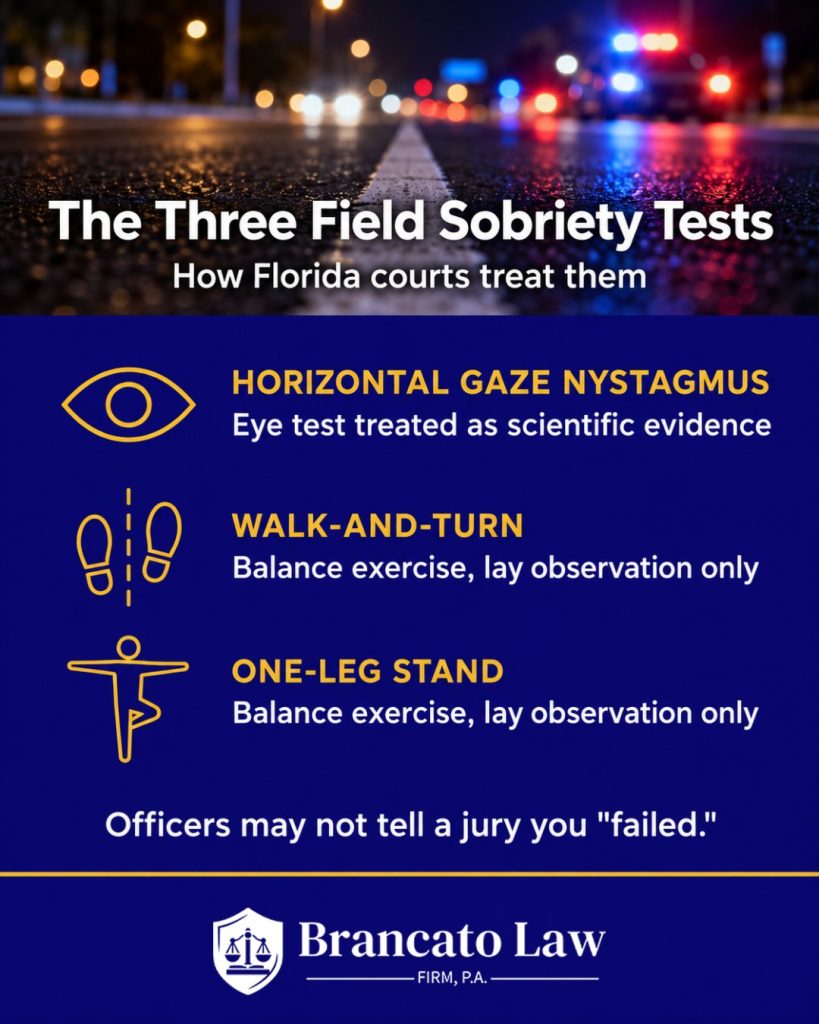
Meador treated HGN differently. Because the eye test depends on scientific principles, the State must lay a scientific foundation before the jury hears it. In practice that means a properly qualified witness and a properly administered test. Roadside HGN tests are sometimes given with the driver facing passing headlights or flashing emergency lights, which can affect the result.
| Issue | Florida rule | Case |
|---|---|---|
| Officer’s basis to request the exercises | Reasonable suspicion of impairment | State v. Ameqrane (Fla. 2d DCA 2010) |
| Driver’s consent | Not required once reasonable suspicion exists | State v. Liefert (Fla. 2d DCA 1971) |
| Refusal to perform | Admissible as consciousness of guilt if the driver was warned of consequences | State v. Taylor (Fla. 1995) |
| Walk-and-turn and one-leg stand | Lay observations, no “pass,” “fail,” or “points” | State v. Meador (Fla. 4th DCA 1996) |
| HGN eye test | Scientific evidence requiring a proper foundation | State v. Meador (Fla. 4th DCA 1996) |
How do our attorneys challenge field sobriety evidence?
Our attorneys challenge field sobriety evidence by comparing the video, frame by frame, with the officer’s report and with NHTSA’s own instructions. The process usually looks like this:
- Get the body camera and dash camera video. We watch for whether the officer gave complete instructions, demonstrated correctly, and stopped the driver from starting early, then count the clues ourselves.
- Check the surface and conditions. Gravel, slopes, wet grass, wind, and passing traffic all affect balance.
- Look for medical and physical explanations. Knee and back injuries, inner-ear conditions, weight, age, fatigue, and footwear affect balance.
- Compare the report with the video. Reports are often written hours later. When a report lists six walk-and-turn clues and the video shows two, the officer’s credibility becomes the issue.
- Hold the State to Meador at trial. We move to keep the words “test,” “pass,” “fail,” and “points” out of the officer’s testimony, and we object to HGN without a proper foundation.
This work produces results. In one of our DUI trials, the scene video showed no impairment and no resistance, and the jury found our client not guilty of both DUI and resisting an officer. Other DUIs have been reduced to reckless driving because the roadside evidence would not hold up. These and other outcomes are on our case results page. Past results do not guarantee future outcomes.
How many DUI cases does Hillsborough County handle?
Hillsborough County handles thousands of DUI cases a year. From October 1, 2024 through September 30, 2025, the MADD court monitoring program tracked more than 4,100 DUI cases in Hillsborough County, according to the Florida Department of Transportation’s FY2025 Highway Safety Annual Report. With that volume, the roadside portion of many arrests is done quickly, and the video often shows shortcuts the report leaves out.
That volume also explains why prosecutors negotiate. When our attorneys show the assigned prosecutor that the roadside exercises were given wrong, the State has to decide whether its remaining evidence can carry a trial. For what comes after the arrest, read What Happens After a DUI Arrest in Hillsborough County and How to Fight a DUI Charge in Hillsborough County.
What should you do if you were arrested after field sobriety tests?
Move quickly on two fronts. The criminal case and the license suspension run on separate tracks, and the license challenge has a 10-day deadline from the arrest. Our post on how to protect your driver’s license after a DUI arrest explains that hearing.
- Write down everything you remember about the stop and the exercises, including the surface, the lighting, what you were wearing, and any injuries.
- List any medical conditions that affect balance or eye movement, with the names of your doctors.
- Do not discuss the arrest on social media or by text.
- Keep your paperwork, including the citation and any property receipt.
- Talk to a DUI defense lawyer before your arraignment, so the video can be requested and reviewed early.
Frequently asked questions about field sobriety tests in Florida
Can I refuse field sobriety tests in Florida?
Yes. Florida does not require a driver to perform roadside sobriety exercises, but under State v. Taylor, 648 So. 2d 701 (Fla. 1995), the refusal can be used at trial if the officer warned you of the consequences. The Brancato Law Firm reviews the video of what the officer actually said, because a missing warning or a missing basis for the request can keep a refusal out of evidence.
Are field sobriety tests scientific evidence in Florida?
Only the HGN eye test is treated as scientific in Florida, under State v. Meador, 674 So. 2d 826 (Fla. 4th DCA 1996); the balance exercises are lay observations. Our attorneys at The Brancato Law Firm use that ruling to keep officers from telling jurors that a driver “failed.”
Can a DUI be dismissed because of how the field sobriety tests were done?
Yes, it can contribute to a dismissal or reduction when the exercises were requested without reasonable suspicion or were given and scored wrong. The Brancato Law Firm has had DUIs reduced to reckless driving and has won a not guilty verdict where the scene video showed no impairment. Read more on our Tampa DUI defense page.
Can a medical condition make me fail a field sobriety test?
Yes. Back, knee, and hip injuries, inner-ear disorders, some neurological conditions, and some medications affect balance and eye movement. Our attorneys at The Brancato Law Firm gather medical records early and, when needed, consult experts who can explain to a jury why a sober person struggled.
Do field sobriety tests matter if I took a breath test?
Yes. They often matter more than people think, because the officer’s roadside observations are the State’s evidence of impairment when the breath result is close to 0.08 or is challenged. The Brancato Law Firm attacks both, and our post on challenging Intoxilyzer maintenance explains the breath side.
What does the walk-and-turn test measure?
It is designed to measure divided attention, meaning the ability to listen to instructions, balance, and walk at the same time. The Brancato Law Firm counts the clues ourselves from the video, because officers often record clues that the footage does not show.
Call a Tampa DUI defense attorney before your arraignment
The first two weeks after a DUI arrest decide what evidence still exists and whether your license stays valid. Call The Brancato Law Firm, P.A. at (813) 727-7159. The firm was founded by Tampa Criminal Defense Attorney Rocky Brancato, and our attorneys will request the roadside video, review it against NHTSA’s own standards, and file the license challenge within the 10-day deadline. You can call us at any hour. Our firm has Spanish-speaking staff, and attorney Jean-Luc Adrien speaks Spanish, Haitian Creole, and French. We also offer criminal defense in Spanish and Haitian Creole.
For more about our defense strategies, visit our Tampa DUI Defense page.
The Brancato Law Firm, P.A.
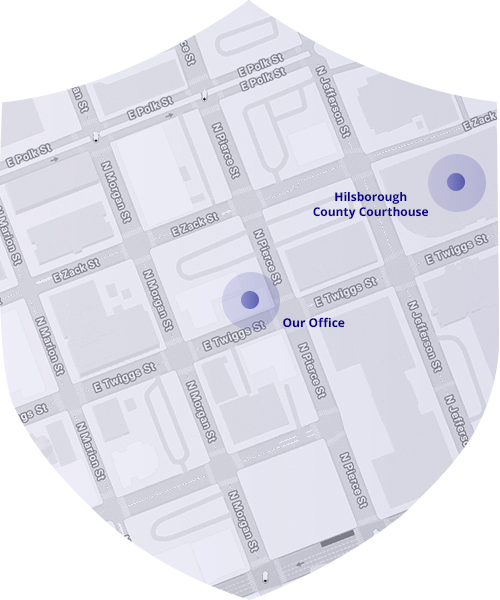
620 E. Twiggs Street, Suite 205, Tampa, FL 33602
(813) 727-7159
Serving Hillsborough, Pinellas, and Pasco Counties
The Brancato Law Firm, P.A. is a Tampa-based criminal defense practice. We are not affiliated with any other Brancato-named law firms.
Each case is unique, and past results do not guarantee future outcomes. This article is general information, not legal advice.
Visit Us
Tampa, FL 33602
Contact Us Now
Free Legal Consultation (813) 727-7159