- Free Consultation 24/7: (813) 727-7159 Tap Here To Call Us


From First DUI to Death Penalty



Is Intoxication a Defense to a Crime in Florida? (2026)



Updated November 5, 2026
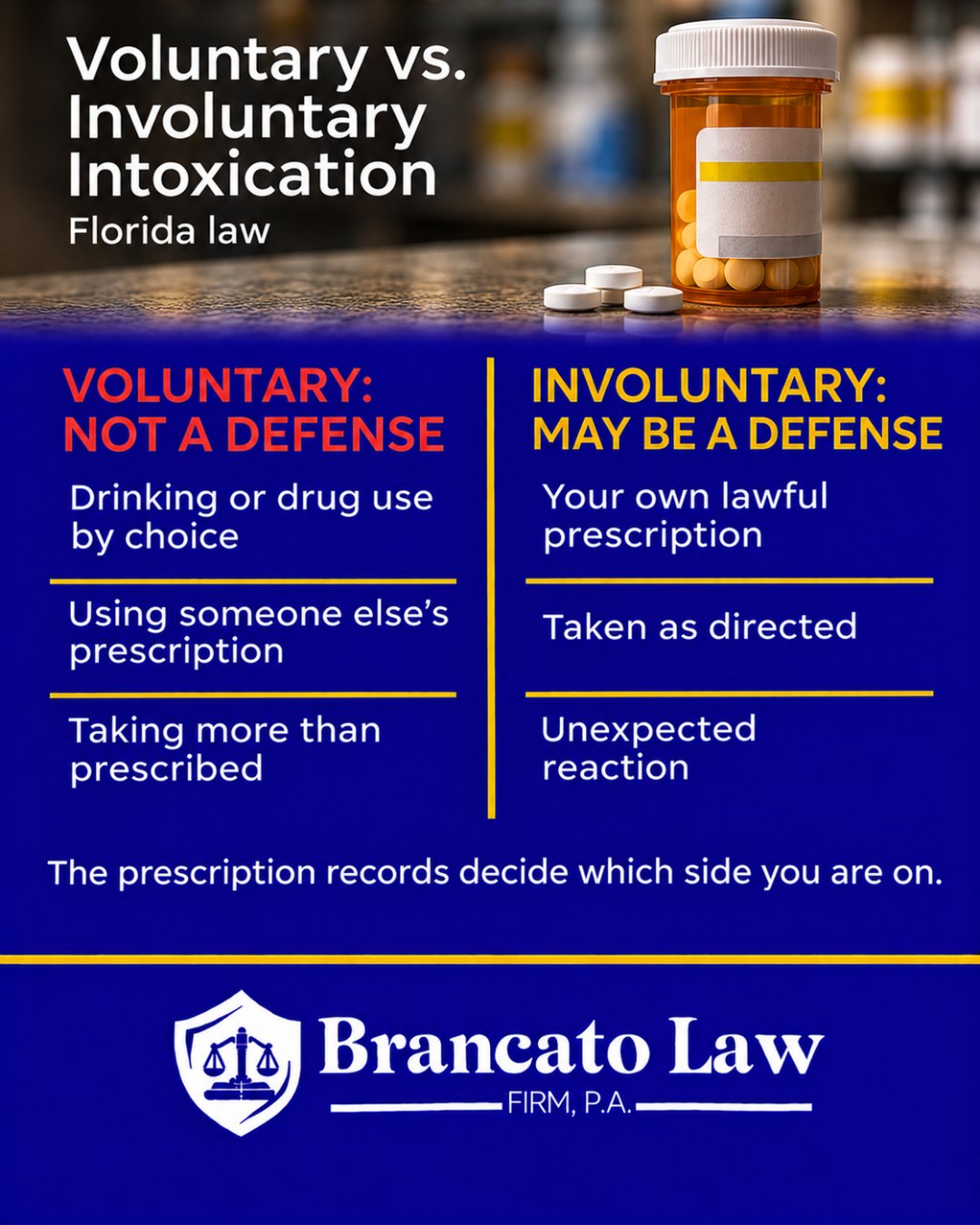
Voluntary intoxication is not a defense to any crime in Florida. Since 1999, section 775.051 has barred evidence of voluntary drinking or drug use to show that a defendant lacked specific intent or was insane. The one statutory exception is intoxication from a controlled substance taken under a lawful prescription, which Florida courts treat as involuntary intoxication when the medication was taken as prescribed and its effect was unexpected.
A Florida judge deciding whether a jury will hear about a defendant’s intoxication asks one question first: was it voluntary? I have watched that question decide cases for more than 25 years in Hillsborough County courtrooms, including during my time in the Major Crimes Unit defending homicide and other serious felony cases, and as the former Chief Operations Officer of the Hillsborough County Public Defender’s Office, where I oversaw a staff of over 100 attorneys. Today, as founder of The Brancato Law Firm, P.A., a Tampa criminal defense firm, I lead a team that examines medical records, prescriptions, and toxicology to find out whether an intoxication issue is a legal defense, a trial fact, or neither.
Is voluntary intoxication a defense in Florida?
No. Section 775.051, Florida Statutes, says that voluntary intoxication from alcohol or a controlled substance “is not a defense to any offense proscribed by law.” It also makes evidence of voluntary intoxication inadmissible to show that the defendant lacked specific intent or was insane at the time of the offense. The statute applies to offenses committed after July 1, 1999.
Before 1999, Florida allowed jurors to consider intoxication when a crime required specific intent, such as premeditated murder or burglary. That is why older articles and some websites still describe a “voluntary intoxication defense.” For offenses committed today, it does not exist.
Is section 775.051 constitutional?
Yes. Florida’s appellate courts have upheld it. In Cuc v. State, 834 So. 2d 378 (Fla. 4th DCA 2003), Ellen Cuc argued that excluding her voluntary intoxication defense violated due process. The Fourth District affirmed her conviction, relying on Montana v. Egelhoff, 518 U.S. 37 (1996), where the U.S. Supreme Court upheld a Montana law that kept jurors from considering voluntary intoxication when deciding intent. The Fourth District wrote that Floridians “have decided to resurrect the rule that intoxication is not a defense to specific intent crimes.”
Florida was part of a national shift. Writing shortly after Egelhoff, Mitchell Keiter counted ten states with these “full responsibility” laws in Just Say No Excuse: The Rise and Fall of the Intoxication Defense, 87 J. Crim. L. & Criminology 482 (1997). Florida joined that group two years later.
When does intoxication count as involuntary in Florida?
Intoxication is involuntary when it results unexpectedly from medication that was lawfully prescribed and taken as prescribed. Section 775.051 carves out use of a controlled substance “pursuant to a lawful prescription issued to the defendant by a practitioner as defined in s. 893.02.” In Montero v. State, 996 So. 2d 888 (Fla. 4th DCA 2008), the Fourth District called that exception “essentially a codification” of the involuntary intoxication defense, which applies “where the defendant unexpectedly becomes intoxicated by prescribed medication that is taken in a lawful manner.”
The leading example is Brancaccio v. State, 698 So. 2d 597 (Fla. 4th DCA 1997). A 16-year-old taking prescribed Zoloft was convicted of first-degree murder and kidnapping. Experts, hospital records, and people who knew him described a sudden personality change consistent with an adverse reaction to the drug. The trial judge refused an involuntary intoxication instruction and gave only the standard insanity instruction. The Fourth District reversed for a new trial, holding that the jury would not have known that involuntary intoxication by medication could be a defense.
| Situation | How Florida law treats it | Authority |
|---|---|---|
| Drinking alcohol by choice | Voluntary; not a defense and not admissible to negate specific intent | Section 775.051 |
| Using illegal drugs | Voluntary; not a defense | Section 775.051 |
| Using someone else’s prescription | Not covered by the prescription exception, which requires a prescription “issued to the defendant” | Section 775.051 |
| Taking your own prescription as directed, with an unexpected reaction | Involuntary intoxication; may be a defense and supports a jury instruction | Montero; Brancaccio |
| Taking more than the prescribed dose | Exception does not apply | Montero |
| Mixing your prescription with alcohol | Expect the State to argue the alcohol made it voluntary; fact-specific | Section 775.051 |
What are the limits of the prescription exception?
The exception does not protect misuse. Montero held that the exception “does not apply where the defendant abuses the prescribed medication by exceeding the prescribed dosage.” In that case, Montero claimed his lawyer should have raised involuntary intoxication from hydrocodone and alprazolam. The court rejected the claim because he never alleged he took the prescribed doses or that the intoxication was unexpected, and it noted that both drugs have well-known intoxicating effects.
In practice, the defense rises or falls on records. Our attorneys gather the prescription history, pharmacy fill dates, pill counts, the prescriber’s notes, and any blood or urine testing, then work with forensic toxicologists and psychiatrists to explain the reaction. Our Tampa criminal mental health lawyer page describes how we handle cases where medication, mental illness, and criminal charges overlap.
How common is intoxication in criminal cases?
Very common, which is why the voluntary intoxication bar affects so many cases. In the 2016 Survey of Prison Inmates, the Bureau of Justice Statistics found that 31% of state prisoners reported drinking alcohol at the time of their offense and 39% reported using drugs at the time of the offense, according to its report Alcohol and Drug Use and Treatment Reported by Prisoners (July 2021). Among state prisoners serving time for a violent offense, 34% reported drinking at the time of the offense.
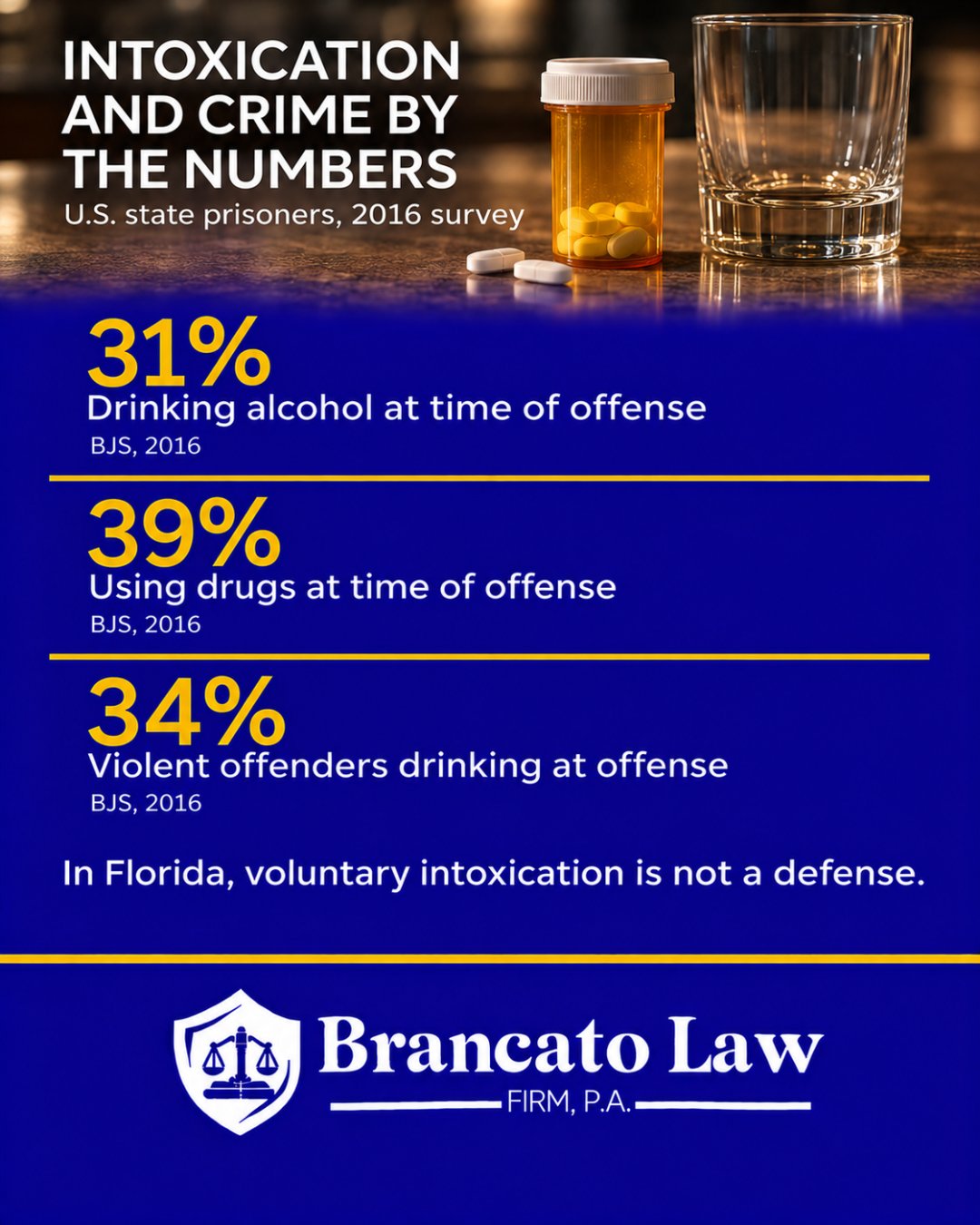
Those numbers explain why prosecutors routinely ask judges to keep intoxication evidence away from jurors, and why an involuntary intoxication claim draws close scrutiny. A defense built on a prescription has to show it is different from the ordinary case.
Can intoxication still matter at trial if it is not a defense?
Sometimes, for purposes other than negating intent. Section 775.051 bars voluntary intoxication evidence offered to show lack of specific intent or insanity. Evidence about drinking or drug use can still come up for other reasons, such as a witness’s ability to perceive and remember events, or the reliability of a statement the accused gave to police while impaired. Whether it comes in depends on the purpose, and judges decide that issue case by case.
How does intoxication relate to the insanity defense?
Voluntary intoxication cannot be used to prove insanity. Insanity is a separate affirmative defense under section 775.027, Florida Statutes, which requires a mental infirmity, disease, or defect that kept the defendant from knowing what he was doing or that it was wrong. The defendant must prove insanity by clear and convincing evidence. Brancaccio shows why the two defenses must be kept separate: an insanity instruction alone did not tell the jury that a reaction to prescribed medication could excuse the conduct.
Does intoxication help at sentencing?
Usually not. Under section 921.0026(3), Florida Statutes, a defendant’s substance abuse or addiction, “including intoxication at the time of the offense,” is not a mitigating factor and “does not, under any circumstances, justify a downward departure.” The one exception is for a nonviolent felony with a scoresheet total of 60 points or fewer, when the court finds the defendant is amenable to a postadjudicatory treatment-based drug court program. Our attorneys build mitigation around treatment, mental health, and other recognized grounds rather than intoxication itself.
| Stage of the case | Voluntary intoxication | Involuntary (prescription) intoxication |
|---|---|---|
| Defense at trial | Not allowed | Allowed when supported by evidence |
| Negating specific intent | Evidence barred | Evidence admissible |
| Insanity claim | Evidence barred | Admissible; separate instruction may be required |
| Downward departure at sentencing | Not a mitigator, except the drug court exception for qualifying nonviolent felonies | Depends on the facts and the recognized mitigator argued |
| DUI charges | Intoxication is an element the State must prove | A prescription is not a defense to DUI by impairment |
That last row matters. In a DUI case, impairment is what the State must prove, so a valid prescription is not a defense to driving while impaired; our post on DUI for prescription drugs in Florida explains that charge.
Frequently asked questions
Can I use being drunk as a defense to burglary or theft in Florida?
No. Voluntary intoxication cannot be used to argue you lacked the intent to commit burglary, theft, or any other crime committed after July 1, 1999. The Brancato Law Firm looks instead at the State’s evidence of intent, entry, and identity, which are often contestable without any intoxication argument.
What if my prescription medication made me act out of character?
That may support an involuntary intoxication defense if you took the medication as prescribed and the reaction was unexpected. The Brancato Law Firm gathers prescription and pharmacy records and consults medical experts, following the approach the court approved in Brancaccio v. State; our criminal mental health defense team handles these cases.
Is it involuntary intoxication if someone drugged my drink?
Florida’s statute bars only voluntary intoxication, so intoxication you did not choose is not covered by that bar. The Brancato Law Firm investigates these claims with toxicology testing and witness evidence, because the claim has to be proven with facts, not just asserted.
Does the prescription exception apply if I took extra pills?
No. Florida courts hold that the exception does not apply when a defendant exceeds the prescribed dosage, as Montero v. State explains. Our attorneys at The Brancato Law Firm review pill counts and fill dates early so we know whether the defense is available before we raise it.
Can intoxication reduce a murder charge in Florida?
Voluntary intoxication cannot be used to argue that a killing was not premeditated. The Brancato Law Firm defends homicide cases on the evidence of premeditation itself, and on involuntary intoxication when prescription records support it, as described on our Tampa homicide attorney page.
Does being intoxicated affect whether my confession can be used?
It can. Impairment is one factor courts consider in deciding whether a statement was voluntary and reliable. The Brancato Law Firm reviews interrogation recordings for signs of impairment and challenges statements taken from people who could not understand their rights.
For how The Brancato Law Firm, P.A. defends these cases, see our Tampa DUI defense practice.
Talk to our attorneys before the State frames the evidence
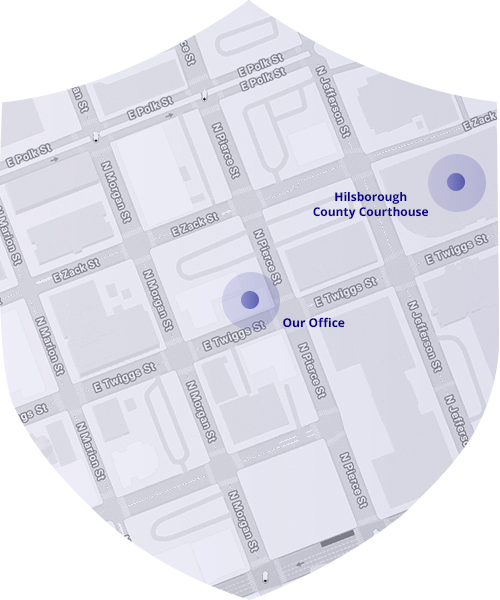
Prosecutors move early to keep intoxication evidence out, so the medical records need to be gathered before the first pretrial motions. Our attorneys will review your prescriptions and the State’s evidence and tell you whether an involuntary intoxication defense is available. Call The Brancato Law Firm, P.A., founded by Tampa Criminal Defense Attorney Rocky Brancato, at (813) 727-7159; call us at any hour. Our office is two blocks from the courthouse. Our firm has Spanish-speaking staff, and attorney Jean-Luc Adrien speaks Spanish, Haitian Creole, and French. Read our guide for criminal defense in Spanish and Haitian Creole in Tampa. For more about our defense strategies, visit our Criminal Mental Health page.
The Brancato Law Firm, P.A.
620 E. Twiggs Street, Suite 205, Tampa, FL 33602
(813) 727-7159
Serving Hillsborough, Pinellas, and Pasco Counties
The Brancato Law Firm, P.A. is a Tampa-based criminal defense practice. We are not affiliated with any other Brancato-named law firms.
Visit Us
Tampa, FL 33602
Contact Us Now
Free Legal Consultation (813) 727-7159