- Free Consultation 24/7: (813) 727-7159 Tap Here To Call Us


From First DUI to Death Penalty



What Is the Criminal Statute of Limitations in Florida? (2026)



Updated November 5, 2026
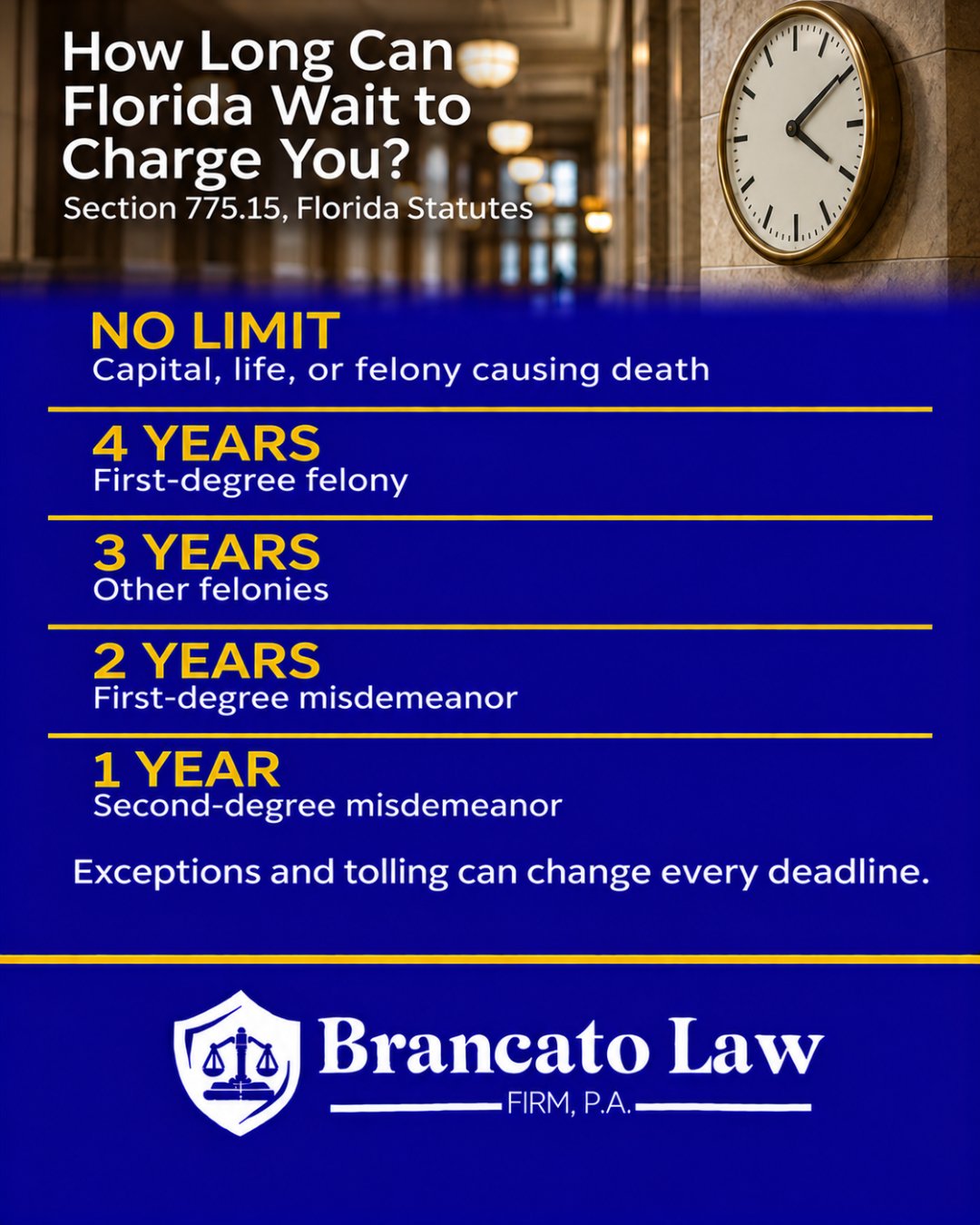
Florida’s criminal statute of limitations, section 775.15, sets how long the State has to start a prosecution: 4 years for a first-degree felony, 3 years for other felonies, 2 years for a first-degree misdemeanor, and 1 year for a second-degree misdemeanor. Capital felonies, life felonies, and felonies that result in a death have no time limit, and many sexual battery and DNA cases have extended or unlimited periods. When the defense raises the issue, the State carries a significant burden to prove the prosecution is not time-barred.
As founder of The Brancato Law Firm, P.A., a Tampa criminal defense firm, and the former Chief Operations Officer of the Hillsborough County Public Defender’s Office, where I oversaw a staff of over 100 attorneys, I know how old cases come back: through a DNA hit, a delayed report, or a warrant that sat unserved for years. More than 25 years in Hillsborough County courtrooms have taught me that the deadline question is rarely as simple as counting years. Our attorneys check the charging date, the service of the warrant, and every tolling claim before a client ever discusses the facts.
What is the statute of limitations for crimes in Florida?
The statute of limitations is the deadline for the State to begin a prosecution. Under section 775.15, Florida Statutes, the clock depends on the degree of the most serious charge. Time starts to run on the day after the offense is committed. For a continuing offense, it starts when the course of conduct ends.
| Offense level | Time limit to begin prosecution | Section 775.15 |
|---|---|---|
| Capital felony, life felony, or felony resulting in a death | No limit | (1) |
| First-degree felony | 4 years | (2)(a) |
| Second- or third-degree felony | 3 years | (2)(b) |
| First-degree misdemeanor | 2 years | (2)(c) |
| Second-degree misdemeanor or noncriminal violation | 1 year | (2)(d) |
| Felony abuse or exploitation of an elderly person or disabled adult under s. 825.102 or 825.103, or a felony under s. 817.5695 | 5 years | (10)(a) |
| Felony workers’ compensation or insurance fraud under s. 440.105 or 817.234 | 5 years | (11) |
When is a prosecution “commenced” in Florida?
A prosecution starts when the charging document is filed, but only if the warrant or summons is then served without unreasonable delay. If the person was already arrested or served with a summons on the charge, the filing of an information or indictment commences the case. If not, section 775.15(4)(b) says the case is commenced when the information or indictment is filed, “provided the capias, summons, or other process issued on such indictment or information is executed without unreasonable delay.”
This is where many limitations defenses are won or lost. A charge filed one week before the deadline does not save the State if the warrant then sits in a database for years while the accused lives openly at a known address. In judging reasonableness, courts consider whether the State could not locate the person after a diligent search, or whether the person was out of state.
Can the statute of limitations be paused?
Yes. Section 775.15(5) stops the clock while the defendant is continuously absent from Florida or has no reasonably ascertainable place of home or work in Florida. That tolling cannot extend the limitations period by more than 3 years, but the cap does not protect someone who was timely charged and not arrested because he was out of state.
The Florida Supreme Court addressed this in Robinson v. State, 205 So. 3d 584 (Fla. 2016). Brian Robinson listed his parents’ Florida address as his address of record, but he lived outside Florida from May 2008 through May 2012. The Court held that his continuous absence tolled the limitations period even though he had an address of record, and that the State did not have to prove a diligent search or that his absence hindered the prosecution. The Court also confirmed that when the statute of limitations is raised, “the State has a significant burden and must prove that the prosecution is not barred.”
A more recent example is Whittamore v. State, No. 5D23-3126 (Fla. 5th DCA Dec. 21, 2023). Adrienne Whittamore was charged with a second-degree misdemeanor, which carries a 1-year limit. A summons mailed to her old address came back unserved, and the warrant listed “General Delivery” as her address. She was arrested about 15 months after the alleged offense. The Fifth District held that she had no reasonably ascertainable place of abode because she had moved at least three times and could not recall when, so the clock was tolled and the case could proceed.
What are the special rules for sexual battery and child sex offenses?
Sex offenses have the most exceptions in section 775.15. Several remove the time limit entirely. Our Tampa sex crimes lawyer page explains how these cases are defended when the accusation surfaces years later.
| Situation | Time limit | Section 775.15 |
|---|---|---|
| Sexual battery (s. 794.011) on a victim under 16 | No limit (except offenses already barred on or before July 1, 2010) | (13)(c) |
| First-degree felony sexual battery on a victim under 18 | No limit (except offenses already barred on or before Oct. 1, 2003) | (13)(b) |
| Sexual battery, lewd or lascivious offenses (s. 800.04), incest, or s. 847.0135(5) offenses with a victim under 18 | The applicable limit does not start until the victim turns 18 or the offense is reported to law enforcement or another government agency, whichever is earlier | (13)(a) |
| First- or second-degree felony sexual battery on a victim 16 or older, reported within 72 hours | No limit | (14)(a) |
| First- or second-degree felony sexual battery on a victim 16 or older, not reported within 72 hours | 8 years | (14)(b) |
| Listed offenses solved through DNA, including sexual battery, lewd or lascivious offenses, felony battery, kidnapping, burglary, and robbery | Any time after DNA establishes identity, if enough of the original evidence is preserved and available for testing by the accused | (16) |
The DNA provision has a condition that matters to the defense. It applies only if “a sufficient portion of the evidence collected at the time of the original investigation and tested for DNA is preserved and available for testing by the accused.” If the sample was consumed or lost, our attorneys examine whether the extension applies at all. Our post on how a DNA cold hit can be wrong covers how those matches are challenged.
Why do so many old accusations surface years later?
Most crimes are never reported to police right away, and some are reported years later. In 2024, only 23.6% of rape or sexual assault victimizations and 47.9% of all violent victimizations were reported to police, according to the Bureau of Justice Statistics report Criminal Victimization, 2024 (September 2025). For property crimes, the 2024 figure was 30.5%.
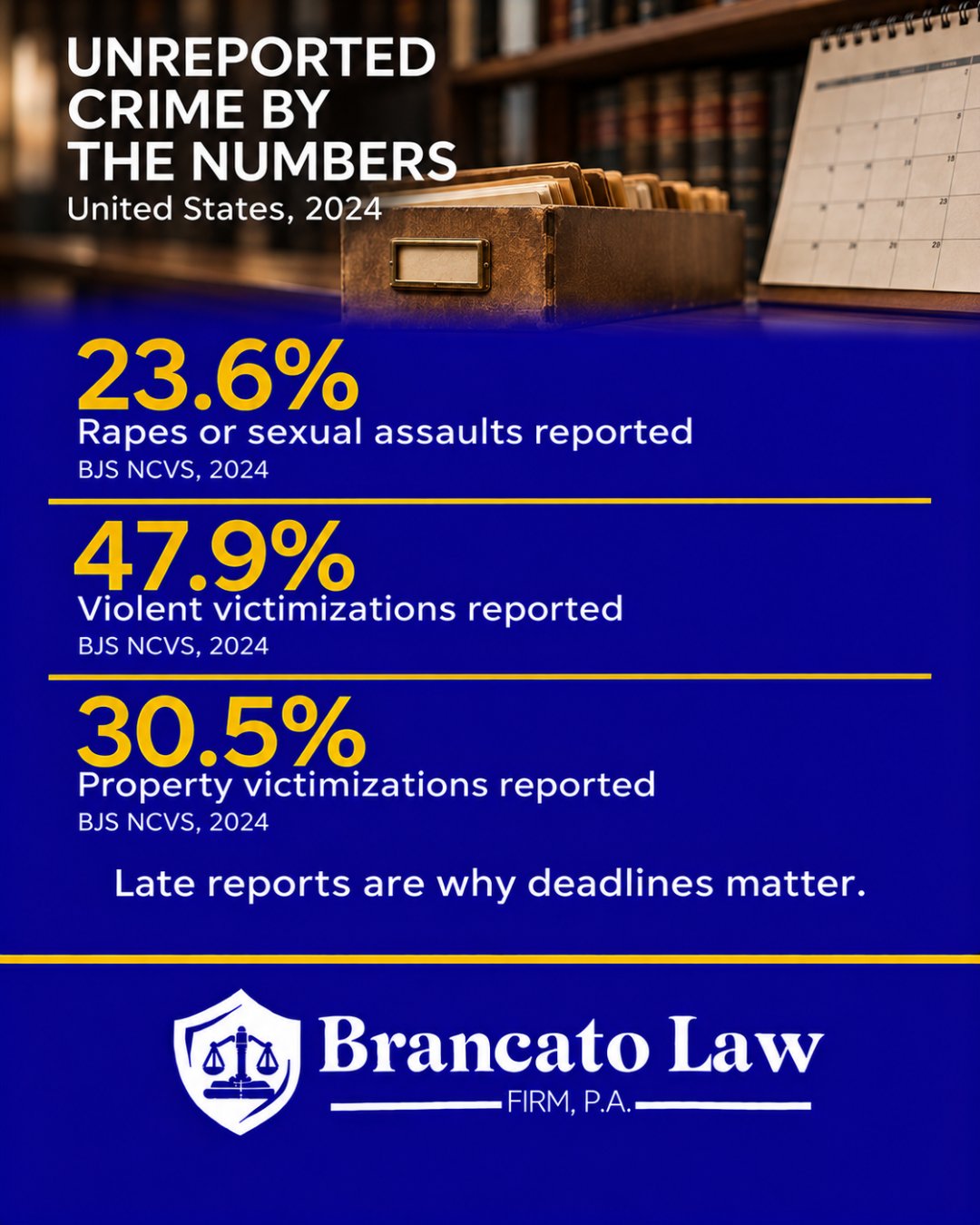
Those numbers explain why the Legislature extended or removed deadlines for sex offenses. They also explain the risk for the accused: an accusation made 10 or 20 years later arrives after phone records are gone, witnesses have moved, and memories have faded.
Why does Florida have a criminal statute of limitations at all?
The deadline protects the accused from defending against stale charges. A Congressional Research Service report, Statute of Limitation in Federal Criminal Cases: An Overview (RL31253, updated Nov. 14, 2017), describes the purpose as ensuring prompt prosecution and sparing the accused “the burden of having to defend against stale charges after memories may have faded or evidence is lost.” The same report notes that a time limit can encourage law enforcement to investigate suspected crimes promptly. Florida’s statute serves the same goals for state charges.
How does the fraud discovery rule extend the deadline?
For offenses where fraud or breach of fiduciary duty is a material element, section 775.15(12)(a) allows prosecution within 1 year after an aggrieved party discovers the offense, even if the normal period has run. That extension cannot add more than 3 years to the otherwise applicable period. Embezzlement and scheme-to-defraud cases often turn on when the business or victim actually discovered the loss. Our Tampa white collar crime attorney page covers those charges.
How do you raise a statute of limitations defense?
Our attorneys raise it by motion to dismiss, supported by the dates in the charging document, the warrant history, and evidence of where the client lived and worked. The State must then prove the prosecution is not barred, including any claim of tolling or reasonable diligence in serving the warrant. The steps we take:
- Identify the exact offense date or the date a continuing course of conduct ended.
- Confirm the degree of each charge, because each count has its own deadline.
- Pull the filing date of the information or indictment and the date the capias or summons was served.
- Gather proof of residence and employment during the gap: leases, utility bills, tax filings, payroll records.
- Test every tolling claim, including absence from the state and the 3-year cap.
- Check whether a sex offense or DNA exception actually applies to this offense and this victim’s age.
What should you do if you think police are investigating an old allegation?
Talk to a lawyer before you talk to police. An old case is often thin on evidence, and a statement can supply what time has erased. Our firm provides representation before charges are filed and can address a pending investigation with detectives and the State Attorney’s Office. If you think you may have an outstanding warrant in Hillsborough County, our attorneys can check and plan how to address it.
Frequently asked questions
How long does the State have to file a third-degree felony in Florida?
Three years from the day after the offense, unless an exception or tolling provision applies. The Brancato Law Firm checks both the filing date and when the warrant was served, because a late-served warrant can make a timely filing too late.
Is there a statute of limitations for murder in Florida?
No. A capital felony, a life felony, or any felony that resulted in a death can be prosecuted at any time under section 775.15(1). The Brancato Law Firm defends these cold cases by focusing on the evidence lost over time and the reliability of any new forensic link, as described on our Tampa homicide attorney page.
Does leaving Florida stop the statute of limitations?
Yes. Continuous absence from Florida tolls the clock, and Robinson v. State held the State does not have to prove it searched for the person. The Brancato Law Firm examines whether the absence was truly continuous and whether the 3-year cap on tolling applies.
Can the State charge a child sex offense decades later?
Often, yes. Sexual battery on a victim under 16 has no time limit, and for many other child sex offenses the clock does not start until the victim turns 18 or the offense is reported. The Brancato Law Firm investigates delayed accusations with the same rigor as recent ones, and our sex crimes defense team starts by reconstructing the timeline.
What if my warrant was issued years ago but never served?
The case may be time-barred if the State did not serve it without unreasonable delay and no tolling applies. The Brancato Law Firm gathers proof that you lived and worked openly at a known address, which is the evidence that undercuts a claim that you could not be found.
Can a misdemeanor be filed after one year?
A second-degree misdemeanor must be commenced within 1 year and a first-degree misdemeanor within 2 years, but tolling can extend those periods. The Brancato Law Firm looks closely at where the summons and warrant were sent, the question that decided Whittamore v. State, and our pre-file advocacy can address a case before it is filed.
For how this fits into the rest of a case, see our guide to each stage of a Florida criminal case.
Ask us whether your case is too old to prosecute
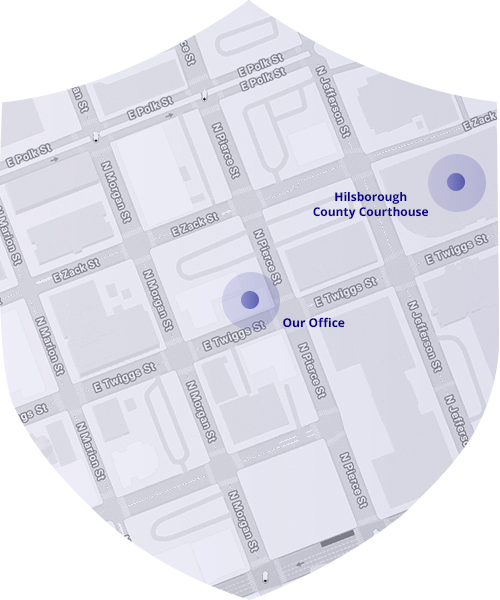
Every count in a charging document has its own deadline, and the answer often turns on dates buried in a warrant history. Send us the charging document or the warrant information, and our attorneys will tell you whether a limitations defense is worth raising. Call The Brancato Law Firm, P.A., founded by Tampa Criminal Defense Attorney Rocky Brancato, at (813) 727-7159; call us at any hour. Our office is two blocks from the courthouse. Our firm has Spanish-speaking staff, and attorney Jean-Luc Adrien speaks Spanish, Haitian Creole, and French. Read our guide for Spanish and Haitian Creole speakers facing criminal charges. For more about our defense strategies, visit our Sex Crimes page.
The Brancato Law Firm, P.A.
620 E. Twiggs Street, Suite 205, Tampa, FL 33602
(813) 727-7159
Serving Hillsborough, Pinellas, and Pasco Counties
The Brancato Law Firm, P.A. is a Tampa-based criminal defense practice. We are not affiliated with any other Brancato-named law firms.
Visit Us
Tampa, FL 33602
Contact Us Now
Free Legal Consultation (813) 727-7159