- Free Consultation 24/7: (813) 727-7159 Tap Here To Call Us


From First DUI to Death Penalty



What Is a Rehabilitation Plan in Hillsborough County Juvenile Sex Cases? (2026)


Rewrite/update date: November 4, 2026. Originally published in October 2025.
A Rehabilitation Plan, known locally as a “Sex Walker Plan,” is a treatment-based agreement used in some Hillsborough County juvenile sex cases. The child enters a plea that is held in abeyance while he or she completes sex-offender-specific treatment and strict conditions, usually over 9 to 12 months. If the plan is completed, the plea is vacated and the charges are dismissed with prejudice, which avoids the adjudication that can trigger sex offender registration for a child 14 or older. If the plan is violated, the court can enter the plea and sentence the child.
If your child is facing a sex charge in Hillsborough County juvenile court, the first question is usually whether the case can end without registration. I’m the founder of The Brancato Law Firm, P.A., a Tampa criminal defense firm, and I handled sex crimes and child abuse cases in the Major Crimes Unit during more than 25 years in Hillsborough County courtrooms. Our attorneys negotiate Rehabilitation Plans when they are available and work with therapists, probation officers, and the court to help children complete them.
What is a Rehabilitation Plan?
A Rehabilitation Plan is an agreement between the defense, the State, and the court in a juvenile sex case. The child enters a plea of guilty or no contest, but the plea is held in abeyance, meaning the court does not act on it, while the child completes treatment and follows strict conditions.
| Outcome | What happens |
|---|---|
| Plan completed | The plea is vacated and the charges are dismissed with prejudice |
| Plan violated | The court can enter the plea, adjudicate the child delinquent, and impose a sentence |
| Plan still in progress | The case stays open until the treating therapist confirms progress and the court ends the plan |
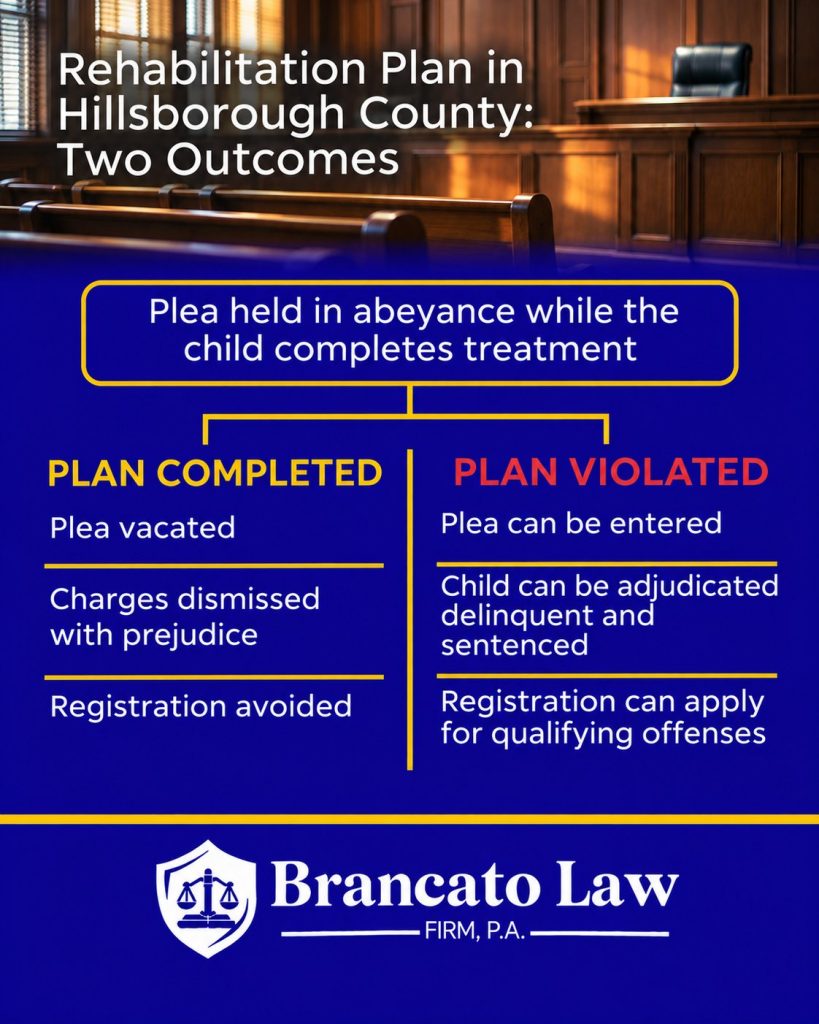
This all-or-nothing structure is why the plea terms, the treatment provider, and the conditions need careful attention from the start. Our Tampa sex crimes defense attorney page explains how our firm approaches sex charges at every stage.
How long does a Rehabilitation Plan last?
Most Rehabilitation Plans last 9 to 12 months in practice, but they have no fixed end date. A plan ends only when treatment is complete and the supervising therapist confirms progress, so the therapist’s evaluation carries great weight. Florida law lets the juvenile court keep jurisdiction over a juvenile sexual offender placed in a community-based treatment program until age 21, specifically so the child can finish the program, under section 985.0301, Florida Statutes.
What conditions come with a Rehabilitation Plan?
The conditions vary with the case, but they usually include:
- Active participation in sex-offender-specific counseling and treatment
- No contact with the alleged victim or other vulnerable people
- Restrictions on internet use, pornography, and social media
- Random device checks by probation officers
- Community service or restitution in some cases
- Curfews and school or work requirements
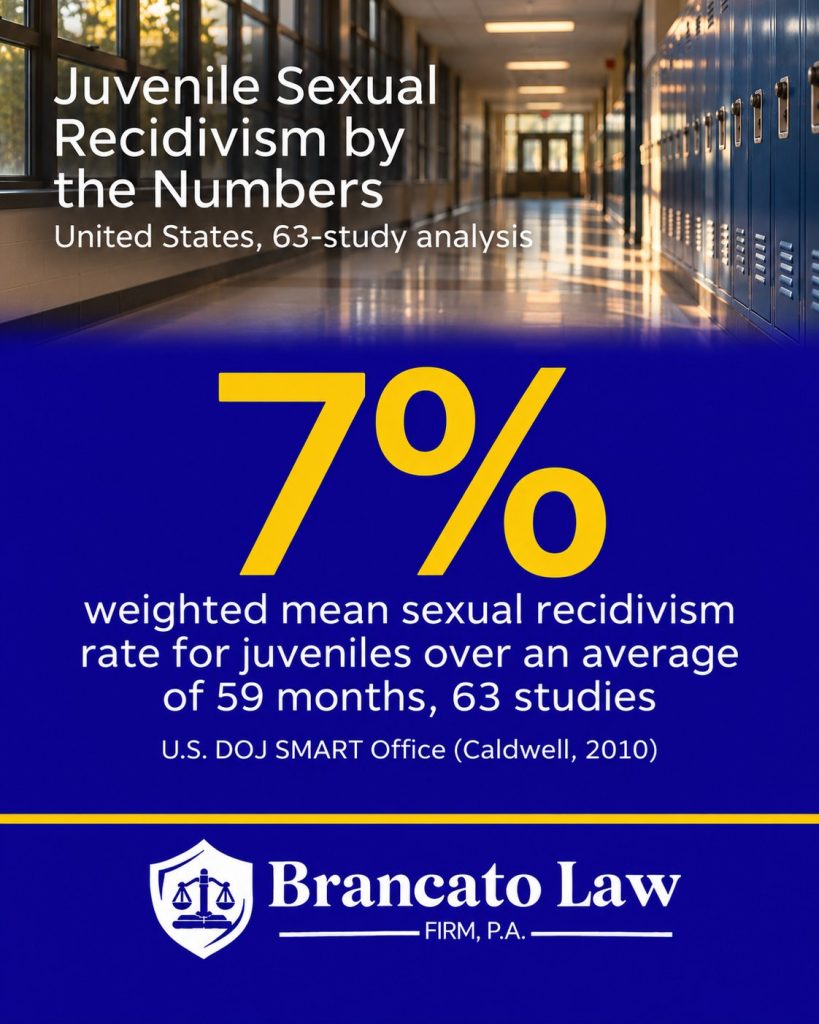
Every plan is tailored to the child and the allegations. Treatment research gives families a reason for hope: a 2010 meta-analysis of 63 studies covering 11,219 juveniles who committed sexual offenses found a weighted mean sexual recidivism rate of 7 percent over an average follow-up of 59 months, according to the U.S. Department of Justice SMART Office’s Sex Offender Management Assessment and Planning Initiative. The same report states that most juveniles do not go on to commit future sexual offenses.
How does a Rehabilitation Plan help avoid sex offender registration?
A Rehabilitation Plan helps because registration for juveniles depends on an adjudication of delinquency, and a completed plan ends in dismissal instead. Under section 943.0435, Florida Statutes, a juvenile must register as a sexual offender if adjudicated delinquent for certain offenses committed when he or she was 14 or older, and the court must make a written finding of the child’s age at the time of the offense.
| Juvenile offense (age 14 or older) | Registration if adjudicated delinquent |
|---|---|
| Sexual battery under section 794.011 (except subsection (10)) | Yes |
| Lewd or lascivious battery under section 800.04(4)(a)2. | Yes, if the victim was under 12 or the court finds force or coercion |
| Lewd or lascivious molestation under section 800.04(5)(c)1. | Yes, if the court finds molestation involving unclothed genitals |
| Lewd or lascivious molestation under section 800.04(5)(d) | Yes, if the court finds force or coercion and unclothed genitals |
Registration brings lasting restrictions on housing, work, school, and family life. Completing the plan avoids the adjudication, so registration is avoided. If the plan is violated and the child is adjudicated on a qualifying offense, registration can still apply. Our post on sexual offender and predator designation explains what registration involves.
Can the record be expunged after a Rehabilitation Plan?
Sometimes. Like other diversion outcomes, a completed plan can open the door to juvenile expungement, which removes the record from public view. Some sex offenses are not eligible for expunction under Florida law even after a successful plan, so eligibility depends on the offense and must be reviewed before applying. Our post on juvenile expungement in Florida walks through the process.
Why does experienced counsel matter in a Rehabilitation Plan case?
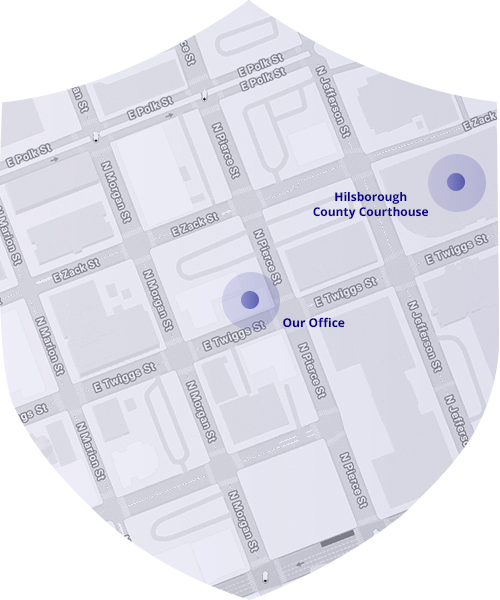
Experienced counsel matters because a Rehabilitation Plan is treatment-focused, open-ended, and closely monitored, and one violation can lead to sentencing. Availability depends on the charge, the child’s age, and the facts, and the plan is negotiated with the State Attorney’s Office in the 13th Judicial Circuit. Our Hillsborough County criminal defense attorneys practice two blocks from the courthouse and know how these plans are structured locally.
When a child is under investigation and has not yet been charged, our attorneys can step in early through representation before charges are filed, before statements are made or a petition is filed.
Frequently asked questions
How long does a Hillsborough County Rehabilitation Plan usually take?
Most plans last 9 to 12 months, but they stay open until treatment is complete. The Brancato Law Firm stays in contact with the treating therapist so the court has the progress reports it needs to close the plan.
Who decides when a Rehabilitation Plan ends?
The court ends the plan, and it usually will not do so without the treating therapist’s recommendation. Our attorneys at The Brancato Law Firm present that recommendation to the court and ask for dismissal once treatment is done.
What happens if my child violates a Rehabilitation Plan?
The court can enter the plea held in abeyance, adjudicate the child delinquent, and impose a sentence. The Brancato Law Firm defends violation allegations and works to keep the plan in place when a violation is minor, as described on our Tampa sex crimes lawyer page.
Does a Rehabilitation Plan guarantee my child will not have to register?
No. Registration is avoided only if the plan is completed, and a violation followed by an adjudication on a qualifying offense can still require registration under section 943.0435. Our attorneys at The Brancato Law Firm review the registration rules for the specific charge before any plea is entered.
Is every juvenile eligible for a Rehabilitation Plan?
No. Eligibility depends on the charges, the child’s age, and the circumstances, and the State must agree. The Brancato Law Firm builds the case for a plan with treatment evaluations and school and family records, and our juvenile expungement guide covers what can happen to the record afterward.
Talk to our attorneys about a Rehabilitation Plan
What your family does in the first weeks after a juvenile sex charge often decides whether a Rehabilitation Plan is still on the table. Call The Brancato Law Firm, P.A., founded by Tampa Criminal Defense Attorney Rocky Brancato, at (813) 727-7159 at any hour for a confidential consultation; our office is two blocks from the courthouse. Our firm has Spanish-speaking staff, and attorney Jean-Luc Adrien speaks Spanish, Haitian Creole, and French. For more about our defense strategies, visit our Sex Crimes page.
The Brancato Law Firm, P.A.
620 E. Twiggs Street, Suite 205, Tampa, FL 33602
(813) 727-7159
Serving Hillsborough, Pinellas, and Pasco Counties
The Brancato Law Firm, P.A. is a Tampa-based criminal defense practice. We are not affiliated with any other Brancato-named law firms.
Visit Us
Tampa, FL 33602
Contact Us Now
Free Legal Consultation (813) 727-7159