- Free Consultation 24/7: (813) 727-7159 Tap Here To Call Us


From First DUI to Death Penalty



Can a Florida Sexual Predator Designation Be Removed? (2026)


Updated November 4, 2026
Yes. A Florida sexual predator designation can be removed when the person never met the legal criteria for it, and the usual tool is a motion to correct an illegal sentence under Florida Rule of Criminal Procedure 3.800(a). Under section 775.21, Florida Statutes, a single conviction makes someone a sexual predator only if it is a capital, life, or first-degree felony version of a listed sex offense; most other listed felonies qualify only with a prior sex offense conviction. A designation that is correct when entered lasts for life unless the person receives a full pardon or the conviction is set aside.
A judge will strike a sexual predator designation only when the court file itself shows the person did not qualify, so the case is won or lost on a close reading of the judgment, the plea, and the statute in effect on the offense date. I learned to read sex crime files that way in the Major Crimes Unit, handling sex crime, homicide, and child abuse prosecutions, and I have spent more than 25 years in Hillsborough County courtrooms since. As founder of The Brancato Law Firm, P.A., a Tampa criminal defense firm, I have seen clients carry the predator label for years because no one checked whether it applied. Our attorneys review the record, file the motion, and present the legal error to the prosecutor and the court.
What is a sexual predator designation in Florida?
A sexual predator designation is a written finding by the sentencing court that a person meets the criteria of the Florida Sexual Predators Act, section 775.21, Florida Statutes. For an offense committed on or after October 1, 1993, the statute says a qualifying offender “shall be designated” a sexual predator, and the sentencing court must make a written finding at sentencing. The clerk sends the order to the Florida Department of Law Enforcement (FDLE) within 48 hours.
The designation is not part of the sentence. Florida courts treat it as a regulatory status that follows from the conviction. In Alvarez v. State, 345 So. 3d 378 (Fla. 3d DCA 2022), the defendant argued that the trial court could not enter a predator finding after sentencing while his appeal was pending. The Third District disagreed, holding that the designation is “neither a sentence nor a punishment but simply a status resulting from the conviction of certain crimes,” so the late finding did not violate double jeopardy or due process.
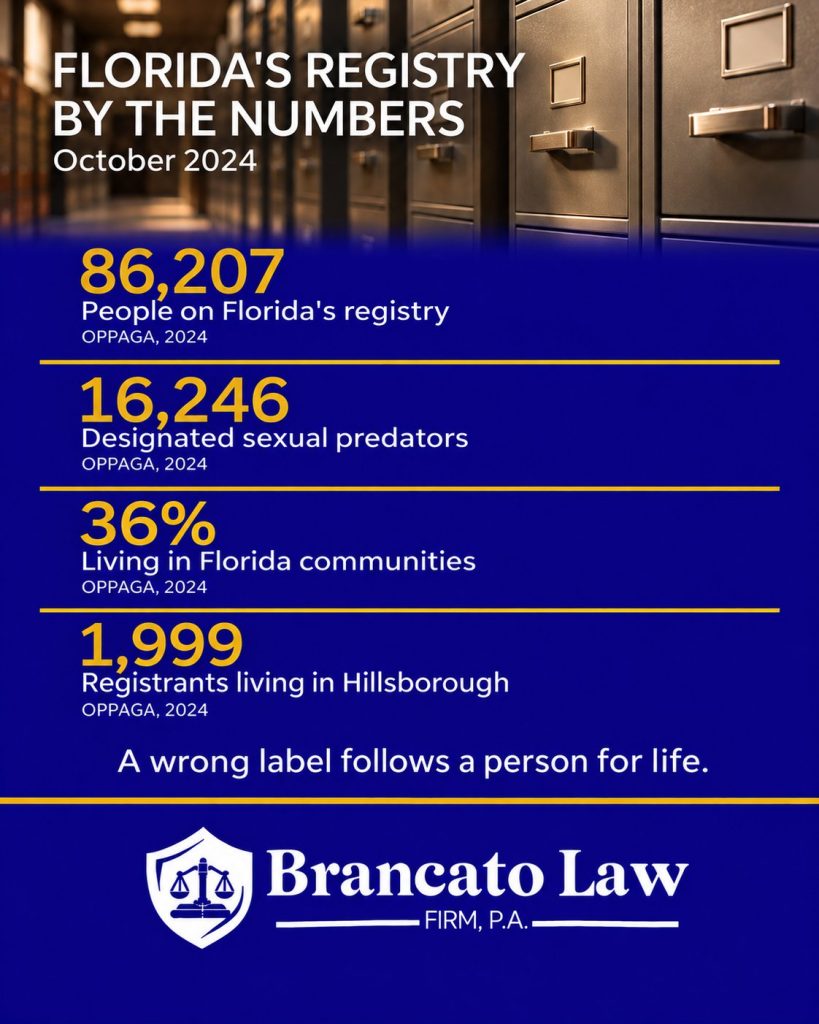
The registry is large. As of October 2024, FDLE’s registry listed 86,207 sexual offenders and predators, including 16,246 sexual predators, according to the Florida Legislature’s Office of Program Policy Analysis and Government Accountability in its Sex Offender Registration and Monitoring Triennial Review (Report 24-11, December 2024). Only 30,907 of the people on the registry, or 36%, lived in Florida communities; the rest were confined or living outside the state. In Hillsborough County, 1,999 registrants lived in the community in 2024, the same report found.
Who qualifies as a sexual predator under Florida law?
A person convicted in Florida qualifies as a sexual predator in one of two main ways: a single conviction for a capital, life, or first-degree felony version of certain sex offenses, or a felony conviction for a listed sex offense combined with a prior qualifying conviction. The table below summarizes section 775.21(4)(a).
| Path | What the current conviction must be | Prior conviction needed? |
|---|---|---|
| One qualifying offense | A capital, life, or first-degree felony (or attempt) under the sexual battery, lewd or lascivious, or selling or buying of minors statutes, kidnapping or false imprisonment of a minor, or listed human trafficking provisions involving a minor | No |
| Repeat offense | Any felony (or attempt) on the longer statutory list, such as second-degree lewd or lascivious offenses, unlawful sexual activity with certain minors, or traveling to meet a minor | Yes, a separate earlier conviction or plea for a listed offense, separately sentenced |
The gap between the first and second rows is where most mistakes happen. A first-time conviction for a second- or third-degree felony, such as a second-degree lewd or lascivious offense or unlawful sexual activity with certain minors under section 794.05, generally does not make someone a sexual predator. Those convictions usually lead to sexual offender registration instead. Our Tampa sex crimes lawyer team checks the degree of the offense, the offense date, and the prior record against the version of the statute that applied.
What is the difference between a sexual predator and a sexual offender in Florida?
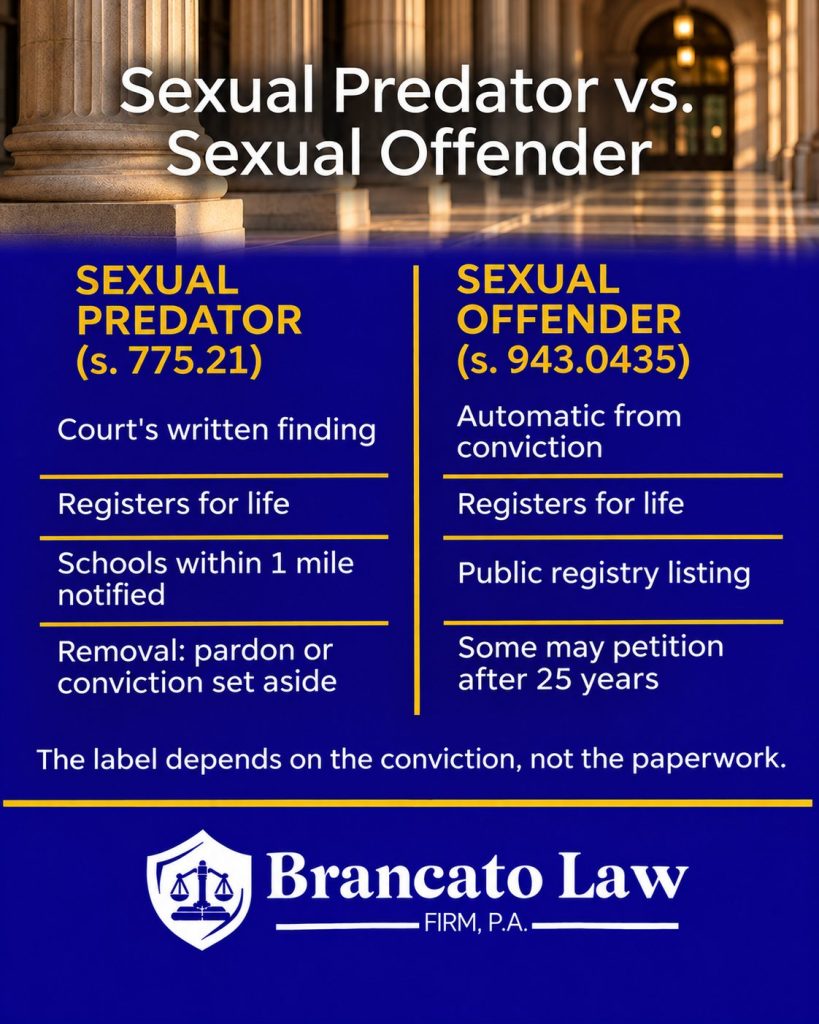
A sexual predator is designated by court order under section 775.21 and registers for life with mandatory community notification, while a sexual offender registers under section 943.0435, Florida Statutes and, in some cases, can petition for removal after 25 years. Both carry heavy reporting duties, and a failure to register is generally a third-degree felony for either.
| Feature | Sexual predator (s. 775.21) | Sexual offender (s. 943.0435) |
|---|---|---|
| How it starts | Written finding by the sentencing court | Automatic from a qualifying conviction and release or residence |
| How long it lasts | Life, unless a full pardon or the conviction is set aside | Life, but some offenders may petition after 25 years arrest-free since release |
| Community notification | Required; within 48 hours the sheriff or police chief notifies every licensed child care facility and school within 1 mile of the residence | Public registry listing |
| Initial registration | In person, on the statute’s deadlines | In person at the sheriff’s office within 48 hours of release or establishing a residence |
| Romeo and Juliet removal | Available if the s. 943.04354 criteria are met | Available if the s. 943.04354 criteria are met |
Residence limits depend on the offense, not the label. Under section 775.215, Florida Statutes, a person convicted of sexual battery, lewd or lascivious offenses, sexual performance by a child, or certain related offenses against a victim under 16, even with adjudication withheld, may not live within 1,000 feet of a school, child care facility, park, or playground. For offenses on or after July 1, 2026, and for covered people who change their permanent residence on or after that date, public swimming pools were added to that list. For the full registration rules, see our guide to sex offender registration in Florida.
Research has questioned what those restrictions achieve. In The Impact of Sex Offender Residence Restrictions: 1,000 Feet From Danger or One Step From Absurd?, 49 Int’l J. Offender Therapy & Comp. Criminology 168 (2005), Jill Levenson and Leo Cotter surveyed 135 sex offenders in outpatient treatment in Florida. A majority reported that the restrictions increased their isolation, forced moves, and created financial and emotional stress, and most did not believe the restrictions would reduce their chances of reoffending.
How do wrongful sexual predator designations happen?
Wrongful designations usually happen at a plea or sentencing hearing where no one compares the conviction to the statute. A form is checked, the court signs the order, and every agency after that enforces what the paper says.
- The offense does not qualify. The conviction is a second- or third-degree felony with no qualifying prior, but the predator box is checked anyway.
- The prior does not count. The statute requires a separate earlier conviction that was separately sentenced. Two counts sentenced on the same day are not a prior.
- A plea negotiation overreaches. The designation is added to a plea form without analysis of whether it applies.
- No one downstream checks. FDLE registers the person as the order directs, and probation officers supervise the terms of the judgment. Neither agency decides whether the designation was legally correct.
That last point is why these errors last. In our firm’s experience in Hillsborough County cases, a probation officer or registration deputy who suspects a mistake has no authority to fix it; only a court order changes the designation. Until a lawyer files the right motion, the label stays on the registry.
How do you remove a sexual predator designation in Florida?
You remove a wrongful sexual predator designation by filing a motion in the sentencing court showing, from the court record, that the person did not meet the statutory criteria. The Florida Supreme Court approved that route in Saintelien v. State, 990 So. 2d 494 (Fla. 2008). Saintelien had pleaded to two counts of attempted sexual battery on a child under 12 and argued that the designation went beyond his plea deal. The court held that a defendant may challenge a sexual predator designation with a rule 3.800(a) motion to correct an illegal sentence, but only “where it is apparent from the face of the record that the defendant did not meet the criteria.” Because Saintelien did meet the criteria, his motion failed.
Two things decide most of these motions. The first is the record: the judgment, the charging document, the plea form, the sentencing transcript, and certified copies of any prior conviction. If the error shows on those papers, rule 3.800(a) can be filed at any time. The second is the plea. In Kingry v. State, 28 So. 3d 173 (Fla. 1st DCA 2010), a defendant claimed he did not qualify, but the record showed he had agreed to the designation as part of his plea bargain. The First District held that because the designation is a status rather than a sentence, a defendant who accepted the benefits of the bargain could not later escape it. The Second District repeated that point in Contreras-Garcia v. State, 95 So. 3d 993 (Fla. 2d DCA 2012), noting that a defendant may agree to the designation as part of a plea even if the conviction does not qualify under the statute.
| Route | When it fits | Source |
|---|---|---|
| Motion to correct illegal sentence | The record shows the person did not meet the criteria and the designation was not bargained for | Fla. R. Crim. P. 3.800(a); Saintelien |
| Romeo and Juliet motion | Registration rests solely on one listed offense, the victim was 13 to 17, and the person was no more than 4 years older | Section 943.04354, Florida Statutes |
| Conviction set aside or pardon | The qualifying conviction is vacated in postconviction proceedings, or a full pardon is granted | Section 775.21(6)(l) |
The Romeo and Juliet law covers sexual predators as well as sexual offenders. Section 943.04354 applies only to convictions under the lewd or lascivious, sexual performance by a child, or section 847.0135(5) statutes, and only when the person has no other conviction under the listed sex offense statutes. Our posts on Romeo and Juliet registry removal and on court errors in registry removal cases go deeper.
What results has our firm obtained in sexual predator designation cases?
Our firm has removed wrongful sexual predator designations for clients who lived under them for years. These results come from our firm’s published case reports.
| Situation | What our firm did | Result |
|---|---|---|
| Client designated a sexual predator in 2021 while represented by a different attorney | Filed a motion to correct the sentencing error; after it was denied, filed a motion for reconsideration laying out the statutory criteria, and the prosecutor agreed the analysis was correct | Judge withdrew the earlier ruling; designation removed |
| Client designated a sexual predator after a plea to unlawful sexual activity with a minor, enhanced under an authority-figure provision | Presented a motion to the State Attorney’s Office showing the offense did not call for the designation; the State agreed, so no contested hearing was needed | Designation removed on an unopposed motion |
| Client improperly designated a sexual predator; prior attorney never challenged it | Challenged the designation against the statutory criteria | Designation removed; status corrected to sexual offender |
Past results do not guarantee future outcomes. These cases also show a pattern our attorneys see often: when the legal error is laid out clearly, prosecutors in the 13th Judicial Circuit will agree to correct it, which can make a contested hearing unnecessary.
Can you avoid a sexual predator designation before sentencing?
Yes, and that is the best time to deal with it. Once a qualifying conviction exists, the statute makes the designation mandatory, so prevention happens in the charging decision and the plea. A defense lawyer can work to keep the case out of the first-degree felony range, negotiate a plea to an offense that does not qualify, and make sure the plea form and judgment say exactly what was agreed.
If you are under investigation and not yet charged, our firm’s representation before charges are filed can address the charge itself, which controls whether the designation is even possible. Our post on withheld adjudication and sex offender registration explains how a withhold of adjudication affects registration.
Frequently asked questions
Is a sexual predator designation part of my sentence in Florida?
No. Florida courts treat the designation as a regulatory status that results from the conviction, not as a sentence or punishment, as the Third District held in Alvarez v. State. The Brancato Law Firm uses that distinction when it reviews a client’s file, because it controls which motion can be filed and whether a plea agreement blocks relief.
Can a court add a sexual predator designation after sentencing?
Yes, a court can enter a predator finding after sentencing when the person meets the statutory criteria, as happened in Alvarez. Our attorneys at The Brancato Law Firm review whether a late designation actually rests on a qualifying conviction and prior record, because a late order is still subject to the same legal criteria.
Will FDLE remove the designation if I show them it is wrong?
No. FDLE registers people according to the court’s order and does not decide whether the designation was legally correct, so the fix has to come from the sentencing court. The Brancato Law Firm files the motion in the court that entered the designation and, where the error is clear, asks the State Attorney’s Office to agree to the correction.
Can a second-degree lewd or lascivious conviction make me a sexual predator?
Not by itself. Under section 775.21(4)(a), a second-degree felony on the listed statutes qualifies only when the person also has a separate prior conviction for a listed sex offense. Our sex crimes defense attorneys at The Brancato Law Firm check the degree of each conviction and the dates and sentencing of any prior before advising whether a designation can be challenged.
Does the Romeo and Juliet law apply to sexual predators?
Yes. Section 943.04354 allows a sexual predator or sexual offender to seek removal of the registration requirement if the conviction was for one of the listed offenses, the victim was 13 to 17, the person was no more than 4 years older, and registration rests solely on that conviction. The Brancato Law Firm prepares these motions with the proof of age and consent the statute and federal law require.
I was removed from the registry in another state. Do I have to register in Florida?
Possibly. Florida applies its own criteria to out-of-state convictions, so a person who no longer registers elsewhere can still be required to register here. Before moving, read our post on moving to Florida after registry removal in another state, and talk with our attorneys at The Brancato Law Firm about how FDLE is likely to classify your conviction.
Have your designation reviewed by our attorneys
Pull together your judgment and plea paperwork and call The Brancato Law Firm, P.A. at (813) 727-7159; every year under a wrongful predator label means more notifications, more registration deadlines, and more felony exposure for a missed report. Our firm was founded by Tampa Criminal Defense Attorney Rocky Brancato, and our attorneys review the court record to tell you whether the designation can be challenged. Call us at any hour. Our firm has Spanish-speaking staff, and attorney Jean-Luc Adrien speaks Spanish, Haitian Creole, and French. For more about our defense strategies, visit our Sex Crimes page.
The Brancato Law Firm, P.A.
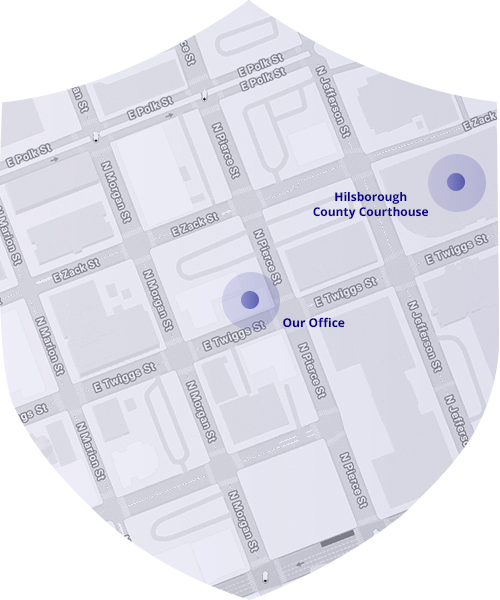
620 E. Twiggs Street, Suite 205, Tampa, FL 33602
(813) 727-7159
Serving Hillsborough, Pinellas, and Pasco Counties
The Brancato Law Firm, P.A. is a Tampa-based criminal defense practice. We are not affiliated with any other Brancato-named law firms.
Visit Us
Tampa, FL 33602
Contact Us Now
Free Legal Consultation (813) 727-7159