- Free Consultation 24/7: (813) 727-7159 Tap Here To Call Us


From First DUI to Death Penalty


How Many Jurors Does a Florida Criminal Trial Have? (2026)


Updated November 5, 2026
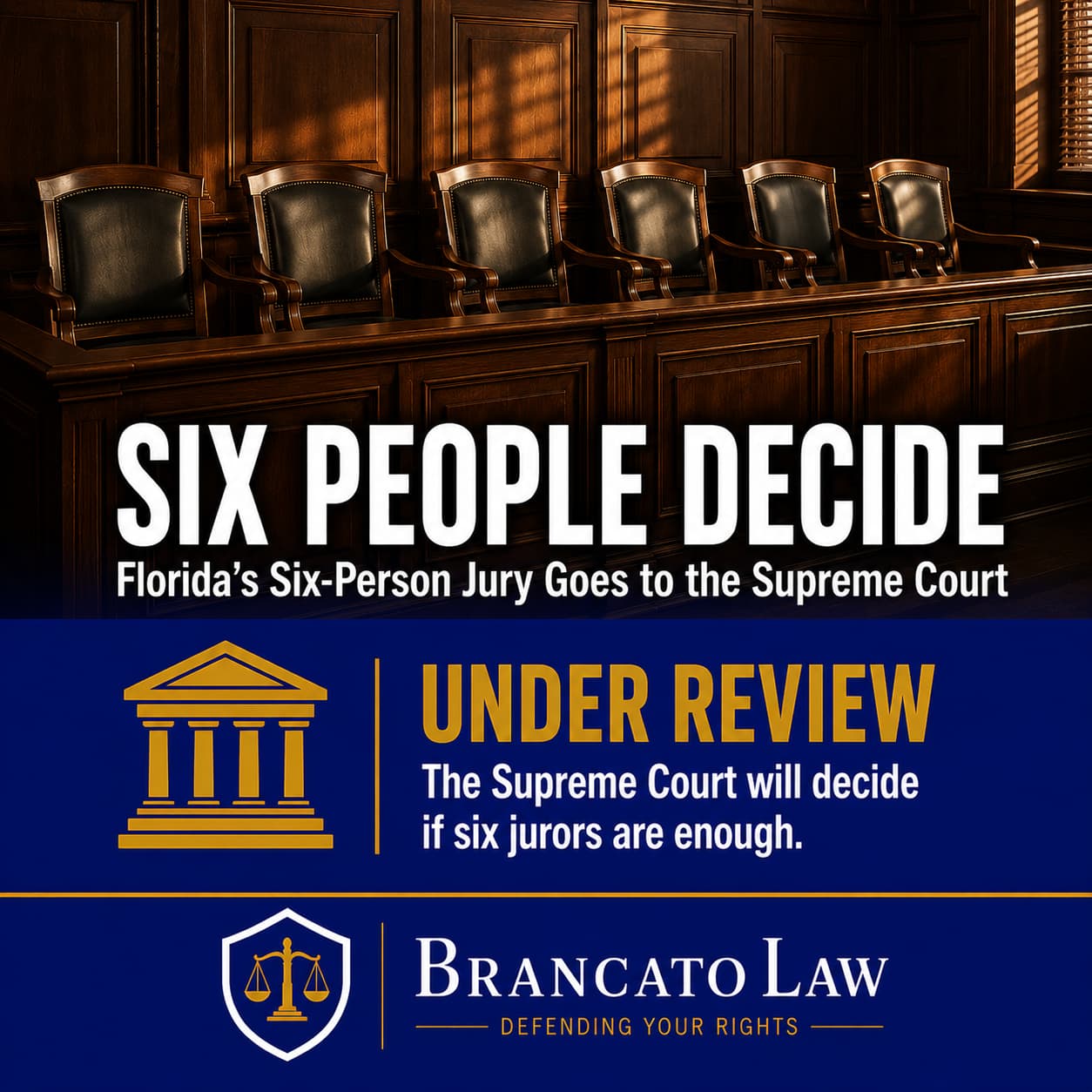
| Key Takeaway: Florida tries almost every criminal case — from misdemeanors to life felonies — to a jury of just six people. Only capital cases get twelve. Florida is one of a handful of states that still does this, and in June 2026 the United States Supreme Court agreed to decide, in Kian v. Florida, whether a six-person jury in a serious felony case violates the Sixth Amendment. Until that decision, six-person juries remain the law — which makes preserving the issue in pending cases critical. |
Almost every felony jury in a Hillsborough County courtroom has six people in the box, not twelve. As founder of The Brancato Law Firm, P.A., a Tampa criminal defense firm, I have tried more than 150 jury trials to verdict in more than 25 years in Hillsborough County courtrooms, almost all of them to six jurors. Our attorneys are now raising and preserving the jury-size issue in cases across Tampa Bay while the Supreme Court decides.
How Many Jurors Sit on a Florida Criminal Jury?
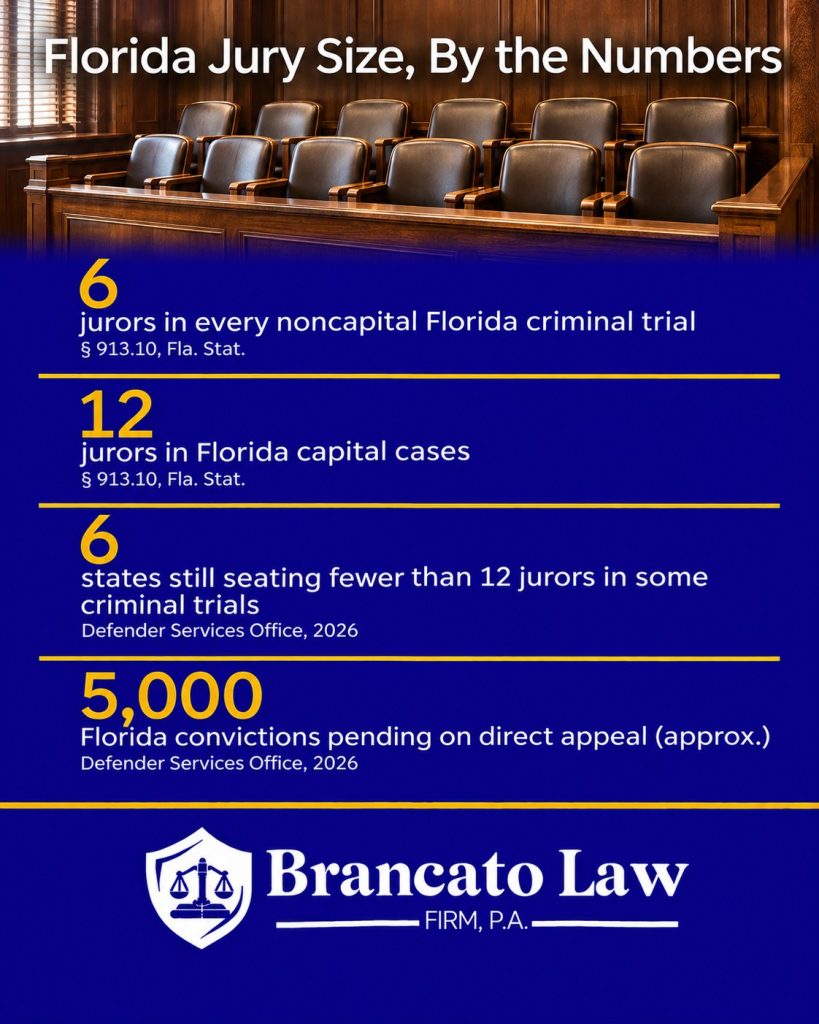
Six — unless the charge is a capital one, such as first-degree murder. Section 913.10, Florida Statutes, sets the number:
| Fla. Stat. § 913.10: “Twelve persons shall constitute a jury to try all capital cases, and six persons shall constitute a jury to try all other criminal cases.” |
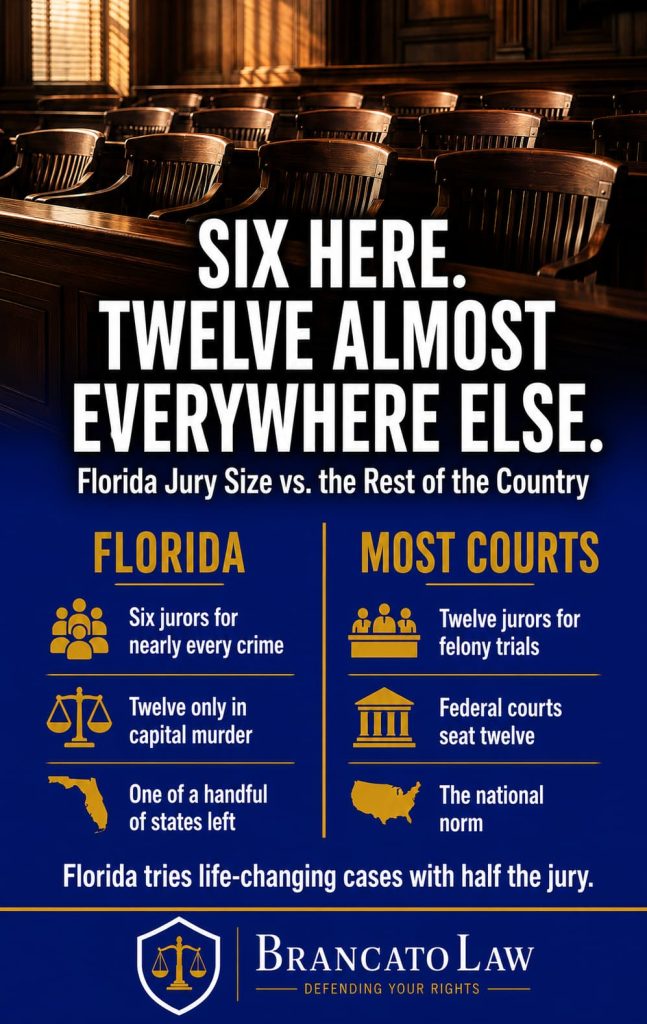
That means a person facing decades in prison on a robbery, trafficking, or attempted murder charge in Florida gets half the jury a shoplifting defendant would get in most other states — and half the jury any defendant gets in federal court across the street. The verdict must still be unanimous: all six jurors must agree to convict.
| Where you’re tried | Jury size |
| Florida — capital murder (even when death is not sought) | 12 jurors |
| Florida — every other felony and misdemeanor | 6 jurors |
| Federal court — felony trial (Fed. R. Crim. P. 23) | 12 jurors |
| The large majority of other states — felony trial | 12 jurors |
The Brancato Law Firm, P.A. — Tampa trial defense — (813) 727-7159
According to the federal Defender Services Office, Florida is one of only six states that still use fewer than twelve jurors in at least some criminal trials, and Florida uses six-member juries for every noncapital crime. The same June 2026 report counted roughly 5,000 Florida criminal convictions pending on direct appeal, the cases most likely to be affected if the Supreme Court changes the rule. Our attorneys try cases in front of these six-person panels every year, and the arithmetic matters: with six jurors, a defendant needs to reach just one less skeptical mind, but also gets far fewer chances that someone on the panel sees the case the way the defense does.
Which Florida Cases Actually Get a Twelve-Person Jury?
Capital murder cases — and that entitlement holds even when the State chooses not to seek the death penalty. In State v. Griffith, 561 So. 2d 528 (Fla. 1990), the Florida Supreme Court held that a prosecutor “cannot, by electing not to seek the death penalty, change the classification of an offense from capital to noncapital” — so a defendant indicted for first-degree murder keeps the statutory right to twelve jurors unless that right is waived, something the defense should never let happen by accident. Our Tampa homicide attorney page explains how we defend first-degree murder cases from indictment through a twelve-person trial.
The “capital felony” label alone, though, is not what controls. Florida defines a capital case for jury purposes as one where death is a possible punishment, so capital sexual battery has long been tried to six jurors. In State v. Hogan, 451 So. 2d 844 (Fla. 1984), the Florida Supreme Court approved a six-person jury for sexual battery of a child because death was not an available penalty, and in Phillips v. State, 316 So. 3d 779 (Fla. 1st DCA 2021), the First District held that a six-person jury was required for the same charge. A 2023 amendment to section 794.011(2)(a), Florida Statutes, now provides a death-or-life sentencing procedure for that offense, but in Oakes v. State, No. 4D2025-2758 (Fla. 4th DCA June 3, 2026), the Fourth District held that a defendant whose offense predated the amendment still was not entitled to twelve jurors. Sit with what that leaves: charges carrying mandatory life, such as trafficking with decades of minimums, attempted murder, and armed robbery, are decided by six people. In our felony practice across the 13th Judicial Circuit, the twelve-person jury is a genuine rarity, which is exactly why the question the Supreme Court agreed to answer reaches nearly every serious case in this state.
Is a Six-Person Jury Legal?
Yes — for now, because of a case that came out of Florida itself. In Williams v. Florida, 399 U.S. 78 (1970), the U.S. Supreme Court held that “the 12-man panel is not a necessary ingredient of ‘trial by jury,’” and that Florida’s six-person jury did not violate the Sixth Amendment. The Court reasoned that the number twelve was a historical accident rather than a functional necessity, and that what matters is whether the jury is large enough to promote group deliberation, resist outside intimidation, and represent a cross-section of the community.
Eight years later, the Court drew the floor. In Ballew v. Georgia, 435 U.S. 223 (1978), it struck down Georgia’s five-person jury, concluding — based on a body of empirical studies — that “the purpose and functioning of the jury in a criminal trial is seriously impaired, and to a constitutional degree, by a reduction in size to below six members.” So the line has sat at six ever since: five is unconstitutional, six is permitted, and Florida has stayed at the constitutional minimum for over half a century.
Why Does Jury Size Matter?
Because the research the Supreme Court itself relied on in Ballew shows smaller juries deliberate worse. The Ballew Court found that as juries shrink, they are less likely to have members who remember each important piece of evidence, less able to counterbalance individual jurors’ biases, and less likely to represent a true cross-section of the community — and that smaller panels raise the risk of convicting the innocent.
For the defense, the practical stakes are concrete. A Florida verdict must be unanimous, so every juror is a potential holdout against a weak case — and six jurors means half as many people who might catch the flaw in the State’s evidence, half as many life experiences in the room, and far fewer minority voices on any given panel. When our attorneys pick a jury at the Hillsborough County Courthouse, we are choosing six people who will carry the full weight most states spread across twelve. That is exactly the concern now in front of the Supreme Court.
The U.S. Supreme Court Is Reconsidering: Kian v. Florida
On June 15, 2026, the United States Supreme Court granted certiorari in Kian v. Florida, No. 25-6623, to decide whether a defendant is deprived of his Sixth and Fourteenth Amendment rights “to a trial by a 12-person jury when the defendant is charged with a serious felony.” The case comes out of Florida’s Fourth District Court of Appeal, which affirmed in Kian v. State, 421 So. 3d 439 (Fla. 4th DCA 2025), where Hamed Kian was convicted by a unanimous six-person jury of five felony counts of practicing chiropractic medicine with a suspended license. It asks the Court to reconsider Williams itself.
Challengers have been knocking on this door for years. Florida’s appellate courts have repeatedly rejected six-person jury challenges — the Fourth District did so again in Gonzales v. State, No. 4D2025-2161 (Fla. 4th DCA Aug. 26, 2026), citing its earlier decision in Guzman v. State, 350 So. 3d 72 (Fla. 4th DCA 2022), and the U.S. Supreme Court declined to take the issue up as recently as 2024 in Cunningham v. Florida, 144 S. Ct. 1287 (2024). But those same August 2026 opinions now add three words that tell you everything about where this is heading: “But see Kian.” The Court that would not hear the issue two years ago has now agreed to hear it, and the case is set for oral argument on January 13, 2027.
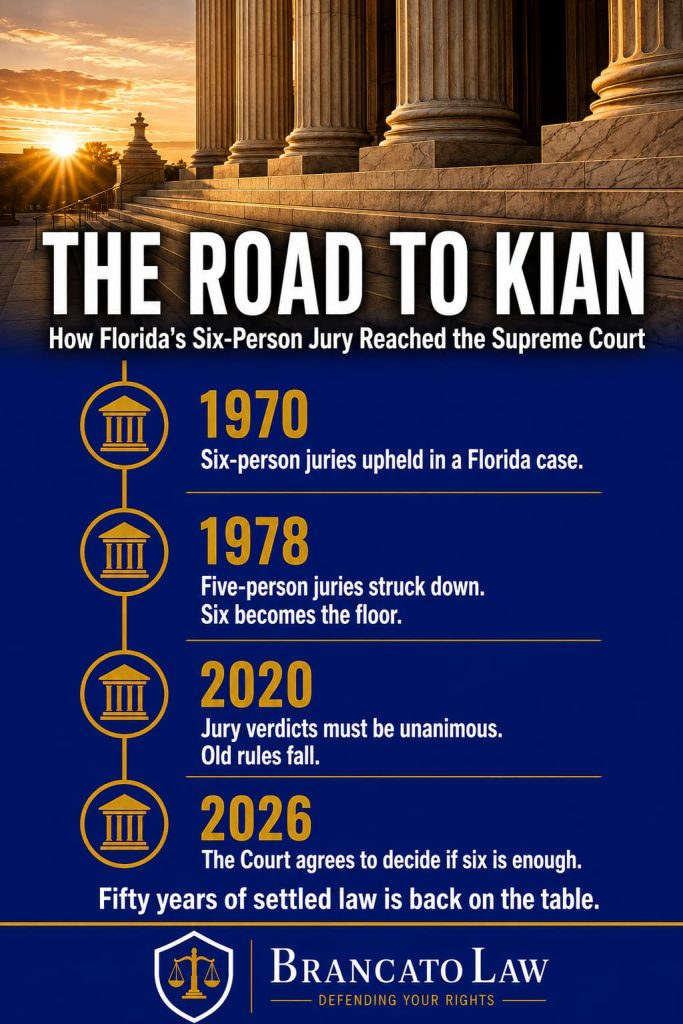
Here is the road that led there:
| Year | What happened |
| 1970 | Williams v. Florida: six-person juries upheld — twelve is not constitutionally required |
| 1978 | Ballew v. Georgia: five-person juries struck down — six becomes the constitutional floor |
| 2020 | Ramos v. Louisiana: jury verdicts in serious cases must be unanimous — the Court revisits a jury rule it had long tolerated |
| 2024 | Cunningham v. Florida: the Court declines to review Florida’s six-person jury |
| 2026 | Kian v. Florida: certiorari granted June 15 — Williams is squarely up for reconsideration |
The Brancato Law Firm, P.A. — (813) 727-7159
Ramos matters in this story for a reason: in Ramos v. Louisiana, 590 U.S. 83 (2020), the Court overruled decades of tolerance for non-unanimous verdicts because history and the jury’s function demanded it. The Kian petition asks the Court to apply that same reasoning to jury size. No one knows how Kian will come out — but the Court does not take cases like this to leave everything as it is.
What Happens to Florida Cases While Kian Is Pending?
Six-person juries remain fully legal, and Florida courts are still bound by Williams until the Supreme Court says otherwise. Florida’s appellate courts made that explicit this summer: in Rogers v. State, No. 6D2025-0883 (Fla. 6th DCA June 29, 2026), the court refused to let a defendant add the jury-size issue after briefing closed, holding that claims based on a cert grant “are speculative and premature.” Critically, it also held that because the defendant left the issue out of his initial brief, he had waived it.
That waiver holding is the practical heart of this entire subject. Rogers also acknowledged the other side of the coin: if the Supreme Court announces a new rule, defendants whose appeals were already final “could seek post-conviction relief to the same extent as any other person” — but whether a new rule would apply retroactively to final cases is a separate question Florida courts would have to resolve. New rules generally apply to cases still pending on direct review; they reach final convictions only through a much narrower retroactivity doctrine. In plain terms: the people best positioned to benefit from a defense win in Kian are the ones whose lawyers put the objection on the record before their case became final.
| Warning: Raise it or lose it. Florida’s appellate courts have already refused to consider six-person jury challenges from defendants who did not object at trial and raise the issue in their opening appellate brief. If Kian changes the law, the record your lawyer builds now decides whether your case can benefit. |
How Do You Preserve the Jury-Size Issue in Your Case?
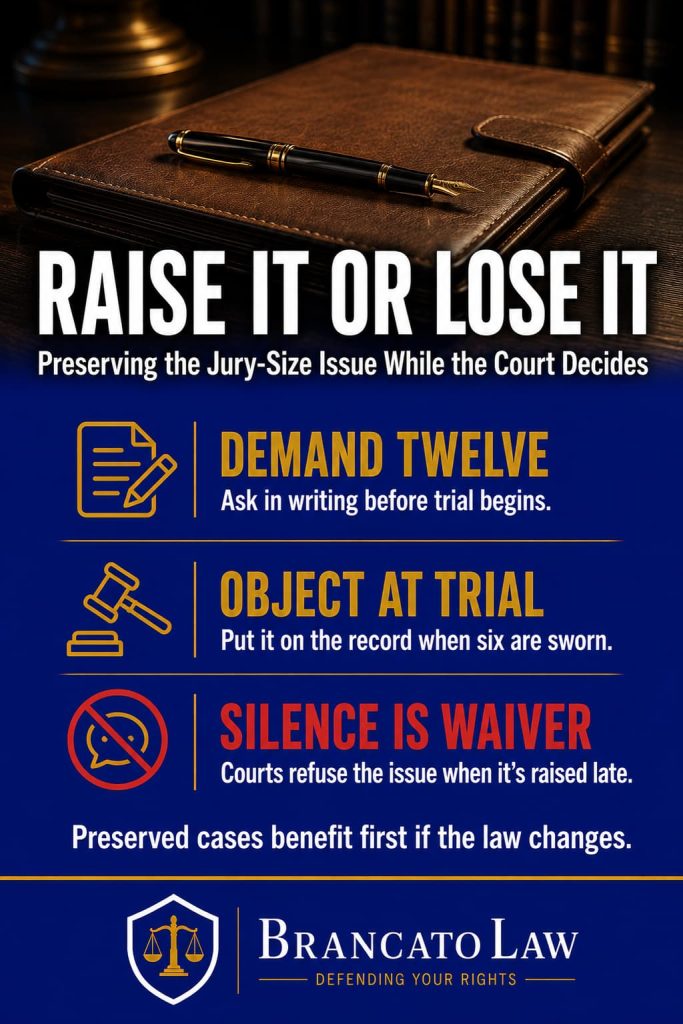
By putting it on the record at every stage — even though today’s courts will deny it. When our firm handles a felony case heading to trial while Kian is pending, preservation looks like this:
- Demand a twelve-person jury in writing before trial. The motion will almost certainly be denied under Williams and § 913.10 — the point is the record.
- Object when the six-person panel is sworn. A contemporaneous objection anchors the issue at trial, where appellate courts require it to be made.
- Raise it in the opening brief on appeal. Rogers shows what happens when it appears late: waiver, no matter what the Supreme Court does afterward.
- Track finality. A case pending on direct review when Kian is decided stands on far stronger ground than one that became final the month before — timing decisions, including whether to seek rehearing, can matter.
None of this costs the defense anything, and all of it is insurance. Our attorneys are building these records now in Hillsborough, Pinellas, and Pasco County cases, because the cheapest issue to preserve is the one you preserve before the law changes.
Facing a Felony Trial in Tampa Bay While Kian Is Pending?
If you or a family member has a felony case heading toward trial, this is a moment when the calendar itself is a defense consideration. The jury that decides the case, the objections made before it is sworn, and the timing of the appeal could all look different a year from now. Call The Brancato Law Firm at (813) 727-7159 — our attorneys can evaluate whether the jury-size issue belongs in your case and make sure nothing is waived while the Supreme Court decides.
Frequently Asked Questions: Florida Jury Size and Kian v. Florida
How many jurors are on a jury in Florida?
Six, in every criminal case except capital cases, which get twelve. Fla. Stat. § 913.10. In our Tampa Bay trials, that means six jurors decide felonies carrying decades of prison exposure.
Does a Florida jury verdict have to be unanimous?
Yes — all six jurors must agree before a defendant can be convicted, and a single holdout means no conviction. That unanimity requirement is one reason jury selection is where our attorneys invest so heavily in every trial.
What is Kian v. Florida?
Kian v. Florida, No. 25-6623, is a U.S. Supreme Court case, accepted for review on June 15, 2026, that will decide whether trying a serious felony to a six-person jury violates the Sixth Amendment. It asks the Court to reconsider Williams v. Florida, the 1970 decision that approved Florida’s six-person jury.
Is a six-person jury unconstitutional?
Not under current law — Williams v. Florida upheld six-person juries in 1970, and Florida courts remain bound by it while Kian is pending. Five-person juries, however, have been unconstitutional since Ballew v. Georgia in 1978. We treat the question as live and preserve it in our clients’ cases.
If the Supreme Court strikes down six-person juries, will it apply to old cases?
Nobody knows yet — new constitutional rules generally apply to cases still pending on direct appeal, while reaching already-final convictions requires a separate retroactivity ruling. That uncertainty is exactly why preserving the issue now matters so much; The Brancato Law Firm is doing that in pending cases rather than betting on retroactivity later.
How long has Florida used six-person juries?
Since 1877. As the Sixth District noted in Rogers v. State (2026), Florida has permitted six-person juries in non-capital cases since an 1877 statute, and the U.S. Supreme Court’s nationwide approval of the practice in 1970 came in a Florida case, Williams v. Florida. In our experience, most clients are surprised to learn the tradition is that old — and that it has never before faced the direct reconsideration it faces now in Kian.
Can my lawyer demand a 12-person jury in Florida right now?
Yes — the demand will be denied under current law, but making it in writing and objecting at trial is what preserves the issue if Kian changes the rule. The attorneys of The Brancato Law Firm, P.A. build that record in felony cases heading to trial. Call (813) 727-7159 for a free, confidential consultation.
For more about our defense strategies, visit our Top-Rated Tampa Homicide Attorney page.
Related reading: How Trial Preparation Builds a Stronger Defense · How to Decide Whether to Accept a Plea Bargain · How Does a Bond Hearing Work in Tampa? · The Complete Guide to Homicide Charges in Florida
For how this fits into the rest of a case, see our guide to each stage of a Florida criminal case.
The Law May Be About to Change — Your Record Should Be Ready
Kian v. Florida is set for argument on January 13, 2027, and the defendants who benefit will be the ones whose lawyers preserved the issue before the decision came down. If you’re facing a felony charge in Hillsborough, Pinellas, or Pasco County, call the attorneys of The Brancato Law Firm, P.A. — founded by Tampa Criminal Defense Attorney Rocky Brancato — at (813) 727-7159. What goes on the record before your trial may decide what relief is available after the Supreme Court rules. Our firm has Spanish-speaking staff, and attorney Jean-Luc Adrien speaks Spanish, Haitian Creole, and French. Read our guide for criminal defense in Spanish and Haitian Creole in Tampa.
The Brancato Law Firm, P.A.
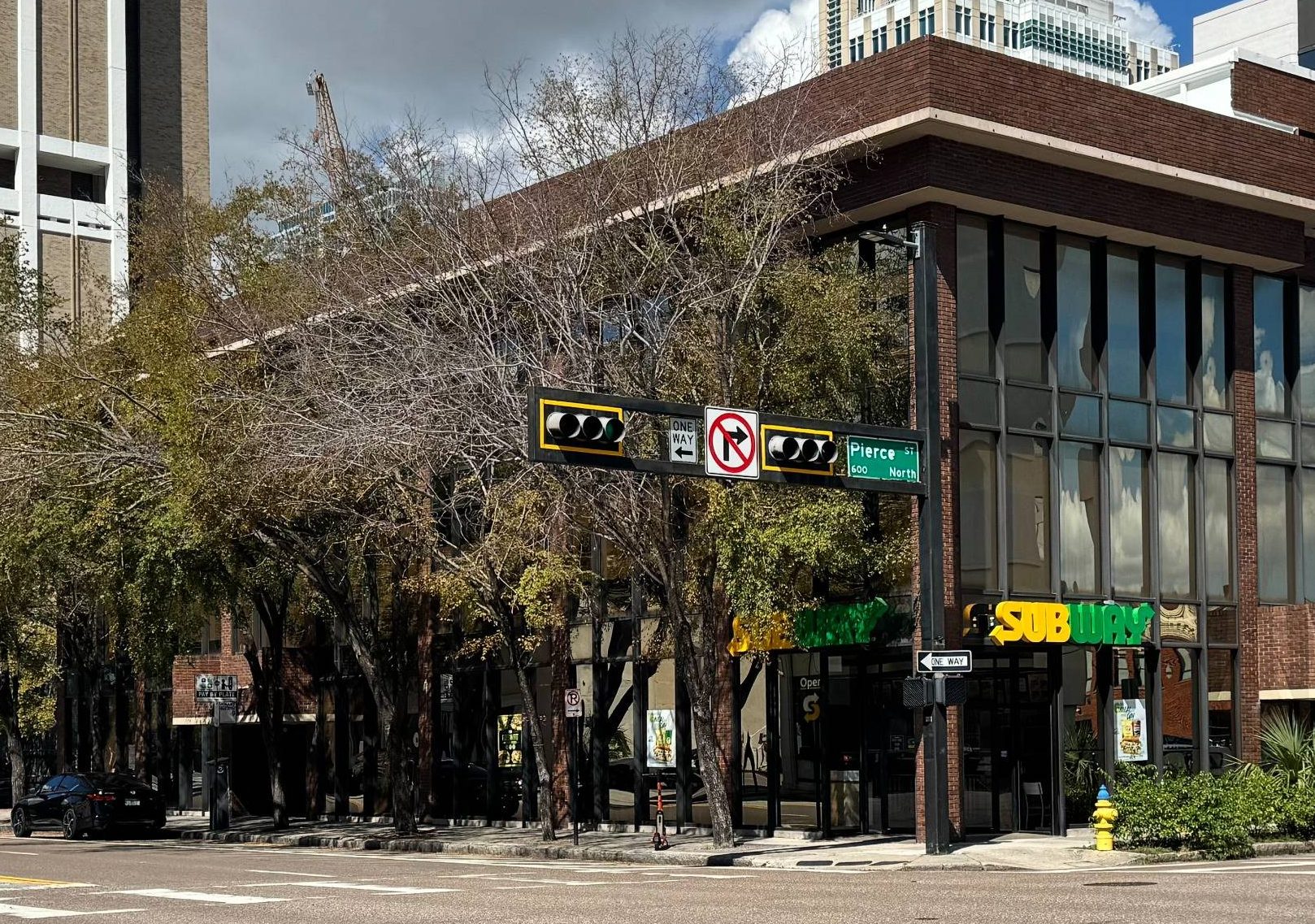
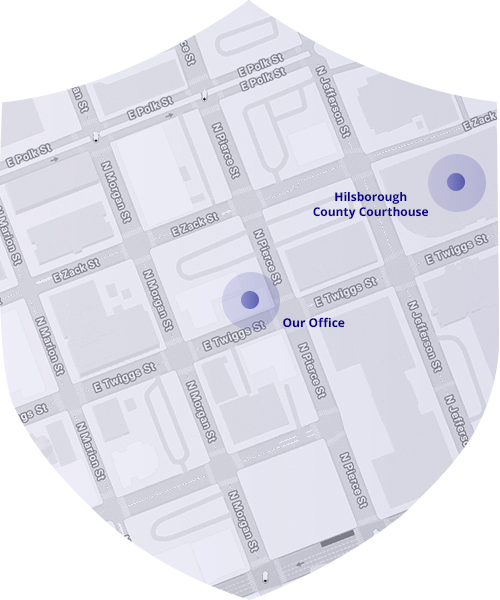
620 E. Twiggs Street, Suite 205, Tampa, FL 33602
(813) 727-7159
Serving Hillsborough, Pinellas, and Pasco Counties
The Brancato Law Firm, P.A. is a Tampa-based criminal defense practice. We are not affiliated with any other Brancato-named law firms.
Visit Us
Tampa, FL 33602
Contact Us Now
Free Legal Consultation (813) 727-7159