- Free Consultation 24/7: (813) 727-7159 Tap Here To Call Us


From First DUI to Death Penalty



What Are the Criminal Penalties for Unlicensed Contracting in Florida Under Section 489.127? (2026)


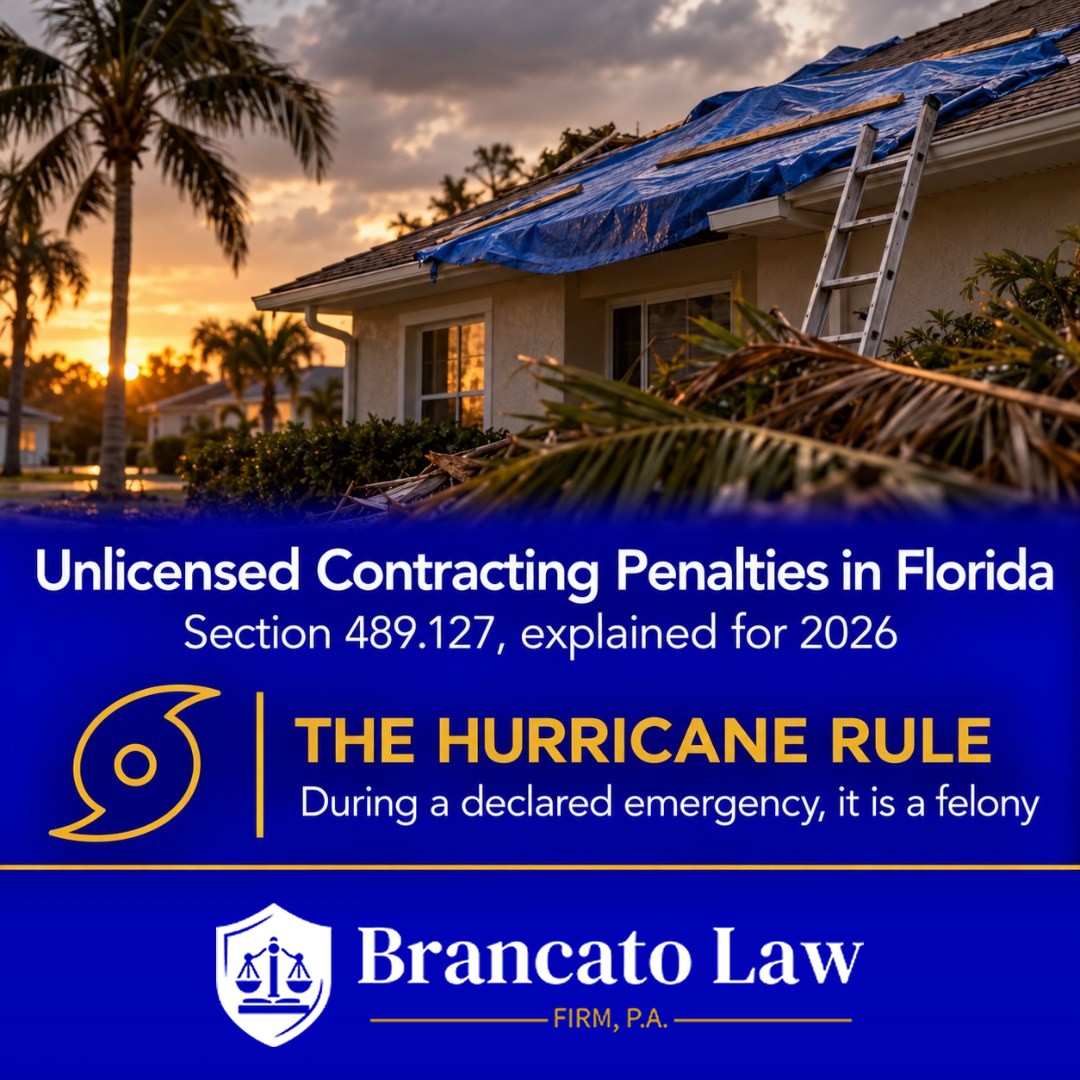
Fully rewritten and updated October 23, 2026.
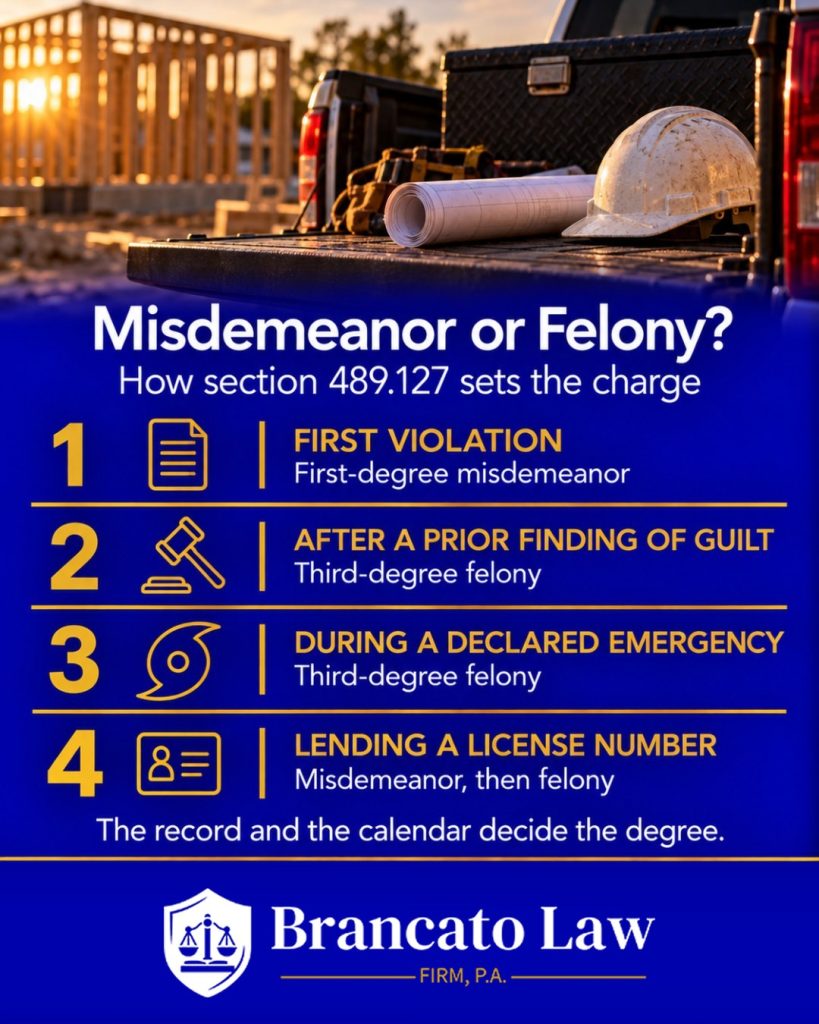
Unlicensed contracting in Florida is a first-degree misdemeanor under section 489.127, Florida Statutes, punishable by up to 1 year in jail and a $1,000 fine. It becomes a third-degree felony, up to 5 years in prison and a $5,000 fine, if the person was previously found guilty of the same violation or if the work happened during a state of emergency declared by the Governor, such as after a hurricane. A licensed contractor who lends a license number faces the same misdemeanor-to-felony ladder. Small jobs under $2,500 and owner-builder work can be exempt.
Many unlicensed contracting cases begin with a homeowner’s complaint to the state or an undercover bid request, not a 911 call, and the first contact is often an investigator asking for a quote or a license number. I’m Rocky Brancato, founder of The Brancato Law Firm, P.A., a Tampa criminal defense firm, and a former Chief Operations Officer of the Hillsborough County Public Defender’s Office, where I oversaw a staff of over 100 attorneys. Our attorneys defend contractors, handymen, and business owners charged under section 489.127 across Hillsborough, Pinellas, and Pasco Counties, and we often step in while the case is still an investigation.
What Does Section 489.127 Make a Crime?
Section 489.127(1), Florida Statutes, lists the prohibited acts. No person may:
- Falsely hold himself, herself, or a business out as a licensee, certificateholder, or registrant;
- Impersonate a certificateholder or registrant, or present another person’s certificate or registration as his or her own;
- Knowingly give false or forged evidence to the licensing board;
- Use or attempt to use a suspended or revoked certificate or registration;
- Engage in the business or act in the capacity of a contractor, or advertise as available to do so, without being duly registered or certified;
- Operate a contracting business more than 60 days after its only qualifying agent leaves without designating a new one;
- Commence or perform work that requires a building permit without the permit; or
- Willfully or deliberately violate a county or municipal ordinance on uncertified or unregistered contractors.
Two definitions in the same subsection catch people off guard. A person or business “operating on an inactive or suspended certificate or registration is not duly certified or registered and is considered unlicensed,” and “A business tax receipt issued under the authority of chapter 205 is not a license.” A county or city business tax receipt does not make someone a licensed contractor.
What Are the Penalties for Unlicensed Contracting in Florida?
The degree depends on the person’s history and when the work happened. Section 489.127(2) sets the ladder, and section 489.127(4) applies a parallel ladder to licensed contractors who lend their numbers.
| Violation | Subsection | Degree | Maximum penalty |
|---|---|---|---|
| Unlicensed person, first violation | (2)(a) | First-degree misdemeanor | 1 year in jail, $1,000 fine |
| Unlicensed person, after a prior finding of guilt for the same violation | (2)(b) | Third-degree felony | 5 years in prison, $5,000 fine |
| Unlicensed person, during a state of emergency declared by the Governor’s executive order | (2)(c) | Third-degree felony | 5 years in prison, $5,000 fine |
| Unlicensed pollutant storage systems contractor, precision tank tester, or tank lining applicator | (2)(d) | Third-degree felony | 5 years in prison, $5,000 fine |
| Licensed contractor who lends a certification or registration number | (4)(d)1. | First-degree misdemeanor | 1 year in jail, $1,000 fine |
| License lending after a prior finding of guilt | (4)(d)2. | Third-degree felony | 5 years in prison, $5,000 fine |
| Willfully refusing to sign and accept a code enforcement citation | (5)(m) | Second-degree misdemeanor | 60 days in jail, $500 fine |
Maximum terms and fines come from section 775.082 and section 775.083, Florida Statutes. The felony step in (2)(b) requires that the person was “previously found guilty” of a violation, so a second arrest alone does not make a case a felony. Our attorneys check the prior disposition first.
Why Does a Hurricane Turn Unlicensed Contracting Into a Felony?
Because section 489.127(2)(c) makes any violation of subsection (1) a third-degree felony when it happens “during the existence of a state of emergency declared by executive order of the Governor.” After a storm, repair work that would be a first-offense misdemeanor any other month can be filed as a felony.
The emergency enhancement is only as strong as the order behind it. Our attorneys pull the executive order, check that it covered the county where the work happened and was still in effect on the dates charged, and hold the State to proving both. The Department of Business and Professional Regulation calls natural disasters “a magnet for unlicensed activity”; its FY 2023-24 annual report says teams including the Tampa office conducted more than 60 sweeps, 338 site visits, and more than 1,200 license checks after Hurricane Idalia.
Can a Licensed Contractor Be Charged for Lending a License Number?
Yes. Under section 489.127(4), a certified or registered contractor may not:
- Enter into an agreement, “oral or written,” that lets an unlicensed person or an unqualified business use his or her certification or registration number;
- “Knowingly allow” an unlicensed person or unqualified business to use the number; or
- Apply for or obtain a building permit unless the contractor, or a business the contractor qualifies, has actually contracted to do the work at that property.
The permit rule has two built-in exceptions: it does not stop a contractor from pulling a permit to do work for someone else without compensation, or to work on property the contractor owns. The “knowingly allow” paragraph requires proof of knowledge, which is often the weakest part of the State’s case. Our attorneys at The Brancato Law Firm look at what the contractor was told, what was signed, and who actually controlled the job.
Which Jobs Do Not Require a Contractor’s License in Florida?
Several kinds of work are exempt under section 489.103, Florida Statutes, and an exemption is a complete answer to an unlicensed contracting charge. Two come up most often:
| Exemption | What it covers | Where it fails |
|---|---|---|
| Minor work, s. 489.103(9) | “Casual, minor, or inconsequential” work where the aggregate contract price for labor, materials, and all other items is less than $2,500 | Work that is part of a larger operation, jobs split into contracts under $2,500 to evade the law, or a person who advertises as a contractor |
| Owner-builder, s. 489.103(7) | Owners acting as their own contractor and directly supervising work on their own one- or two-family home or farm outbuilding, or a commercial building up to $75,000, for their own use | A sale or lease within 1 year after completion creates a presumption the work was for sale or lease |
Whether a job needed a license at all is also a question of what the work was. The State must show the person was acting as a contractor as section 489.105 defines it, and that is where the next case comes in.
What Does the State Have to Prove in an Unlicensed Contracting Case?
In Dubois v. State, 363 So. 3d 246 (Fla. 6th DCA 2023), a Lee County jury convicted a woman of contracting without a license over a home generator. The Sixth District explained that, to prove a person was a contractor, the State must show the person undertook to “construct, repair, alter, remodel, add to, demolish, subtract from or improve a building or structure” for others, did so for compensation, and had a job scope substantially similar to one of the contractor categories in section 489.105(3).
The State never introduced the written contract, and the homeowner did not testify that she had agreed to install the generator, let alone in a way that altered the house. The court held that “no rational trier of fact could have found the existence of all of the elements” and ordered a judgment of acquittal. Delivering equipment or quoting a price is not the same as contracting to alter a structure, and our attorneys hold the State to the difference.
What Happens After a DBPR Stop-Work Order or Code Enforcement Citation?
Both can come before, or instead of, a criminal case. Under section 489.127(3), DBPR may issue a stop-work order “upon finding probable cause” that work requiring a license is being done without one, and it may enforce the order through cease-and-desist actions under section 455.228, Florida Statutes.
Under section 489.127(5), counties and cities may designate code enforcement officers to cite unlicensed contracting. The officer’s citation penalty “may not exceed $2,000,” but a person who requests a hearing and loses can be ordered by the board or special magistrate to pay up to “$2,500 per day for each violation,” and a recorded order becomes a lien on the violator’s real and personal property. The person has 10 days, excluding weekends and legal holidays, to pay or request a hearing. What a contractor says at that hearing can become evidence in a criminal case, so our attorneys prepare it with the criminal exposure in mind.
How Often Does Florida Act Against Unlicensed Activity?
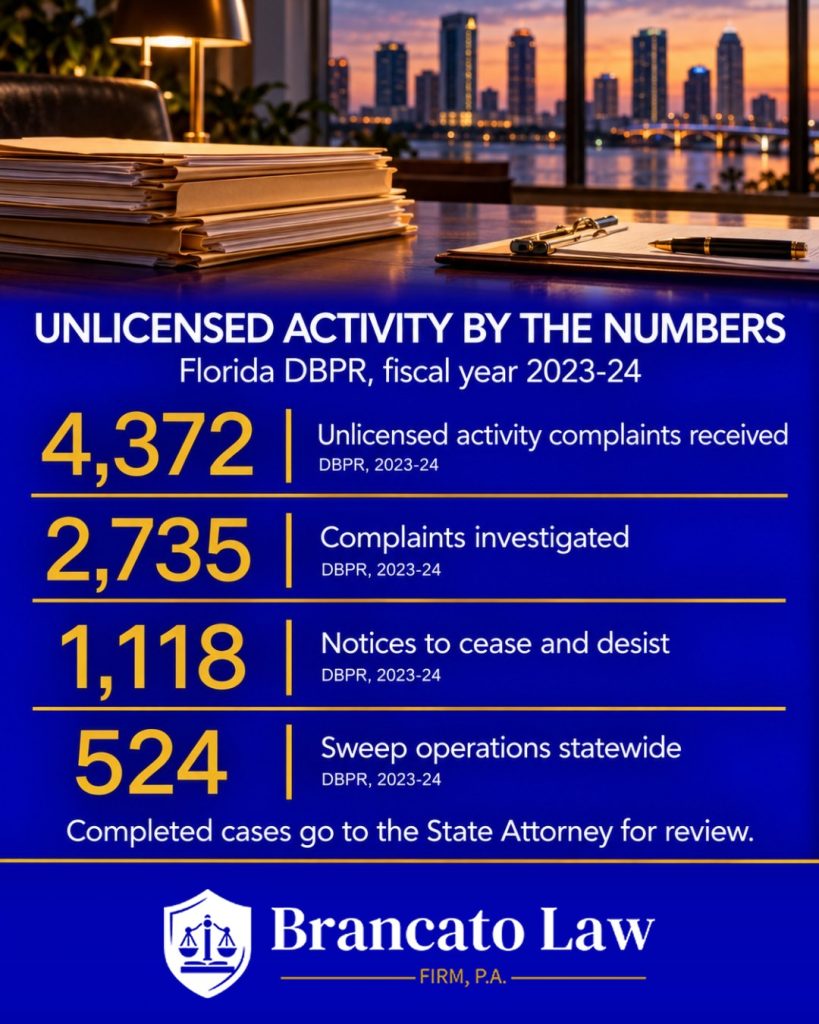
Thousands of times a year. In fiscal year 2023-24, DBPR’s Division of Regulation received 4,372 complaints of unlicensed activity across the professions it regulates, found 2,735 legally sufficient for investigation, and issued 1,118 notices to cease and desist, 731 citations, and 1,013 final orders, according to the department’s FY 2023-24 annual report. The same report counts 524 sweep operations and 12 undercover enforcement operations, and says completed unlicensed activity cases “are also forwarded to State Attorney’s Offices for review and potential criminal prosecution.”
Arrests follow the stings. The Legislature’s Office of Program Policy Analysis and Government Accountability, in Report No. 10-03 (January 2010), found that DBPR conducted 352 construction-related sweeps and 20 sting operations in FY 2008-09, and that law enforcement took part in 28 sweeps and 19 stings and made 367 arrests. The figures are from 2010, the most recent year that report covers.
What Civil Consequences Come With Unlicensed Contracting?
The criminal case is only part of the exposure. Under section 489.128, Florida Statutes, contracts entered into by an unlicensed contractor “shall be unenforceable in law or in equity by the unlicensed contractor,” which can wipe out the right to collect for finished work. In Earth Trades, Inc. v. T & G Corp., 108 So. 3d 580 (Fla. 2013), the Florida Supreme Court held that “a party’s knowledge that a contractor is unlicensed is insufficient as a matter of law to establish the defense of in pari delicto,” so the unlicensed contractor cannot argue the customer was equally at fault.
Timing matters under section 489.128. For that statute, a contractor is considered unlicensed “only if the contractor was unlicensed on the effective date of the original contract,” or on the signing date or the first day of work if no effective date is stated. That rule governs contract enforcement, not the criminal charge, but the licensing records gathered for one usually decide the other.
How Do Our Attorneys Defend an Unlicensed Contracting Charge?
We start with the elements and the paper trail:
- Was a license required? We test the job against the $2,500 minor-work exemption, the owner-builder exemption, and the other exemptions in section 489.103.
- Was the person acting as a contractor? Under Dubois, the State must prove an agreement to alter or improve a structure, for compensation, within a contractor’s job scope.
- What did the licensing records show on the dates charged? We pull DBPR history for active, inactive, suspended, and qualifying-agent status.
- Does the felony enhancement hold? We check the prior finding of guilt, or the emergency order’s dates and counties.
- For license lending, what did the contractor know? The “knowingly allow” paragraph requires proof of knowledge.
- Can the case end without a conviction? Restitution, a corrected license status, and diversion can resolve many first offenses.
Our Tampa white collar crime attorney page explains how we handle regulatory and fraud-related charges, and our representation before charges are filed can address a DBPR or police investigation before an arrest.
What Should You Do If You Are Under Investigation for Unlicensed Contracting?
- Do not give a recorded statement to an investigator or code officer about whether you hold a license or what you agreed to do.
- Stop the work in question if you received a stop-work order, and keep a copy of the order.
- Gather the paperwork: contracts, estimates, invoices, permits, texts with the customer, and any license or qualifying-agent records.
- Note the deadline on any code enforcement citation; you have 10 days, excluding weekends and holidays, to pay or request a hearing.
- Call a defense lawyer before the hearing or any interview.
Cases filed in Hillsborough County are prosecuted by the State Attorney’s Office for the 13th Judicial Circuit. See our Hillsborough County criminal defense attorney page, or our pages for Pinellas County and Pasco County cases.
Frequently Asked Questions About Unlicensed Contracting in Florida
Is unlicensed contracting a felony in Florida?
It is a first-degree misdemeanor for a first violation, and a third-degree felony after a prior finding of guilt or during a Governor-declared state of emergency. The Brancato Law Firm checks the prior record and the emergency order before anything else, because those two facts set the degree; our white collar defense page has more.
How much work can you do without a license in Florida?
Casual, minor, or inconsequential work with an aggregate contract price under $2,500 is exempt, unless it is part of a larger job, was split up to evade the law, or the person advertises as a contractor. Our attorneys at The Brancato Law Firm add up every invoice on the project, because the State often does.
Can unlicensed contracting charges be dropped in Florida?
Yes, when an exemption applies, the work was not contracting, the license records do not support the charge, or the case resolves through restitution or diversion. The Brancato Law Firm presents those facts to the prosecutor early, often through our pre-file advocacy.
Is a business tax receipt the same as a contractor’s license?
No. Section 489.127(1) says a business tax receipt issued under chapter 205 “is not a license for purposes of this part.” The Brancato Law Firm reviews which state certification or registration, if any, the job actually required.
Can I go to jail for contracting without a license in Florida?
Yes, up to 1 year for a first-offense misdemeanor and up to 5 years for a felony, although many first offenses resolve without jail. Our attorneys at The Brancato Law Firm focus on restitution, licensing fixes, and diversion where the facts allow.
What happens if I ignore a code enforcement citation for unlicensed contracting?
The citation becomes final, the penalty can become a recorded lien, and willfully refusing to sign and accept a citation is a second-degree misdemeanor. The Brancato Law Firm can request the hearing and prepare for it with any criminal exposure in mind.
Talk to a Tampa Defense Attorney About a Contracting Charge
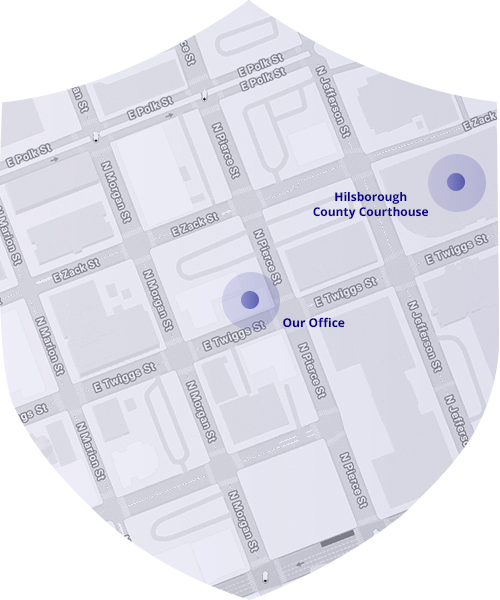
If an investigator has asked about your license, a job site has been shut down, or you have a court date, call The Brancato Law Firm, P.A., founded by Tampa Criminal Defense Attorney Rocky Brancato, at (813) 727-7159. We will review the license records, the contracts, and any emergency order, and work toward a result that protects both your record and your business. You can call us at any hour; our office is two blocks from the courthouse. Our firm has Spanish-speaking staff, and attorney Jean-Luc Adrien speaks Spanish, Haitian Creole, and French. Read our guide for Spanish-speaking criminal defense clients in Tampa.
For more about our defense strategies, visit our Tampa White Collar Crime Attorney page.
The Brancato Law Firm, P.A.
620 E. Twiggs Street, Suite 205, Tampa, FL 33602
(813) 727-7159
Serving Hillsborough, Pinellas, and Pasco Counties
The Brancato Law Firm, P.A. is a Tampa-based criminal defense practice. We are not affiliated with any other Brancato-named law firms.
Visit Us
Tampa, FL 33602
Contact Us Now
Free Legal Consultation (813) 727-7159