- Free Consultation 24/7: (813) 727-7159 Tap Here To Call Us


From First DUI to Death Penalty



Is Spanking Illegal in Florida? Corporal Punishment Law in Tampa (2026)


Fully rewritten and updated October 23, 2026.
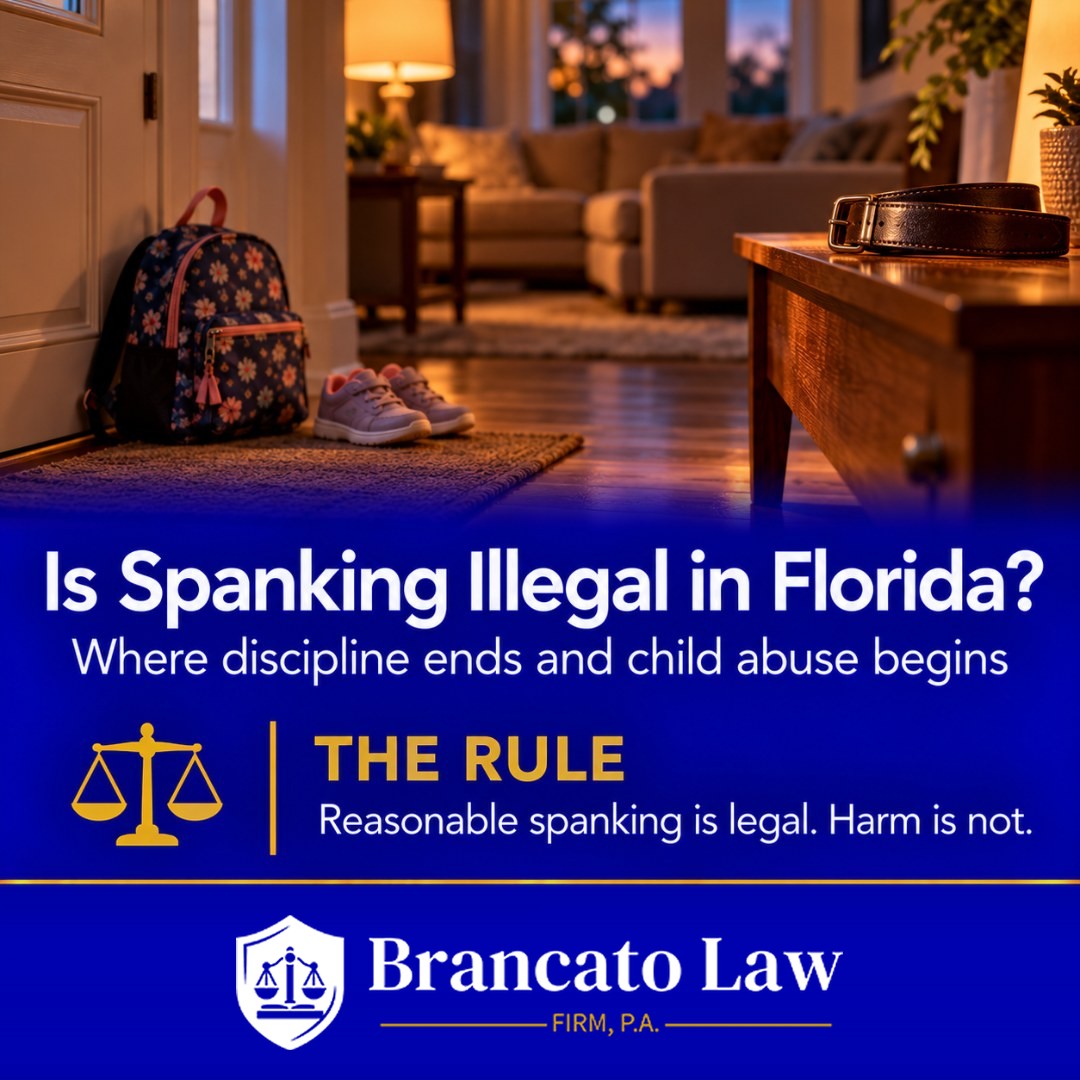
No, spanking is not illegal in Florida. Florida law allows a parent to use reasonable corporal punishment, and section 39.01(2), Florida Statutes, says corporal discipline by a parent does not in itself constitute abuse when it does not result in harm to the child. Discipline becomes child abuse when it causes injuries such as significant bruises or welts, cuts, burns, or broken bones, which section 39.01(37)(a)4 lists as signs of excessive punishment. A parent who crosses that line can face a DCF investigation and charges ranging from misdemeanor battery to aggravated child abuse, a first-degree felony.
Florida spanking cases usually turn on one thing a jury can see: what the discipline left on the child’s body. I learned how much that matters in the Major Crimes Unit of the Hillsborough County Public Defender’s Office, where I handled child abuse, sex crimes, and homicide cases, and later as the former Chief Operations Officer of the Hillsborough County Public Defender’s Office, where I oversaw a staff of over 100 attorneys. I am Rocky Brancato, founder of The Brancato Law Firm, P.A., a Tampa criminal defense firm, and I have spent more than 25 years in Hillsborough County courtrooms. Our attorneys now defend parents, stepparents, and teachers whose discipline has been reported to DCF or the police.
Is it illegal to spank your child in Florida?
It is legal to spank your child in Florida as long as the spanking is reasonable and does not harm the child. The Florida Legislature wrote that rule into the child welfare code: under section 39.01(2), Florida Statutes, “corporal discipline of a child by a parent or legal custodian for disciplinary purposes does not in itself constitute abuse when it does not result in harm to the child.” Florida has no statute that bans spanking at home.
The Florida Supreme Court set the framework in Raford v. State, 828 So. 2d 1012 (Fla. 2002). Willie Raford was convicted of child abuse for repeatedly striking his girlfriend’s eight-year-old child with a belt, and he argued that a parent cannot be prosecuted for disciplining a child. The court rejected that argument and held that a parent, or a person acting in the place of a parent, has no blanket immunity from a child abuse prosecution. The court also held that a parent may raise reasonable or nonexcessive corporal punishment, such as a typical spanking, as an affirmative defense to a charge of child abuse.
Put simply, Florida protects the spanking and punishes the injury. That is why the questions our attorneys ask first in every discipline case are physical ones: what was used, where on the body the child was struck, how many times, and what marks were left. If you are already facing a report, our Tampa child abuse attorney page explains how our firm defends these cases from the first DCF contact through trial.
What does Florida’s corporal punishment statute say?
Florida’s corporal punishment rule lives in the definitions section of Chapter 39, the law that governs DCF investigations. Section 39.01(2) protects disciplinary spanking that causes no harm, and section 39.01(37)(a)4 defines harm to include “inappropriate or excessively harsh disciplinary action that is likely to result in physical injury, mental injury as defined in this section, or emotional injury.” The same subsection lists the injuries that can make corporal discipline excessive or abusive.
| Generally consistent with reasonable discipline | Listed in section 39.01(37)(a)4 as signs of excessive or abusive discipline |
|---|---|
| An open-hand spank on the buttocks that leaves no lasting mark | Significant bruises or welts |
| Brief redness that fades the same day | Cuts, lacerations, punctures, or bites |
| Physical discipline tied to specific misbehavior and the child’s age | Burns or scalding; sprains, dislocations, or cartilage damage |
| Physically taking a phone away as punishment, as in Bechert (below) | Bone or skull fractures; brain or spinal cord damage; internal injuries |
| Moderate force that a reasonable parent would use for that child | Permanent or temporary disfigurement, or loss or impairment of a body part or function; injury from a deadly weapon; asphyxiation |
The statute also tells investigators how to judge an injury. Section 39.01(37)(a)4 requires DCF to weigh the age of the child, any prior history of injuries, the location of the injury on the body, the multiplicity of the injury, and the type of trauma inflicted. A single mark on the buttocks of a 12-year-old is analyzed differently from repeated marks on the face of a toddler, and our firm builds the defense around those five factors.
When does spanking become child abuse in Florida?
Spanking becomes child abuse in Florida when the force is excessive for the child and the misbehavior, or when it causes the kind of injury listed in section 39.01(37)(a)4. The criminal statute, section 827.03, Florida Statutes, defines child abuse as the intentional infliction of physical or mental injury on a child, or an intentional act that could reasonably be expected to result in physical or mental injury. Florida courts have drawn the line between discipline and abuse case by case.
The leading Tampa-area case is State v. McDonald, 785 So. 2d 640 (Fla. 2d DCA 2001). A father was accused of spanking his six-year-old daughter hard enough to leave dark bruising over both buttocks, and the trial court dismissed the felony charge on the theory that parental discipline is privileged. The Second District Court of Appeal, which hears appeals from Hillsborough, Pinellas, and Pasco Counties, reversed the dismissal. It explained that a spanking causing significant welts can be charged as the misdemeanor of contributing to the dependency of a child, that more serious beatings without permanent injury can be charged as felony child abuse, and that aggravated child abuse is reserved for great bodily harm, permanent injury, or actual malice.
Two later cases show where courts refuse to call physical punishment discipline. In Czapla v. State, 957 So. 2d 676 (Fla. 1st DCA 2007), a father punched his 15-year-old son in the head and kicked him in the side while the boy was on the floor during an argument over yard work, and the court held that kicking a child lying on the ground is not reasonable corporal discipline as a matter of law. In Julius v. State, 953 So. 2d 33 (Fla. 2d DCA 2007), a mother beat her children with a wooden table leg after losing a shoe, and the court affirmed her convictions because the jury could find she acted out of frustration and without any disciplinary purpose.
Is hitting a child with a belt illegal in Florida?
Hitting a child with a belt is not automatically illegal in Florida, but it appears again and again in Florida child abuse appeals. In both Raford and Hall v. State, 260 So. 3d 1152 (Fla. 1st DCA 2018), a belt was the instrument. In Hall, a father whipped his 11-year-old son with a belt hard enough to break the skin and leave marks visible days later, and the court affirmed his felony conviction, explaining that his discipline defense was extremely weak because the boy was punished for trying to stop his father from hitting his mother. When a belt leaves welts, broken skin, or marks outside the buttocks, our attorneys expect DCF and the State Attorney’s Office to treat the case as a possible felony.
Is it legal to slap your child in the face in Florida?
No Florida statute makes a slap automatically a crime, but a slap to the face carries far more risk than a spanking. Section 39.01(37)(a)4 makes the location of the injury a required factor, and several injuries the statute lists, such as disfigurement, brain damage, or impairment of a body part or function, are most likely to come from blows to the head and face. A slap that leaves a handprint, a split lip, or a bruise near the eye can be charged as battery or child abuse, and our firm handles those cases with the same focus on medical evidence that we bring to any aggravated child abuse defense.
What charges can a parent face for excessive discipline?
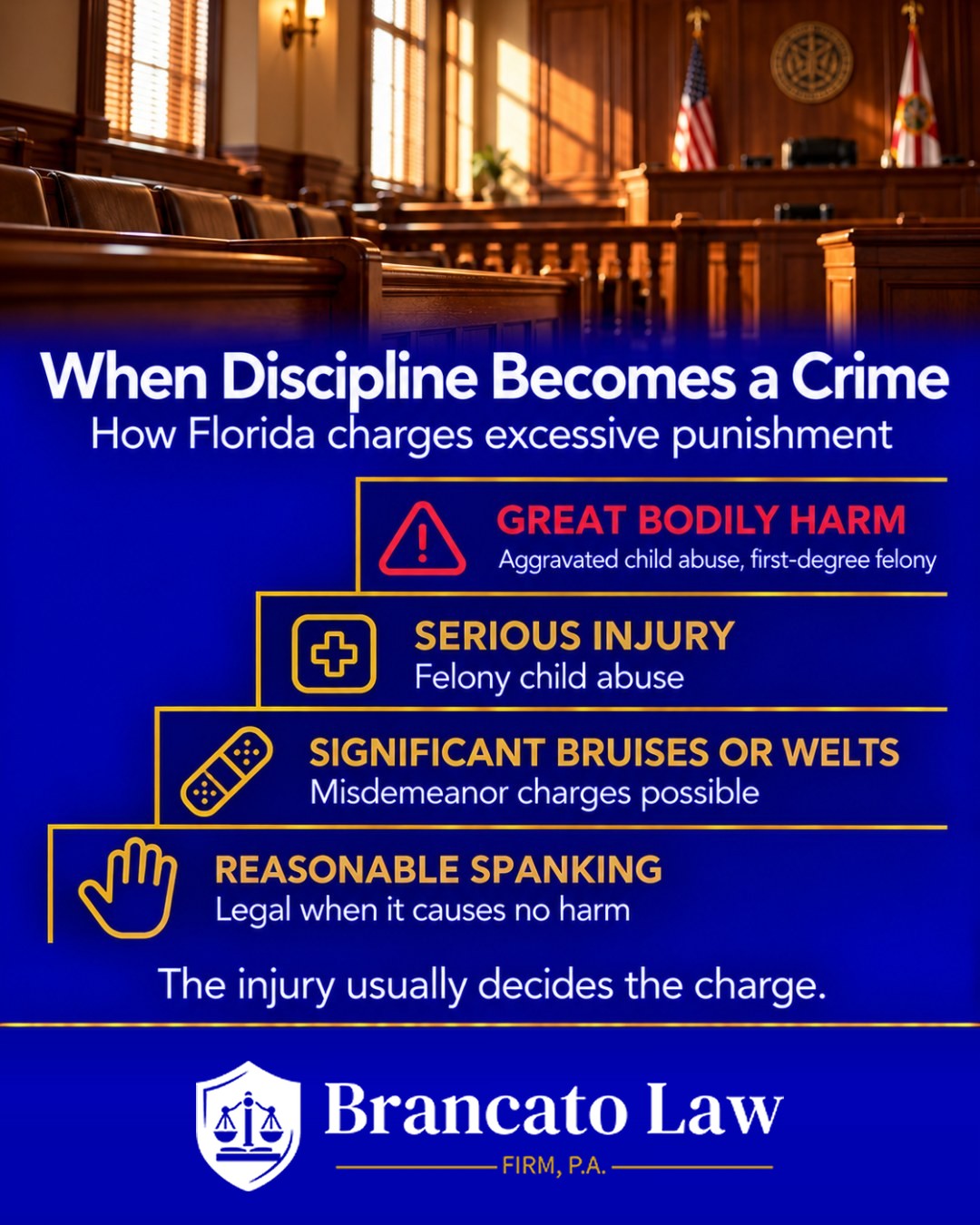
A parent accused of excessive discipline in Florida can face four main charges, and the charge usually tracks the injury. Prosecutors in Hillsborough County choose among battery, contributing to the dependency of a child, felony child abuse, and aggravated child abuse, and the difference between them is the difference between probation and a prison sentence.
| Charge | Statute | Typical discipline fact pattern | Degree and maximum penalty |
|---|---|---|---|
| Battery | § 784.03 | Intentional touching or striking against the child’s will, without the injury needed for a child abuse charge | First-degree misdemeanor: up to 1 year in jail and a $1,000 fine |
| Contributing to the dependency of a child | § 827.04 | Spanking that leaves significant bruises or welts, under the reasoning of McDonald | First-degree misdemeanor: up to 1 year in jail and a $1,000 fine |
| Child abuse | § 827.03(2)(c) | Intentional injury, or an act that could reasonably be expected to injure, without great bodily harm or permanent injury | Third-degree felony: up to 5 years in prison and a $5,000 fine |
| Aggravated child abuse | § 827.03(2)(a) | Aggravated battery on a child, malicious punishment, or abuse causing great bodily harm, permanent disability, or permanent disfigurement | First-degree felony: up to 30 years in prison and a $10,000 fine |
The prison and fine maximums come from section 775.082 and section 775.083, Florida Statutes. A felony charge also carries consequences outside the courtroom, which can include a dependency case, a no-contact condition with your own children while the case is pending, and problems with professional licenses. Much of our early work in these cases is aimed at moving the charge down this ladder, and our published results include an aggravated child abuse charge reduced to misdemeanor battery with probation.
Does a bruise from spanking mean felony child abuse?
A bruise from spanking does not, by itself, prove felony child abuse in Florida. In King v. State, 903 So. 2d 954 (Fla. 2d DCA 2005), a private school administrator paddled an eight-year-old student twice on her clothed buttocks with a wooden paddle for cheating and lying, and she developed significant welts and bruises but needed no medical treatment. The Second District held that those injuries, without a corresponding mental injury, were not felony child abuse as a matter of law, reversed the conviction, and ordered the administrator discharged. The Second District later distinguished King in Julius because King involved real discipline under a school policy, so this argument works only when the facts show punishment for misbehavior.
What is the parental discipline defense in Florida?
The parental discipline defense is an affirmative defense that lets a parent argue the force used was reasonable punishment for misbehavior. Florida’s standard jury instruction on child abuse, quoted in Hall, tells jurors: “It is not a crime for a parent of a child to impose reasonable physical discipline on a child for misbehavior under the circumstances even though physical injury resulted from the discipline.” The instruction applies to a parent or a person acting as the child’s lawful guardian.
Three facts usually decide whether the defense succeeds. First, there must be real misbehavior that called for discipline, which is the element the defendants in Hall and Julius could not show. Second, the method and force must be reasonable for the child’s age and size. Third, the injury must stay below the level the Legislature treats as excessive. Who bears the burden of proof on this defense is not settled by the statute; the Florida Supreme Court’s jury instruction committee noted that the statute and case law are silent on that point and left it to trial judges. Our attorneys ask for a special instruction placing the burden on the State to disprove the defense beyond a reasonable doubt, as Florida courts have done for defenses such as self-defense.
A 2025 appellate decision on discipline and domestic violence injunctions
The defense also protects parents outside criminal court. In Bechert v. Bechert, 408 So. 3d 17 (Fla. 4th DCA 2025), decided April 9, 2025, a mother obtained a domestic violence injunction on behalf of the parties’ 14-year-old daughter after the father physically wrenched a cell phone away from her as punishment for suspected theft and possession of marijuana and a vape pen. The Fourth District reversed, holding that reasonable and non-excessive parental corporal discipline is not domestic violence as a matter of law. For parents in a custody dispute, Bechert means a reasonable act of discipline should not become the basis for an injunction, and our attorneys raise it whenever an injunction petition rests on ordinary parenting.
Can teachers, stepparents, or daycare workers spank a child in Florida?
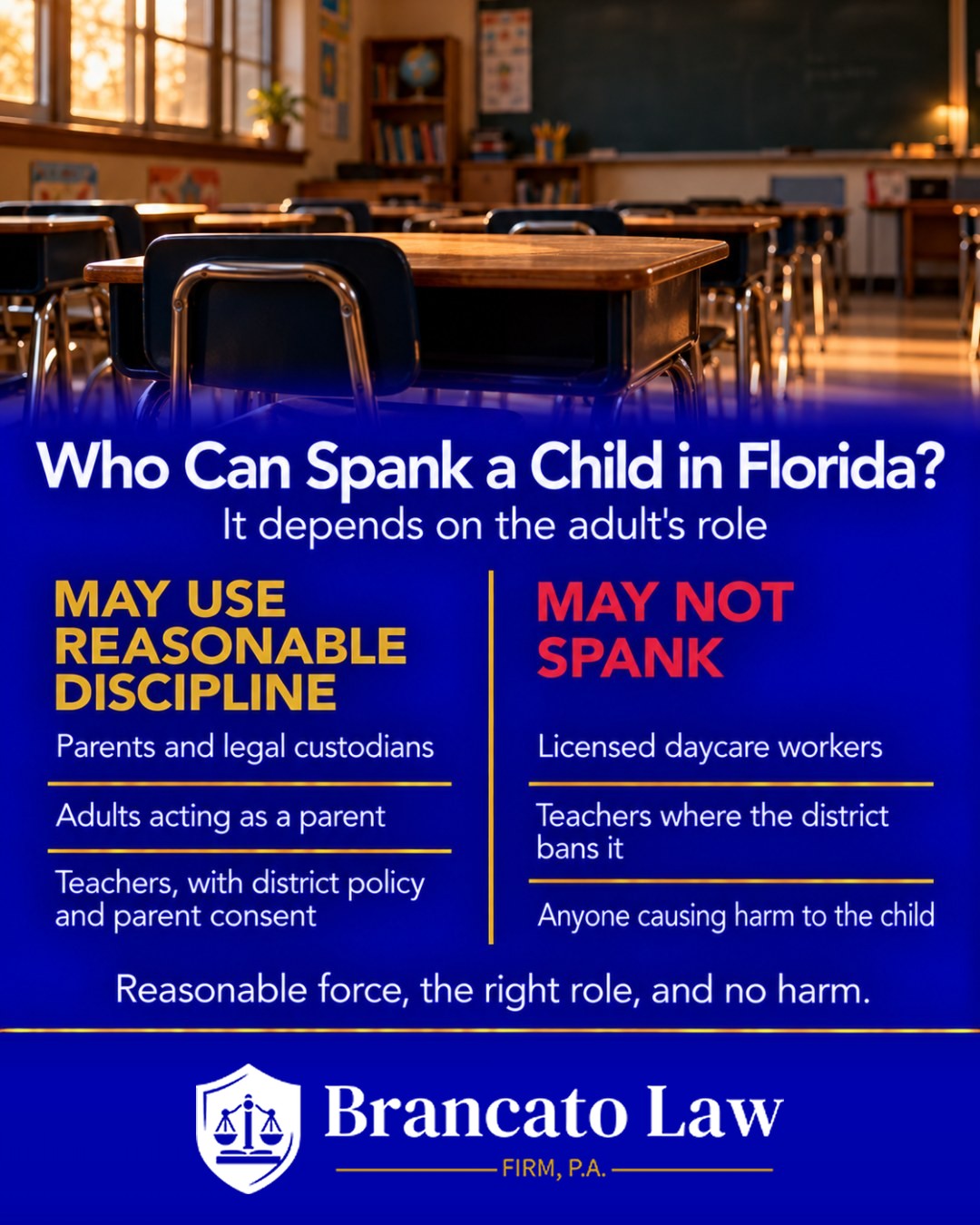
Stepparents, guardians, and teachers can sometimes use the parental discipline defense in Florida, but licensed daycares cannot spank at all. The rule depends on who the adult is and what role they hold over the child.
| Adult | Can they use corporal punishment? | Source |
|---|---|---|
| Parent or legal custodian | Yes, if reasonable and it does not harm the child | § 39.01(2); Raford |
| Stepparent, live-in partner, grandparent, or guardian acting as a parent | Possibly, if the adult stands in loco parentis (in the place of a parent); Raford discussed the defense for a parent or a person standing in loco parentis, in a case involving a man who disciplined his girlfriend’s child | Raford |
| Public school teacher or principal | Only if the school district’s policy allows it, the principal has approved it in principle, another adult is present, and the parent has given consent | § 1003.32(1)(k); § 1002.20(4)(c) |
| Teacher or aide acting in loco parentis | Non-abusive physical discipline is privileged against a battery charge | Morris |
| Licensed child care facility | No. “Spanking or any other form of physical punishment is prohibited.” | § 402.305(12)(a)3 |
Can teachers hit students in Florida?
Florida teachers can paddle students only where the district school board’s policy authorizes corporal punishment, and Florida law now requires that policy to include parental consent. Under section 1002.20(4)(c), a district that allows corporal punishment must require a parent’s consent, either for the school year or before each paddling, and must review the policy every three years at a public board meeting. In Morris v. State, 228 So. 3d 670 (Fla. 1st DCA 2017), a teacher’s aide in Pensacola was acquitted of child abuse but convicted of battery after disciplining a combative pre-kindergarten student; the First District reversed and ordered an acquittal, holding that teachers stand in loco parentis and that non-abusive discipline is privileged. A school policy violation can still cost a teacher a job and a certificate, which our post on what happens when a Florida teacher is arrested covers in detail.
How often do DCF child abuse investigations end in a verified finding?
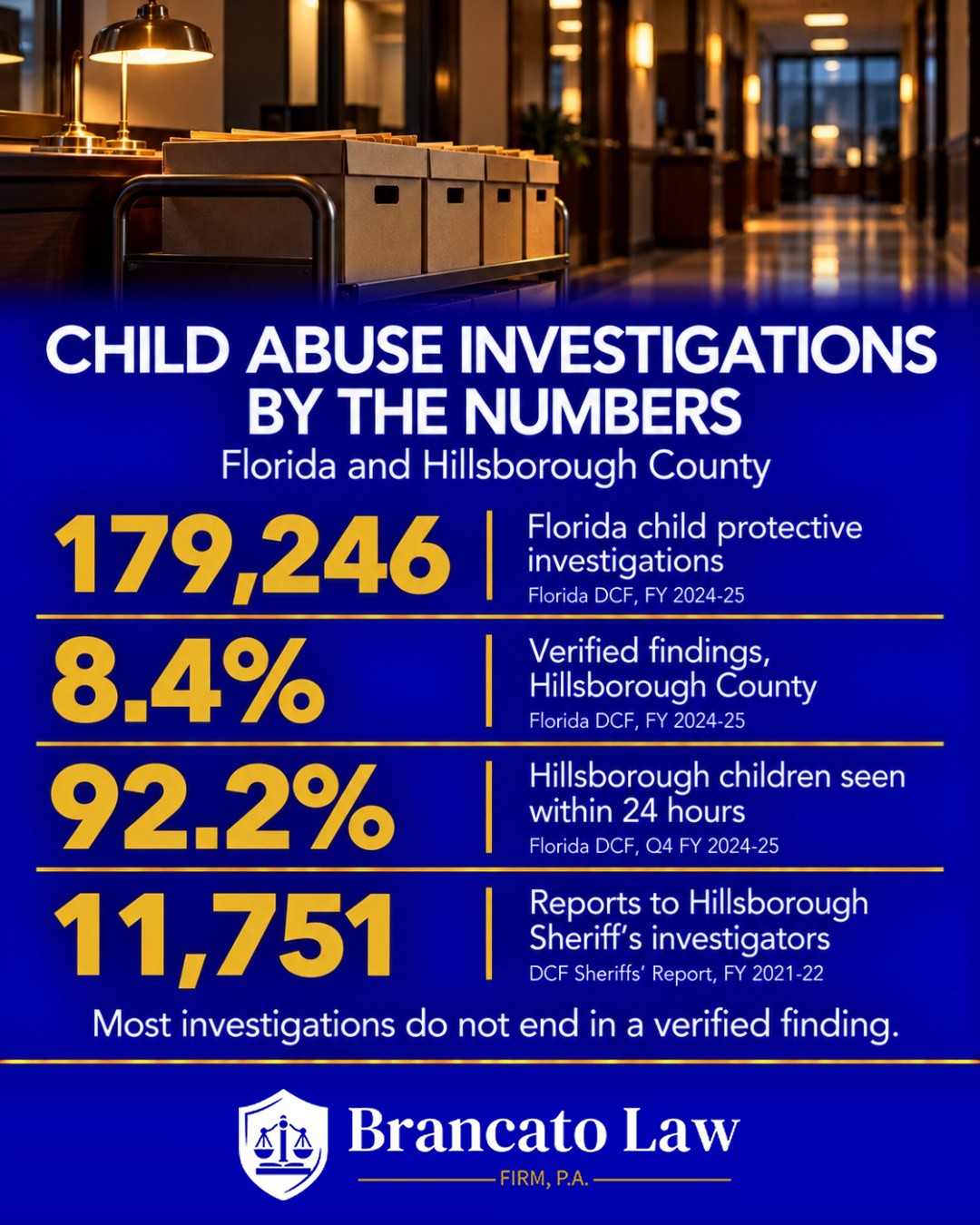
Most DCF investigations in Florida do not end with a verified finding of abuse. Until July 14, 2023, the Hillsborough County Sheriff’s Office ran child protective investigations in the county, and in fiscal year 2021-2022 it received 11,751 child and special condition reports, according to the Florida Sheriffs Performing Child Protective Investigations Annual Program Performance Evaluation Report, Fiscal Year 2021-2022. On July 14, 2023, DCF took over those investigations in Hillsborough County, as the Sheriff’s Office announced in July 2023.
DCF conducted 179,246 child protective investigations across Florida in state fiscal year 2024-2025, according to its Results-Oriented Accountability 2025 Annual Performance Report. The same report shows that only 8.4% of investigations ended with a most serious finding of “verified,” both statewide and in the Thirteenth Judicial Circuit, which is Hillsborough County. In Circuit 13, that rate fell from 15.9% in state fiscal year 2021-2022 to 8.4% in state fiscal year 2024-2025.
Those numbers matter to a parent because an investigation is not a finding. A spanking report starts a process with a predictable sequence: a hotline call, a home visit, photographs, interviews with the child, and often a medical exam. How a parent handles that process often decides whether the case closes with no further action or moves to the State Attorney’s Office, and our firm steps in at that stage through representation before charges are filed.
The law and the research on spanking point in different directions. A 2016 meta-analysis published in the Journal of Family Psychology by Elizabeth Gershoff of the University of Texas at Austin and Andrew Grogan-Kaylor of the University of Michigan, covering five decades of research on more than 160,000 children, found spanking significantly linked with 13 of 17 detrimental outcomes, as the University of Texas reported in 2016. Florida’s Legislature has kept reasonable spanking legal anyway, so the legal question in any case remains whether the discipline was reasonable and caused no harm.
What happens when DCF or the police investigate a spanking in Hillsborough County?
A spanking report in Hillsborough County often triggers two investigations at once: a DCF child protective investigation and, when injuries are reported, a criminal investigation by the Tampa Police Department or the Hillsborough County Sheriff’s Office. Teachers, doctors, and daycare workers who call the Florida Abuse Hotline must give their names under section 39.201, Florida Statutes, and any person who knows or has reasonable cause to suspect abuse by a parent is required to report it.
In the Hillsborough County cases our firm handles, the medical opinion usually comes from a Child Protection Team physician who examines the child at the request of DCF or law enforcement, and the DCF investigator, the Child Protection Team, and the detective share what they learn. Investigations often last weeks before the State Attorney’s Office decides whether to file charges in the Hillsborough County courts. During that window, what a parent says to an investigator can become the central evidence in the criminal case, and conversations with some professionals may not be as confidential as parents assume, as our post on privileged communication in Florida child abuse cases explains.
| Do | Avoid |
|---|---|
| Stay calm and polite with the investigator or detective | Explaining or justifying the discipline before you speak with a lawyer |
| Say you want to speak with a lawyer before any interview | Signing a safety plan or written statement you do not fully understand |
| Write down names, dates, and what was said at each contact | Coaching the child or discussing the allegation with the child |
| Keep texts, school records, and medical records that show the child’s history | Posting about the investigation on social media |
| Call a criminal defense lawyer before the case is referred to the State Attorney | Assuming the case is over because DCF closed its file |
Some discipline investigations widen into claims that a child lacked needed care or supervision, which Florida charges as child neglect; our post on child neglect charges in Tampa covers those cases.
How fast does DCF act after a spanking report, and why does timing matter?
DCF usually reaches the child within a day of a spanking report, so the time to get a lawyer involved is before the first interview. In the last quarter of state fiscal year 2024-2025, DCF reported that 92.2% of alleged child victims in Circuit 13 were seen within 24 hours, against a department target of 90% or higher, according to the same 2025 DCF performance report. That means photographs and the child’s first statement are often taken before a parent has spoken with anyone.
Our attorneys use that early window to collect evidence for the defense: the child’s pediatric records, prior injuries with innocent explanations, witnesses to the misbehavior, and, when needed, an independent medical review of the Child Protection Team findings. We then present that information to the investigator or the assigned prosecutor before a charging decision is made.
Results in child abuse cases
Our firm’s published results in child abuse cases include the following. Past results do not guarantee future outcomes.
| Charge | Outcome |
|---|---|
| Aggravated child abuse | Charge reduced to misdemeanor battery with probation after a psychiatrist linked the conduct to the client’s medical condition |
| Aggravated child abuse | Charges dismissed after a forensic pathologist traced the child’s injury to a congenital choledochal cyst |
Frequently asked questions about spanking and Florida law
Can you go to jail for spanking your child in Florida?
You can go to jail for spanking your child in Florida only if the discipline was excessive and the State proves a crime such as battery, child abuse, or aggravated child abuse. The Brancato Law Firm defends parents charged under section 827.03 by testing every element, starting with whether the injuries meet the statute’s definition of harm, and you can read more about our approach to defending parents accused of child abuse.
Does Florida law allow a daycare to spank my child if I give permission?
No, Florida law does not allow a licensed daycare to spank a child, even with a parent’s permission. Our attorneys at The Brancato Law Firm point to section 402.305(12)(a)3, Florida Statutes, which states that spanking or any other form of physical punishment is prohibited in licensed child care facilities, with no parental-consent exception.
Can a stepparent or grandparent spank a child in Florida?
A stepparent or grandparent may be able to use the parental discipline defense in Florida if they stand in loco parentis, meaning they actually act as a parent to the child. When The Brancato Law Firm represents a stepparent or relative, we document the adult’s day-to-day parenting role, because the defense depends on showing that the adult actually acted as a parent.
Can child abuse charges from spanking be dropped in Florida?
Yes, child abuse charges from spanking can be dropped or reduced in Florida when the evidence shows reasonable discipline, injuries below the statutory threshold, or weak medical proof. The Brancato Law Firm works to resolve these cases before charges are filed whenever possible through our pre-file advocacy, and after filing we press for dismissal or a reduction to a misdemeanor.
Will DCF take my child because a spanking left a mark?
A single mark from a spanking does not automatically lead DCF to remove a child, because section 39.01(2) protects corporal discipline that does not harm the child. The Brancato Law Firm advises parents to treat any DCF contact as serious, since significant bruises or welts are listed in section 39.01(37)(a)4 and can support both a dependency case and a criminal referral.
Should I talk to a DCF investigator about a spanking without a lawyer?
You should speak with a lawyer before giving a DCF investigator or detective a detailed account of a spanking, because those statements can be used in a criminal case. Our attorneys at The Brancato Law Firm can speak with the investigator for you and help you decide what, if anything, to say.
¿Es ilegal pegarle a sus hijos en Florida?
No, en Florida no es ilegal dar una nalgada razonable a un hijo, pero el castigo físico que causa moretones o verdugones significativos, cortes o quemaduras puede llevar a una investigación del DCF y a cargos de abuso infantil. The Brancato Law Firm tiene personal que habla español, y el abogado Jean-Luc Adrien habla español, criollo haitiano y francés; lea más sobre nuestros servicios de defensa penal en español.
Talk to our attorneys before you talk to DCF
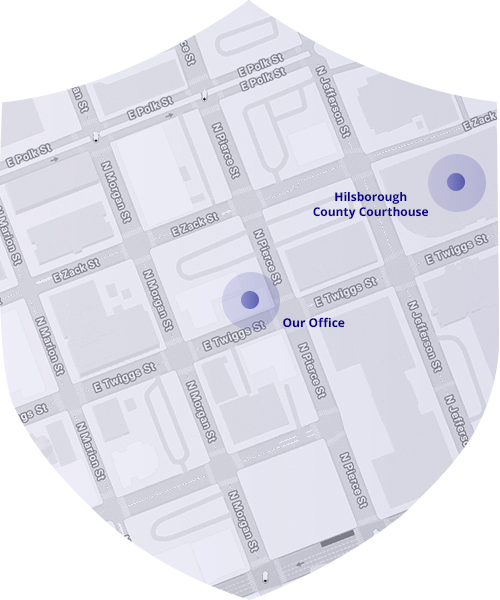
Before you sit down with a DCF investigator or a detective about a spanking, call our firm so an attorney can review the facts and handle that conversation with you. The Brancato Law Firm, P.A., founded by Tampa Criminal Defense Attorney Rocky Brancato, defends parents, stepparents, and teachers in child abuse investigations across Hillsborough, Pinellas, and Pasco Counties. Call (813) 727-7159 for a confidential consultation; DCF often sees the child within 24 hours, and the earlier we are involved, the more we can shape what investigators and prosecutors see. You can call us at any hour, and our office is two blocks from the courthouse. Our firm has Spanish-speaking staff, and attorney Jean-Luc Adrien speaks Spanish, Haitian Creole, and French. Read about our Spanish and Haitian Creole criminal defense services.
For more about our defense strategies, visit our Child Abuse Defense page.
The Brancato Law Firm, P.A.
620 E. Twiggs Street, Suite 205, Tampa, FL 33602
(813) 727-7159
Serving Hillsborough, Pinellas, and Pasco Counties
The Brancato Law Firm, P.A. is a Tampa-based criminal defense practice. We are not affiliated with any other Brancato-named law firms.
Visit Us

Tampa, FL 33602
Contact Us Now
Free Legal Consultation (813) 727-7159