- Free Consultation 24/7: (813) 727-7159 Tap Here To Call Us


From First DUI to Death Penalty



What Is the Junny Rios-Martinez Act in Florida? (2026)


Rewrite/update date: November 1, 2026. Originally published in June 2025.
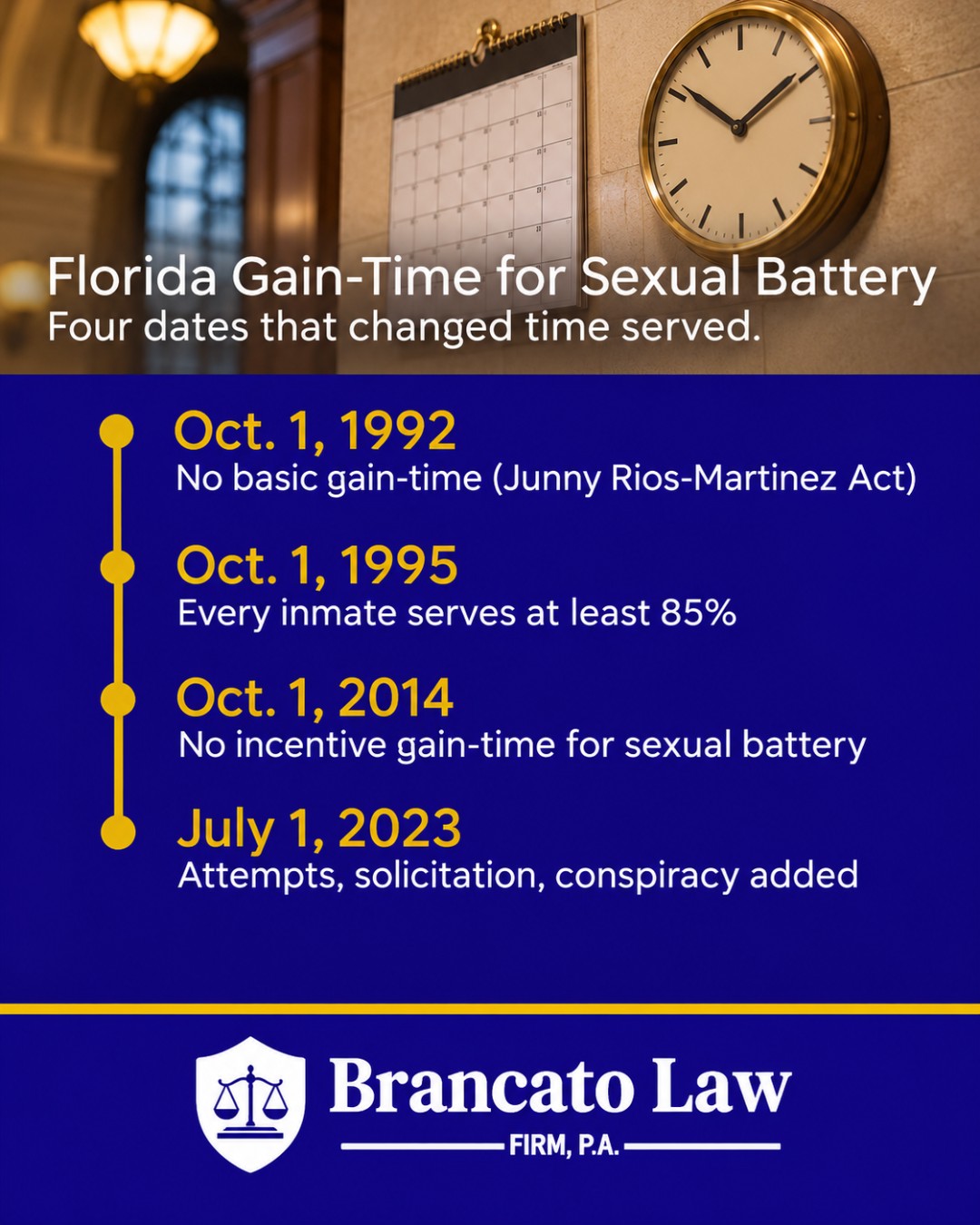
| The Junny Rios-Martinez, Jr. Act of 1992 is the part of Florida’s sexual battery statute, section 794.011(7), Florida Statutes, that makes anyone convicted of sexual battery committed on or after October 1, 1992, ineligible for basic gain-time. Since July 1, 2023, it also covers attempted, solicited, and conspired sexual battery. Today the bigger practical rule is in section 944.275, Florida Statutes: for sexual battery committed on or after October 1, 2014, the prison system may not award incentive gain-time either, so most of these sentences are served close to day for day. |
The statute number written on a plea form can decide whether a person serves 85% of a prison sentence or nearly all of it. I’m Rocky Brancato, founder of The Brancato Law Firm, P.A., a Tampa criminal defense firm, and I handled sex crimes, homicide, and child abuse cases in the Major Crimes Unit before spending more than 25 years in Hillsborough County courtrooms. Our attorneys look at the gain-time consequences of every charge and every plea offer before a client decides anything.
What Is the Junny Rios-Martinez, Jr. Act?
The Junny Rios-Martinez, Jr. Act is the name of subsection (7) of Florida’s sexual battery statute. It says a person convicted of committing a sexual battery on or after October 1, 1992, “is not eligible for basic gain-time,” and a 2023 amendment extended that rule to attempts, solicitations, and conspiracies committed on or after July 1, 2023. Our attorneys at The Brancato Law Firm explain this law to clients because its name comes up in plea discussions, but its real effect today depends on other gain-time rules.
The law is named for an 11-year-old Brevard County boy. According to the federal appeals court opinion in Schwab v. Crosby, 451 F.3d 1308 (11th Cir. 2006), Mark Dean Schwab received an eight-year prison sentence for sexual battery in 1988 but was released on probation in early March 1991, about three years into that sentence. On April 18, 1991, Junny Rios-Martinez left for his sixth-grade class and never came home. Schwab was convicted of his murder and was later executed. In 1992, the Legislature cut off basic gain-time for sexual battery and named the law after him.
Do You Serve 100% of a Sexual Battery Sentence in Florida?
Close to it, for offenses committed on or after October 1, 2014. Florida prison sentences earn time off only through gain-time, and a person convicted of sexual battery today cannot earn the two ordinary kinds: basic gain-time is barred by the Junny Rios-Martinez Act, and incentive gain-time is barred by section 944.275, Florida Statutes. Our attorneys at The Brancato Law Firm treat a sexual battery prison sentence as a sentence that will be served in full when we evaluate any plea offer.
Here is why the Junny Rios-Martinez Act alone no longer drives the result. Florida stopped applying basic gain-time to all offenses committed on or after January 1, 1994. For offenses committed on or after October 1, 1995, every Florida prisoner must serve at least 85% of the sentence imposed, and the only common way to reach that 85% floor is incentive gain-time of up to 10 days per month. Section 944.275 then takes incentive gain-time away for sexual battery committed on or after October 1, 2014, with one narrow statutory exception.
| Date of the offense | Basic gain-time | Incentive gain-time | Practical result |
|---|---|---|---|
| October 1, 1992 to December 31, 1993 | Barred by the Junny Rios-Martinez Act | Available under the law at the time | Earlier release still possible |
| January 1, 1994 to September 30, 1995 | Abolished for all offenses | Available | Earlier release still possible |
| October 1, 1995 to September 30, 2014 | Abolished for all offenses | Up to 10 days per month | Minimum 85% of the sentence |
| October 1, 2014 to June 30, 2023 | Abolished for all offenses | Barred for sexual battery | Served close to day for day |
| July 1, 2023 and later | Abolished; Act now also names attempts, solicitation, conspiracy | Barred for sexual battery and attempts, solicitation, conspiracy | Served close to day for day |
For an attempted sexual battery committed before July 1, 2023, the 85% rule usually controls, because both gain-time bars were written for completed offenses until the 2023 amendment. Our attorneys check the offense date in the charging document first, because the date decides which rule applies.
Which Sex Offenses Lose Incentive Gain-Time in Florida?
For offenses committed on or after October 1, 2014, section 944.275 bars incentive gain-time for sexual battery under section 794.011 (with one narrow exception), lewd or lascivious offenses under section 800.04, lewd or lascivious offenses against an elderly or disabled person under section 825.1025, certain computer solicitation offenses under section 847.0135(5), and specified kidnapping, false imprisonment, and murder provisions tied to sexual offenses. The Brancato Law Firm compares every proposed plea charge against that list, because a plea that avoids “sexual battery” but lands on a listed lewd or lascivious count does not change how much of the sentence is served.
| Possible charge or plea | Incentive gain-time (offense on or after Oct. 1, 2014) | Sex offender registration |
|---|---|---|
| Sexual battery, section 794.011 | Barred | Required |
| Lewd or lascivious offense, section 800.04 | Barred | Required |
| Unlawful sexual activity with certain minors, section 794.05 | Not on the barred list (85% rule applies) | Required |
| Battery or aggravated battery without a sexual element | Not on the barred list (85% rule applies) | Not required for that conviction |
| Probation or a non-prison sentence | No prison gain-time issue | Depends on the offense of conviction |
That is why the old advice that “lewd or lascivious” avoids the harshest sentencing rule is out of date. Our post on unlawful sexual activity with a minor under section 794.05 explains one charge that sits outside the incentive gain-time bar but still carries registration.
What Happens After a Sexual Battery Sentence Is Served?
Release from prison is rarely the end of the case. A sexual battery conviction brings lifetime registration in most cases, possible sex offender probation, and a screening for civil commitment under the Jimmy Ryce Act before release. The Brancato Law Firm plans for those consequences at the charging stage, because the plea that shortens a sentence can still lock in decades of supervision.
The numbers show how long those consequences last. As of October 2024, Florida’s sex offender registry listed 86,207 people, and 20,742 of them were confined, including people in prison and people civilly committed, according to the Florida Office of Program Policy Analysis and Government Accountability (OPPAGA). The same report counted 1,999 registered sex offenders living in the community in Hillsborough County in 2024.
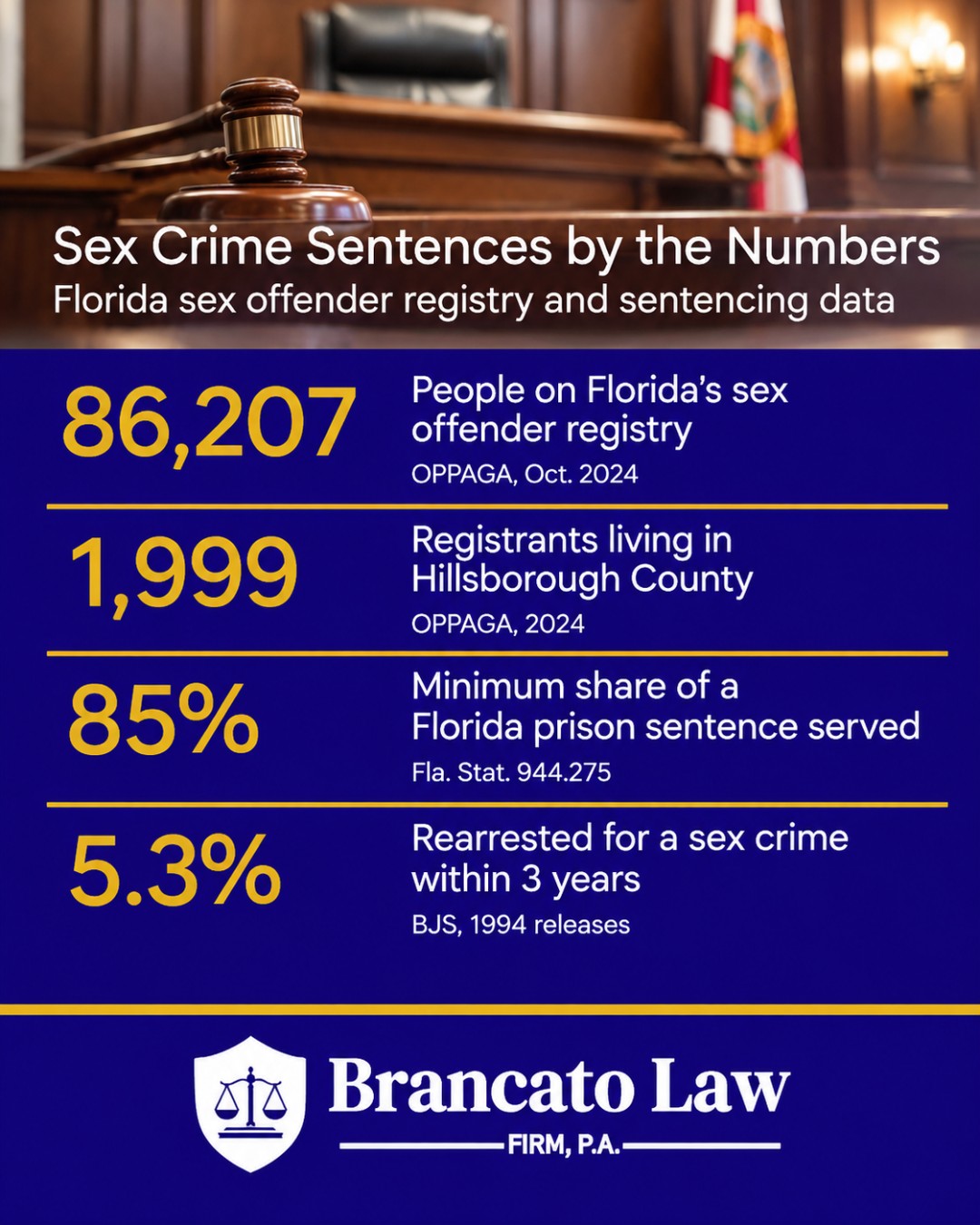
Policy has moved toward longer prison terms even though the national research on reoffending is more mixed than the public assumes. A Bureau of Justice Statistics study of nearly 9,700 sex offenders released from state prisons in 15 states in 1994 found that 5.3% were rearrested for a new sex crime within 3 years. The same study found sex offenders were about four times more likely than non-sex offenders to be arrested for another sex crime. Our attorneys use that kind of data carefully at sentencing, where a judge decides how much prison is necessary in the first place.
| Consequence | Where it comes from | When it starts |
|---|---|---|
| No basic gain-time | Section 794.011(7), the Junny Rios-Martinez Act | At sentencing (offenses on or after Oct. 1, 1992) |
| No incentive gain-time | Section 944.275 | At sentencing (offenses on or after Oct. 1, 2014) |
| Sex offender registration | Florida registration statutes | At release or sentencing |
| Civil commitment screening | Jimmy Ryce Act | Before release from prison |
| Sex offender probation conditions | Florida probation statutes | If probation follows prison |
We cover each of these in more depth in our guides to sex offender registration in Florida, fighting Jimmy Ryce civil commitment, and sex offender probation rules.
How Do Our Attorneys Defend Against a Sentence With No Gain-Time?
Our attorneys defend these cases on the assumption that any prison term will be served almost in full, so the work focuses on the charge itself, the offense date, and the charge of any plea. As a Tampa sex crimes lawyer team, The Brancato Law Firm follows five steps:
- Fight the charge. We test the evidence, the forensic findings, and the accuser’s statements, because an acquittal or dismissal avoids every consequence on this page.
- Confirm the offense date. The date decides whether the Junny Rios-Martinez Act, the 85% rule, or the 2014 incentive gain-time bar applies.
- Read the plea charge against the statute. We check whether a proposed plea lands on a statute listed in section 944.275 before advising a client to accept it.
- Count real time, not paper time. We explain to clients and families how much of any proposed sentence will actually be served, including jail credit.
- Plan for after release. We address registration, probation conditions, and civil commitment exposure as part of the same negotiation.
Many sexual battery investigations start months before an arrest. When detectives call or a controlled call is suspected, representation before charges are filed gives our attorneys a chance to shape the charging decision before a sexual battery count is ever filed.
Why Should You Talk to a Lawyer Before Discussing a Plea?
Because the gain-time consequences are fixed by the statute of conviction, and they cannot be fixed after the plea is entered. A plea offer that sounds shorter on paper can mean more real time in prison than a longer sentence on a different charge. The Brancato Law Firm runs those numbers before any plea discussion with the State Attorney’s Office, and we advise families on the real release date, not the headline number.
Frequently Asked Questions About the Junny Rios-Martinez Act
Does the Junny Rios-Martinez Act apply to lewd or lascivious charges?
No. The Act applies only to sexual battery under section 794.011, but lewd or lascivious offenses under section 800.04 committed on or after October 1, 2014, lose incentive gain-time under section 944.275 anyway. Our attorneys at The Brancato Law Firm check both statutes before telling a client how much of a sentence will be served.
Does the Junny Rios-Martinez Act apply to attempted sexual battery?
Yes, for offenses committed on or after July 1, 2023, when the Legislature added attempts, solicitations, and conspiracies. For older attempt cases, The Brancato Law Firm reviews the offense date closely, because the 85% rule may control instead.
Can you get out early on a Florida sexual battery sentence for good behavior?
Generally no, for sexual battery committed on or after October 1, 2014, because incentive gain-time, Florida’s main good-behavior credit, is barred. The Brancato Law Firm makes sure clients get every day of jail credit the law allows, since credit for time already served still counts against the sentence.
Can sexual battery charges be dropped or reduced in Florida?
Yes. Prosecutors dismiss or reduce sexual battery charges when the evidence does not hold up, when the accuser’s account changes, or when the defense shows a lesser charge fits the facts better. Our attorneys at The Brancato Law Firm build that case for the State Attorney’s Office early, and our sex crimes defense practice handles these negotiations in Hillsborough, Pinellas, and Pasco Counties.
Does a sexual battery conviction mean civil commitment after prison?
Not automatically. A person convicted of a sexually violent offense is screened before release, and the State must prove in a separate proceeding that the person meets the Jimmy Ryce Act criteria. The Brancato Law Firm explains that process in our guide to fighting Jimmy Ryce civil commitment.
Is the Junny Rios-Martinez Act a mandatory minimum sentence?
No. The Act does not set a minimum prison term; it controls how much of whatever sentence the judge imposes will be served. Our attorneys at The Brancato Law Firm address both questions separately, first the sentence length under the scoresheet and then how much of it the client will actually serve.
Talk to Our Attorneys Before Any Plea Discussion
Before you or a loved one discusses any plea on a sexual battery charge, call The Brancato Law Firm, P.A. at (813) 727-7159. Founded by Tampa Criminal Defense Attorney Rocky Brancato, our firm reviews the offense date, the charge, and every plea option for its real-time consequences, and you can call us at any hour. Our firm has Spanish-speaking staff, and attorney Jean-Luc Adrien speaks Spanish, Haitian Creole, and French. Read our guide for criminal defense in Spanish and Haitian Creole in Tampa.

For more about our defense strategies, visit our Sex Crimes Defense page.
The Brancato Law Firm, P.A.
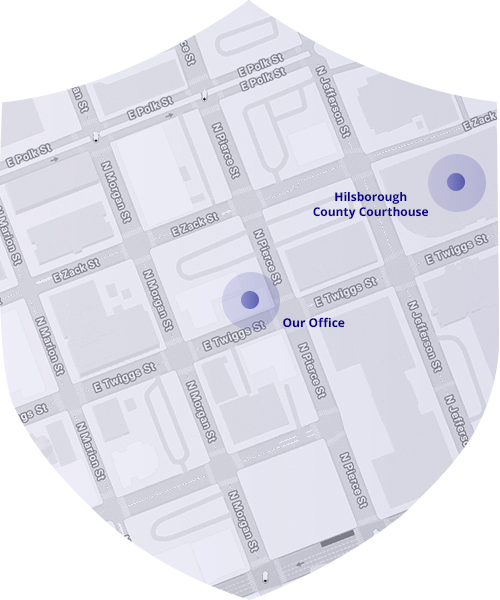
620 E. Twiggs Street, Suite 205, Tampa, FL 33602
(813) 727-7159
Serving Hillsborough, Pinellas, and Pasco Counties
The Brancato Law Firm, P.A. is a Tampa-based criminal defense practice. We are not affiliated with any other Brancato-named law firms.
Visit Us
Tampa, FL 33602
Contact Us Now
Free Legal Consultation (813) 727-7159