- Free Consultation 24/7: (813) 727-7159 Tap Here To Call Us


From First DUI to Death Penalty


Can You Get a Continuance in a Florida Criminal Case? (2026)


Rewrite/update date: November 2, 2026. Originally published in April 2025.
| Yes. A Florida judge may grant a continuance, meaning a postponement of a hearing or trial, on a motion by the defense or the State when there is good cause, such as new evidence, a missing witness, or counsel who needs time to prepare. The decision is discretionary, but an appeals court will reverse a conviction when denying a continuance caused undue prejudice, as the Second District did in a 2025 Pasco County case where the defendant’s only expert could not appear. A defense continuance usually waives the speedy trial deadlines, so it is a strategic choice. |
A Florida judge deciding whether to postpone a trial asks one practical question: will the defense be unfairly hurt if the case goes forward today? I have argued that question for more than 25 years in Hillsborough County courtrooms, including more than 150 jury trials to verdict, first in public defense and now as founder of The Brancato Law Firm, P.A., a Tampa criminal defense firm. Our attorneys ask for more time when the case needs it, oppose delay when the State is not ready, and build the record so a wrongly denied continuance can be fixed on appeal.
What is a continuance in a Florida criminal case?
A continuance is the postponement of a hearing or trial to a later date. Florida Rule of Criminal Procedure 3.190 defines it as “the postponement of a cause for any period of time” and allows the court to grant one on motion of the State, the defense, or on its own motion “for good cause shown.” The rule requires the motion to be made before or when the case is set for trial unless the reason arose later, and it must include counsel’s certificate that the motion is made in good faith.
Continuances are routine. Most felony cases are reset several times while discovery, depositions, and plea negotiations proceed. The fight comes at trial, when one side is ready and the other is not.
What are good reasons for a continuance?
Good cause is any reason that makes going forward unfair or impossible. The 13th Judicial Circuit’s standard motion for continuance form for Hillsborough County lists the grounds judges see most often:
- Defense counsel needs more time to prepare or investigate
- Illness of a witness, a party, or the attorney
- A witness or attorney is unavailable
- The other side disclosed evidence late
- A witness or the alleged victim could not be deposed
- A question about the defendant’s competency to proceed
- New counsel was appointed or retained
In our experience, judges in the 13th Circuit weigh how old the case is, how many times it has been continued, and whether the request is made early or on the morning of trial. When a defendant moves for the continuance, the Hillsborough form requires counsel to state that the client was consulted, has no objection, and understands that speedy trial is waived if the motion is granted. Our attorneys explain that trade-off to every client before we sign it.
Does asking for a continuance waive speedy trial in Florida?
Usually, yes. Under Florida Rule of Criminal Procedure 3.191, the State must try a misdemeanor within 90 days and a felony within 175 days of formal charging, but a defense continuance generally waives those periods. In State v. Naveira, 873 So. 2d 300 (Fla. 2004), the Florida Supreme Court held that a defendant who asked for a continuance during the recapture period could not then be discharged, quoting the rule that a defense request for continuance, absent State misconduct or discovery violations, “waives the 175 day ‘speedy trial’ time.”
The constitutional right to a speedy trial survives a continuance, but it is harder to win. Section 918.015, Florida Statutes gives both the State and the defendant the right to a speedy trial. Our guide to how speedy trial works in Florida explains the 2025 rule change and how the notice of expiration works.
| Who asks for the continuance | Effect on speedy trial deadlines | What our attorneys watch for |
|---|---|---|
| Defense | Usually waives the Rule 3.191 periods | Whether the delay is caused by the State’s late discovery, which can preserve the client’s rights |
| State | Does not waive the defense’s speedy trial rights | Whether the State’s reason is good cause, and whether the clock keeps running |
| Court on its own motion | Depends on the reason and the record | Making a record that the defense was ready |
| Joint request | Treated as a defense waiver in most cases | Whether the client truly benefits from the delay |
When does a denied continuance get a conviction reversed?
A conviction is reversed when the record shows a palpable abuse of discretion that caused the defendant undue prejudice. When the request involves a missing witness, Florida courts require the defense to show prior due diligence to get the witness there, that the testimony would be substantially favorable, that the witness was available and willing, and that denying the continuance caused material prejudice.
In Surratt v. State, 407 So. 3d 1270 (Fla. 2d DCA 2025), a Pasco County woman charged with aggravated child abuse relied on one witness, a board-certified radiologist who would testify that an undiagnosed bone disease, not abuse, explained the child’s injuries. On the morning of trial, the expert would not fly in from California. The judge refused to let her testify remotely and refused a continuance, the jury convicted, and the court imposed 30 years in prison. The Second District reversed, finding the expert’s testimony “critical to her defense” and the denial unduly prejudicial. Our Tampa child abuse attorney page describes how our firm uses medical experts in these cases.
Late changes by the State can also require a continuance. In Turner v. State, 311 So. 3d 185 (Fla. 2d DCA 2020), a Sarasota County case, the State added a first-degree burglary charge less than a week before trial and listed three new police witnesses. The Second District held that denying a continuance was an abuse of discretion and ordered a new trial on the new charge, because the defense had no fair chance to prepare for different elements and a much higher penalty.
How long do continuances delay a criminal case?
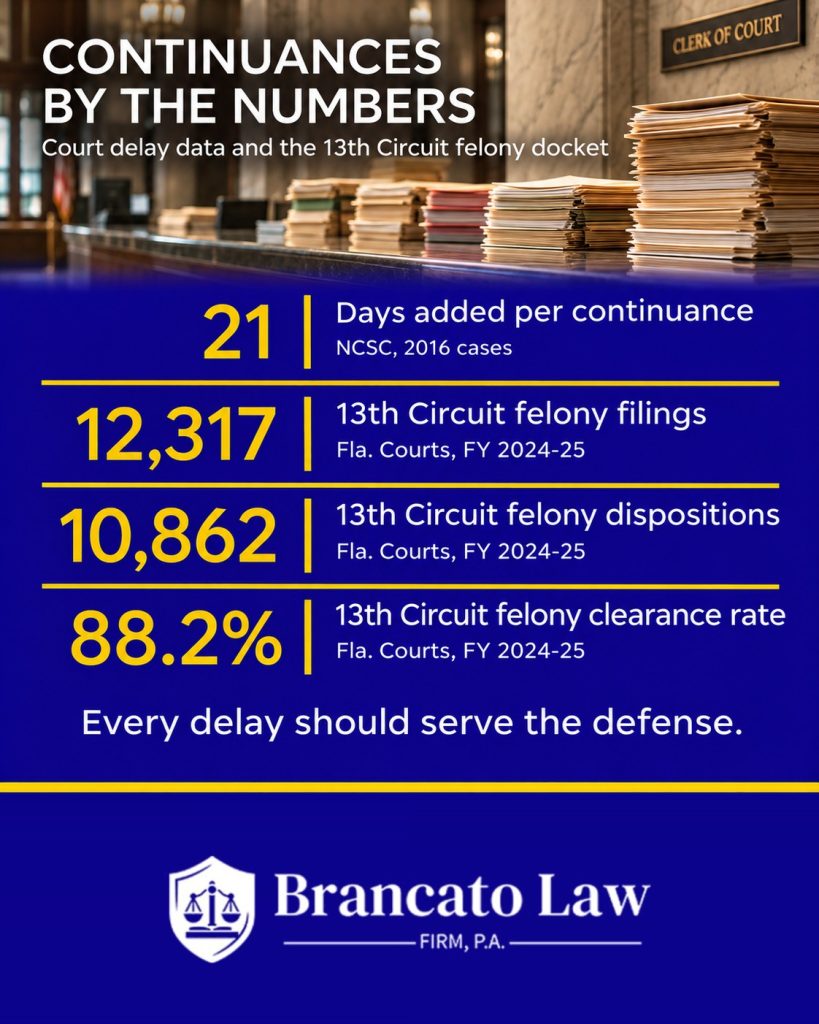
Each continuance adds weeks. A National Center for State Courts study, Brian Ostrom and colleagues’ Timely Justice in Criminal Cases: What the Data Tells Us, examined felony cases from 2016 in 136 courts across 21 states and found that each continuance added about 21 days to a case on average. Continuances and hearings were the main drivers of how long cases took, and faster courts averaged 2.5 continuances per felony disposition compared with 3.2 in slower courts.
Hillsborough County’s docket shows the pressure. The 13th Judicial Circuit received 12,317 felony filings and disposed of 10,862 felony cases in FY 2024-25, a clearance rate of 88.2%, according to the Florida courts’ FY 2024-25 Statistical Reference Guide. Florida’s presumptive time standard is 180 days from arrest to final disposition for a felony and 90 days for a misdemeanor under Rule 2.250 of the Florida Rules of General Practice and Judicial Administration, and many cases exceed it.
Can the alleged victim object to a continuance?
Yes. Marsy’s Law, in Article I, Section 16 of the Florida Constitution, gives crime victims the right to proceedings “free from unreasonable delay, and to a prompt and final conclusion of the case.” Prosecutors often raise it when opposing a defense continuance. Some cases involving children carry an added statutory mandate: under section 918.0155, Florida Statutes, prosecutions for child abuse or sexual offenses involving a child under 16 “shall be heard and disposed of as expeditiously as possible.”
Those rules do not override the defendant’s right to a fair trial. They make the record more important. Our attorneys file a written motion that spells out exactly why the time is needed, what will be done with it, and how the client will be prejudiced without it, so the judge can weigh the victim’s interest against a concrete need.
How do our attorneys handle continuances?
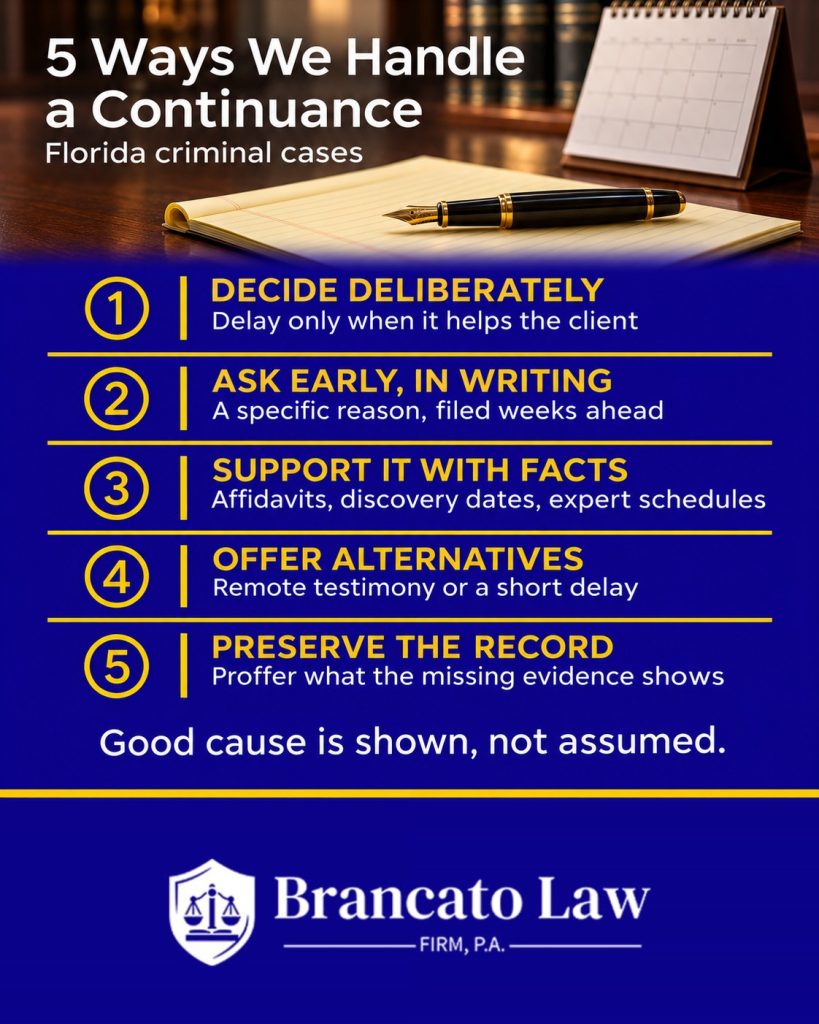
- Decide deliberately. We weigh whether delay helps the client, such as time for an expert or mitigation, or whether pressing for trial puts the State on the clock.
- Ask early and in writing. A motion filed weeks ahead, with a specific reason, is far more likely to be granted than an oral request on the trial date.
- Support it with facts. Affidavits, discovery dates, and expert schedules show good cause.
- Offer alternatives. Remote testimony, a short delay, or a deposition to preserve testimony can save the defense when a full continuance is denied.
- Preserve the record. If the motion is denied, we proffer what the missing evidence would have shown, which is what made reversal possible in cases like Surratt.
Our Hillsborough County criminal defense attorney page explains the local court process, and our guide to expert witnesses in criminal defense explains why expert scheduling is a common reason for continuances.
Frequently asked questions about continuances in Florida criminal cases
How many continuances can you get in a Florida criminal case?
Florida’s rules set no fixed limit, but each request must show good cause, and judges grow less willing as a case ages. The Brancato Law Firm plans each request so the client does not use up the court’s patience before the time is truly needed.
Can I ask for a continuance to hire a new lawyer?
You can, and courts consider whether the request is made in good faith or to delay. A short continuance for newly retained counsel is often granted when the request is prompt. When our attorneys at The Brancato Law Firm take over a case, we tell the court right away what preparation is needed and how long it will take.
What happens if the State is not ready for trial?
The State must show good cause, and a State continuance does not waive the defendant’s speedy trial rights. Our attorneys at The Brancato Law Firm object when the State is unprepared and use the speedy trial clock to press for dismissal or a better resolution, as explained in our speedy trial guide.
Can a judge deny a continuance if my expert witness is unavailable?
A judge can, but the denial may be reversed if the expert was critical, the defense was diligent, and the absence caused real prejudice, as in Surratt v. State, 407 So. 3d 1270 (Fla. 2d DCA 2025). The Brancato Law Firm schedules experts early and asks for remote testimony as a backup to protect that record.
Do I have to be in court for a continuance hearing?
Often your attorney can handle a continuance without you, but some judges require the defendant’s presence, especially when speedy trial is being waived. The Brancato Law Firm tells clients ahead of time whether they need to appear so they never miss a required court date.
Does a continuance mean my case is going badly?
No. Most continuances reflect ordinary preparation, such as depositions, lab results, or plea discussions. Our attorneys at The Brancato Law Firm explain the reason for each reset so clients know exactly where their case stands.
For how this fits into the rest of a case, see our step-by-step guide to what happens in a Florida criminal case.
Get advice before you agree to more time, or less
Before you agree to a continuance, or push for a fast trial, call The Brancato Law Firm, P.A. at (813) 727-7159. We are available 24/7. Tampa Criminal Defense Attorney Rocky Brancato founded the firm, and our attorneys will review your discovery, your speedy trial dates, and your witnesses, then tell you whether time helps or hurts your case. Our firm has Spanish-speaking staff, and attorney Jean-Luc Adrien speaks Spanish, Haitian Creole, and French. Read our guide for criminal defense in Spanish and Haitian Creole in Tampa.

For more about our defense strategies, visit our Hillsborough County criminal defense page.
The Brancato Law Firm, P.A.
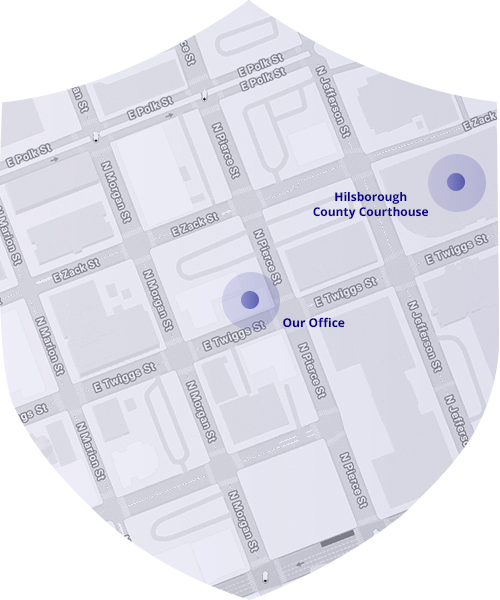
620 E. Twiggs Street, Suite 205, Tampa, FL 33602
(813) 727-7159
Serving Hillsborough, Pinellas, and Pasco Counties
The Brancato Law Firm, P.A. is a Tampa-based criminal defense practice. We are not affiliated with any other Brancato-named law firms.
Visit Us
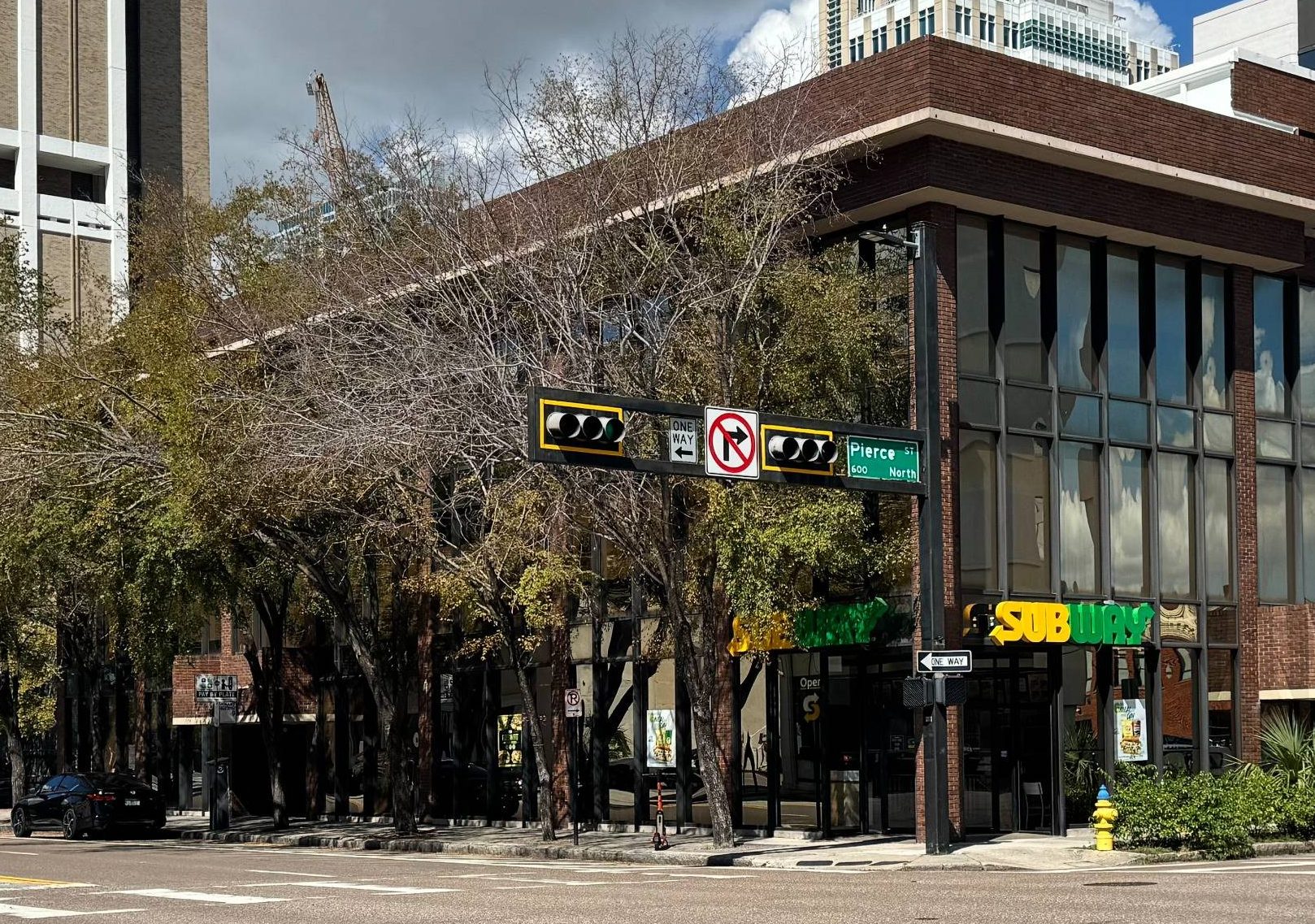
Tampa, FL 33602
Contact Us Now
Free Legal Consultation (813) 727-7159