- Free Consultation 24/7: (813) 727-7159 Tap Here To Call Us


From First DUI to Death Penalty



Is It Legal to Film Police in Tampa, Florida? (2026)


Updated November 8, 2026
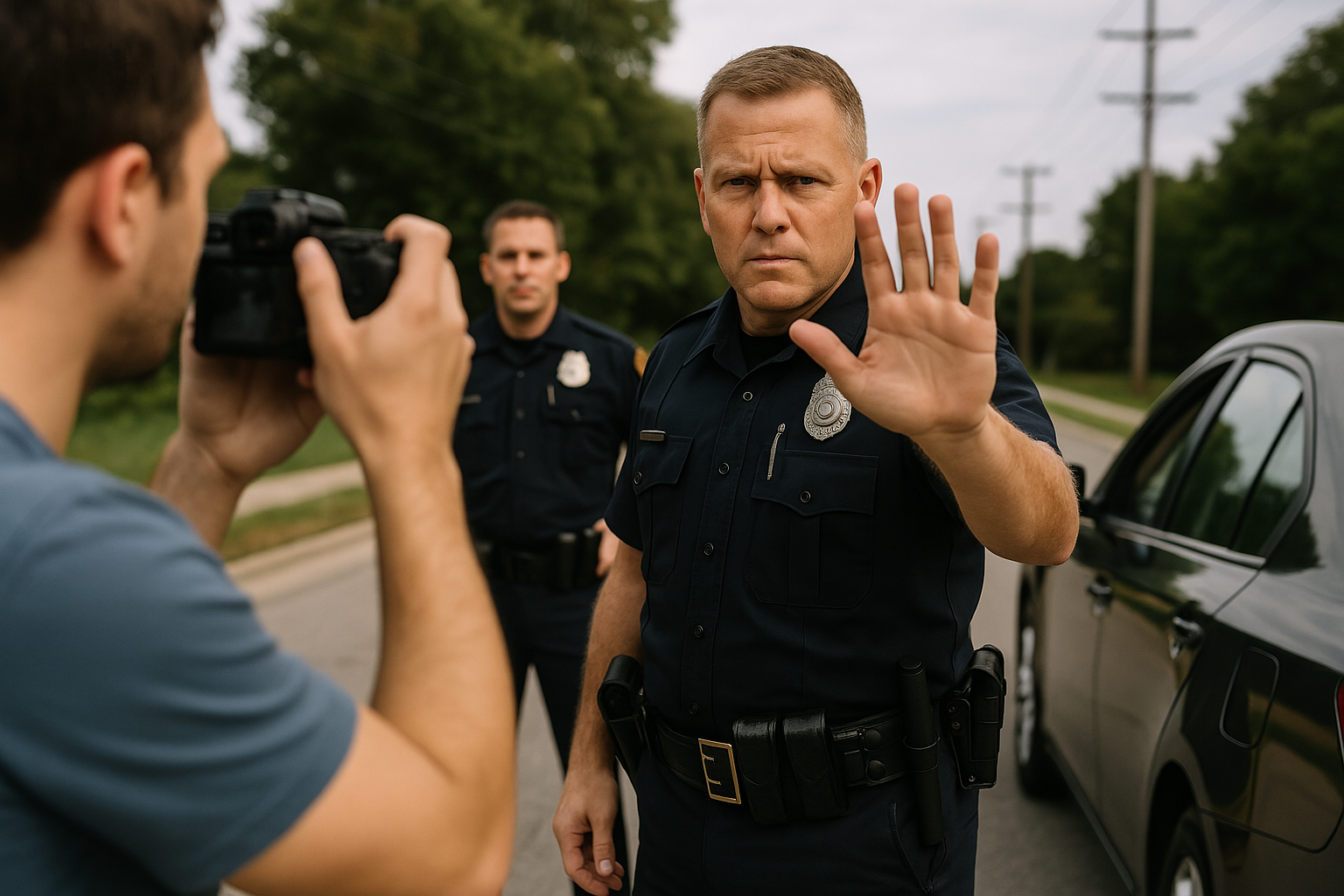
Short answer: Yes. It is legal to film police officers doing their jobs in public in Tampa and the rest of Florida, and the federal appeals court that covers Florida has recognized a First Amendment right to record police conduct, subject to reasonable time, place, and manner limits. Since January 1, 2025, section 843.31, Florida Statutes, makes it a second-degree misdemeanor to stay within 25 feet of a first responder after a verbal warning, but only if you also intend to interfere, threaten, or harass. Recording from a distance, without interfering, remains lawful.
Filming an arrest on your phone is legal, but the way you film it can get you arrested. As a former police academy instructor, a former Chief Operations Officer of the Hillsborough County Public Defender’s Office, where I oversaw a staff of over 100 attorneys, and the founder of The Brancato Law Firm, P.A., a Tampa criminal defense firm, I have seen these encounters from the training side and the defense side. Our attorneys defend people arrested while recording police, and the cases usually turn on distance, warnings, and what the video itself shows.
Is it legal to record police in Tampa?
Yes. In Smith v. City of Cumming, 212 F.3d 1332 (11th Cir. 2000), a Georgia couple sued after police kept Mr. Smith from videotaping officers. The Eleventh Circuit, whose decisions bind federal courts in Florida, held that people have “a First Amendment right, subject to reasonable time, manner and place restrictions, to photograph or videotape police conduct,” though it found the Smiths had not shown the officers violated that right. The right covers sidewalks, streets, parks, and other public places in Tampa and Hillsborough County.
The right has limits. In Crocker v. Beatty, 995 F.3d 1232 (11th Cir. 2021), a driver stopped on the median of I-95 in Martin County to photograph a fatal crash, and a deputy took his phone. The Eleventh Circuit held the deputy had qualified immunity on the First Amendment claim because it was not clearly established that Smith protected photographing from a highway median at a chaotic crash scene. Crocker still won $1,000 from a jury on his separate Fourth Amendment claim over the phone seizure. The lesson: film from a lawful place, and the seizure of your phone can be challenged even when the recording claim fails.
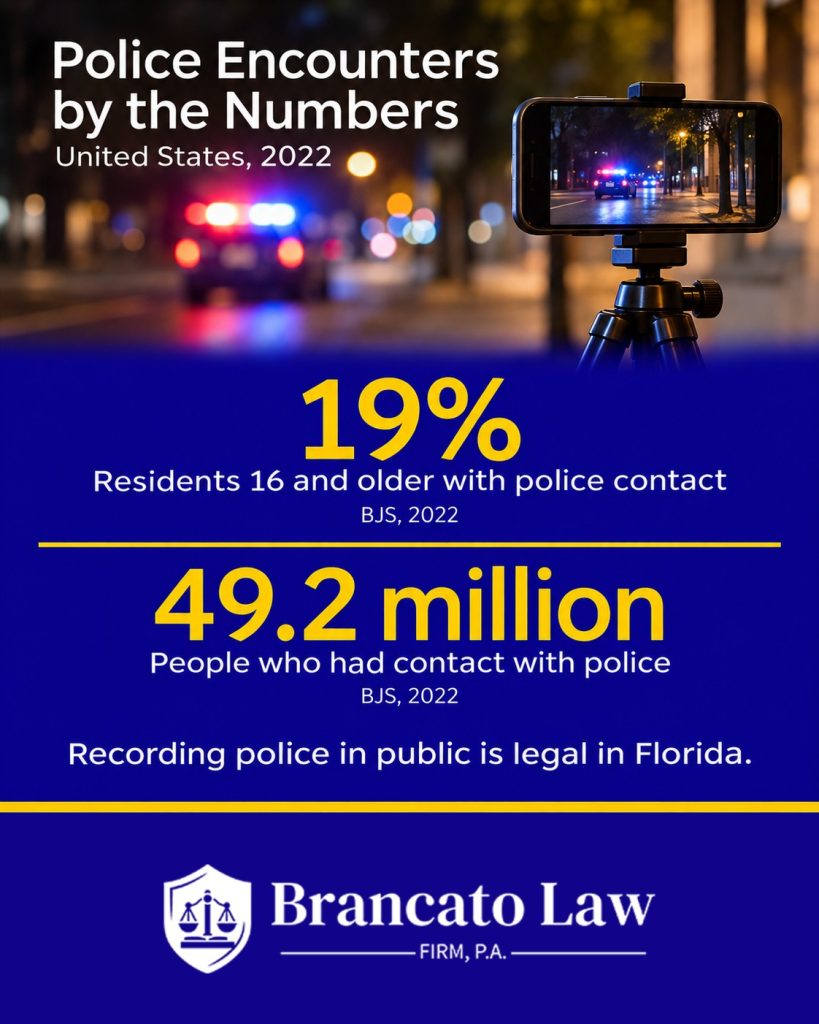
Scholars have tied this right to the role phone video now plays in public debate. Professor Seth F. Kreimer’s article “Pervasive Image Capture and the First Amendment: Memory, Discourse, and the Right to Record,” 159 University of Pennsylvania Law Review 335 (2011), argues that recording images is protected expression, not mere conduct. Encounters with police are common: the Bureau of Justice Statistics report Contacts Between Police and the Public, 2022 found that 19% of U.S. residents age 16 or older, about 49.2 million people, had contact with police in 2022.
What does Florida’s 25-foot buffer law, section 843.31, prohibit?
Section 843.31, Florida Statutes, created by chapter 2024-85, Laws of Florida (SB 184) and effective January 1, 2025, makes it a crime to knowingly and willfully violate a first responder’s verbal warning not to approach and to approach or remain within 25 feet with the intent to impede or interfere with the responder’s duties, threaten the responder with physical harm, or harass the responder. “First responder” includes law enforcement officers, correctional probation officers, firefighters, and emergency medical care providers.
| Element the State must prove | What it means in practice |
|---|---|
| A verbal warning not to approach | A warning from someone you knew or should have known was a first responder engaged in a lawful duty |
| Knowing and willful violation | You heard the warning and chose to approach or stay within 25 feet |
| Within 25 feet | Distance is measured from the first responder; video often settles it |
| Specific intent | Intent to impede or interfere, to threaten physical harm, or to harass |
| “Harass” (if charged that way) | A willful course of conduct directed at the responder that intentionally causes substantial emotional distress and serves no legitimate purpose |
A violation is a second-degree misdemeanor, punishable by up to 60 days in jail and a fine of up to $500 under sections 775.082 and 775.083. Standing within 25 feet is not a crime by itself, and neither is recording. The intent element is where most of these cases are won or lost.
What other charges do people face for filming police?
The most common charge is resisting an officer without violence under section 843.02, Florida Statutes, a first-degree misdemeanor punishable by up to one year in jail. That charge requires proof that the officer was engaged in the lawful execution of a legal duty and that the person obstructed or opposed it. Filming, by itself, is not obstruction. Refusing a lawful order to move, physically blocking an officer, or stepping into an active scene can be.
In Hillsborough County, these charges are misdemeanors filed in county court, and a person taken into custody is booked at the Orient Road Jail. Our Hillsborough County criminal defense attorney team reviews body camera footage, the bystander’s own video, and dispatch records to test the officer’s account of distance and intent.
Can police make you stop recording or delete your video?
Officers can give lawful orders that affect where you stand, but they cannot lawfully order you to delete a recording, and a warrantless search of your phone is generally prohibited under the Fourth Amendment. If an officer seizes your phone as “evidence,” do not consent to a search, do not unlock it, and say clearly that you do not consent. That refusal preserves a later motion to suppress and, as Crocker shows, a seizure claim.
Does Florida’s wiretap law ban recording police audio?
Usually not for police encounters in public. Section 934.03, Florida Statutes, makes it a third-degree felony to intercept an “oral communication” without the consent of all parties, but section 934.02 defines oral communication as one made with a justified expectation that it is not being intercepted. In Waite v. State, No. 5D2023-1354 (Fla. 5th DCA Aug. 16, 2024), a Citrus County man was charged with intercepting oral communications for secretly recording his conversations with on-duty sheriff’s deputies about official business. The Fifth District held the deputies had no reasonable expectation of privacy in those conversations and reversed the denial of his motion to dismiss those charges.
There is a caution. A concurring judge in Waite noted that phone calls are “wire” communications, not oral ones, and that secretly recording a phone call with an officer could be charged under a different part of the statute. Recording an officer you can see in public is very different from secretly recording a private phone call, and the safest course is to record openly.
How can you film police safely in Tampa?
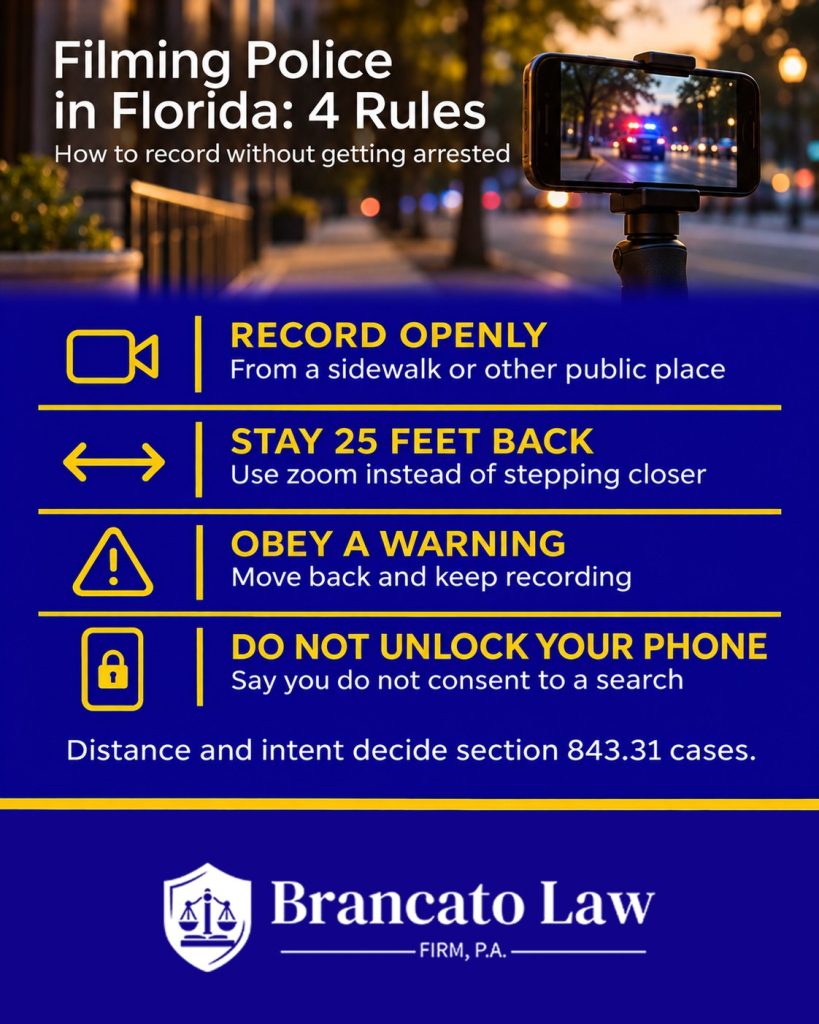
- Record openly from a lawful place. Sidewalks and public property are best; do not stand in a roadway, median, or active crime scene.
- Keep your distance. Use zoom rather than stepping closer. Staying 25 feet back avoids a section 843.31 charge entirely.
- Obey a warning to back up. Move, keep recording, and say aloud that you are complying so the video captures it.
- Do not touch officers or equipment, and do not block anyone’s path.
- Do not unlock or hand over your phone. State that you do not consent to a search.
- Save and back up the video. Upload it to cloud storage quickly; it may be the best evidence in your case or someone else’s.
Frequently asked questions
Is it illegal to film police within 25 feet in Florida?
No, not by itself. Section 843.31 requires a verbal warning, a knowing violation, and intent to interfere, threaten, or harass, so filming within 25 feet without that intent is not a crime under that statute. The Brancato Law Firm uses the video and the officer’s own body camera to contest the intent element in these cases.
Can I be arrested for recording a traffic stop in Tampa?
Recording a traffic stop is legal, including your own stop, as long as you follow lawful commands and do not interfere. Our attorneys at The Brancato Law Firm defend drivers and passengers when a recording leads to a resisting charge, and we often use that same recording as the defense.
Can police take my phone because I recorded them?
Officers sometimes seize phones as evidence, but searching the phone generally requires a warrant or your consent. The Brancato Law Firm challenges unlawful phone seizures and searches with a motion to suppress through our Hillsborough County defense practice.
Can charges for filming police be dropped in Florida?
Yes. Section 843.31 and resisting charges are frequently dropped or dismissed when video shows the person kept distance, complied with warnings, or did not interfere. The Brancato Law Firm gathers bystander video and body camera footage early, before it is overwritten.
Is it legal to record police inside a police station in Florida?
The answer depends on the area, because lobbies and secure areas are not the same as a public sidewalk, and federal courts have treated recording inside government buildings differently from recording outdoors. Our attorneys at The Brancato Law Firm advise checking posted rules and leaving rather than arguing if told to stop in a non-public area.
For how this fits into the rest of a case, see our guide to each stage of a Florida criminal case.
Talk to a Tampa criminal defense attorney about a recording arrest
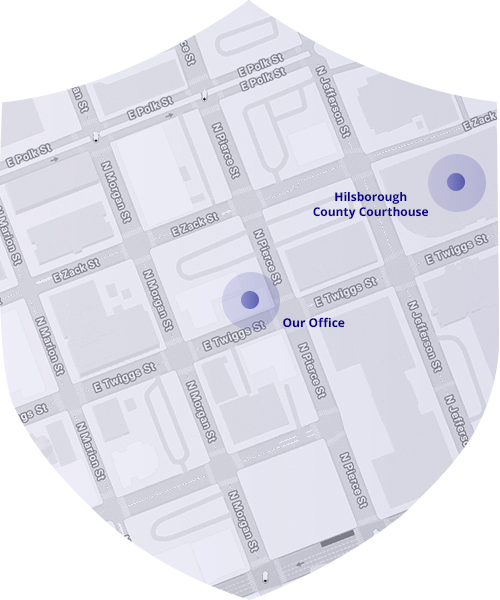
Video from the scene, yours and the officers’, is the evidence that wins these cases, and body camera footage is not kept forever. Call The Brancato Law Firm, P.A., founded by Tampa Criminal Defense Attorney Rocky Brancato, at (813) 727-7159 as soon as you are released so our attorneys can request it. You can call us at any hour, and our office is two blocks from the courthouse. Our firm has Spanish-speaking staff, and attorney Jean-Luc Adrien speaks Spanish, Haitian Creole, and French. Read our guide for Spanish-speaking criminal defense clients in Tampa. For more about our defense strategies, visit our Hillsborough County Criminal Defense page.
The Brancato Law Firm, P.A.
620 E. Twiggs Street, Suite 205, Tampa, FL 33602
(813) 727-7159
Serving Hillsborough, Pinellas, and Pasco Counties
The Brancato Law Firm, P.A. is a Tampa-based criminal defense practice. We are not affiliated with any other Brancato-named law firms.
Visit Us
Tampa, FL 33602
Contact Us Now
Free Legal Consultation (813) 727-7159