- Free Consultation 24/7: (813) 727-7159 Tap Here To Call Us


From First DUI to Death Penalty


What Is Clergy Privilege in Florida? Can a Pastor Testify Against You? (2026)



Rewrite/update date: October 27, 2026. Originally published in May 2025.
| Yes, in most cases. Florida’s clergy privilege, in section 90.505, Florida Statutes, lets a person refuse to disclose, and stop a pastor, priest, rabbi, or other member of the clergy from disclosing, a confidential communication made privately to seek spiritual counsel. Unlike most privileges, it survives in child abuse cases: section 39.204 keeps the clergy and attorney-client privileges while abrogating the others. The privilege fails when the listener is not clergy, when the talk was not for spiritual advice, or when outsiders were present. |
A Florida judge deciding whether a pastor can testify asks four specific questions about the conversation, and the answers usually turn on details the State never mentions in its charging papers. I have spent more than 25 years in Hillsborough County courtrooms, including years in the Major Crimes Unit of the Hillsborough County Public Defender’s Office, where I handled sex crime and child abuse cases. I’m Rocky Brancato, founder of The Brancato Law Firm, P.A., a Tampa criminal defense firm, and our attorneys build the factual record that decides whether a statement to clergy stays out of a trial.
What Is the Clergy Privilege in Florida?
The clergy privilege is a rule of evidence that protects confidential conversations with a member of the clergy acting as a spiritual adviser. Under section 90.505, Florida Statutes, “a person has a privilege to refuse to disclose, and to prevent another from disclosing, a confidential communication by the person to a member of the clergy in his or her capacity as spiritual adviser.”
The statute defines a “member of the clergy” as “a priest, rabbi, practitioner of Christian Science, or minister of any religious organization or denomination usually referred to as a church, or an individual reasonably believed so to be by the person consulting him or her.” The privilege belongs to the person who confided, not the pastor. It may be claimed by that person, a guardian, a personal representative, or the clergy member on the person’s behalf.
What Are the Four Requirements for Clergy Privilege in Florida?
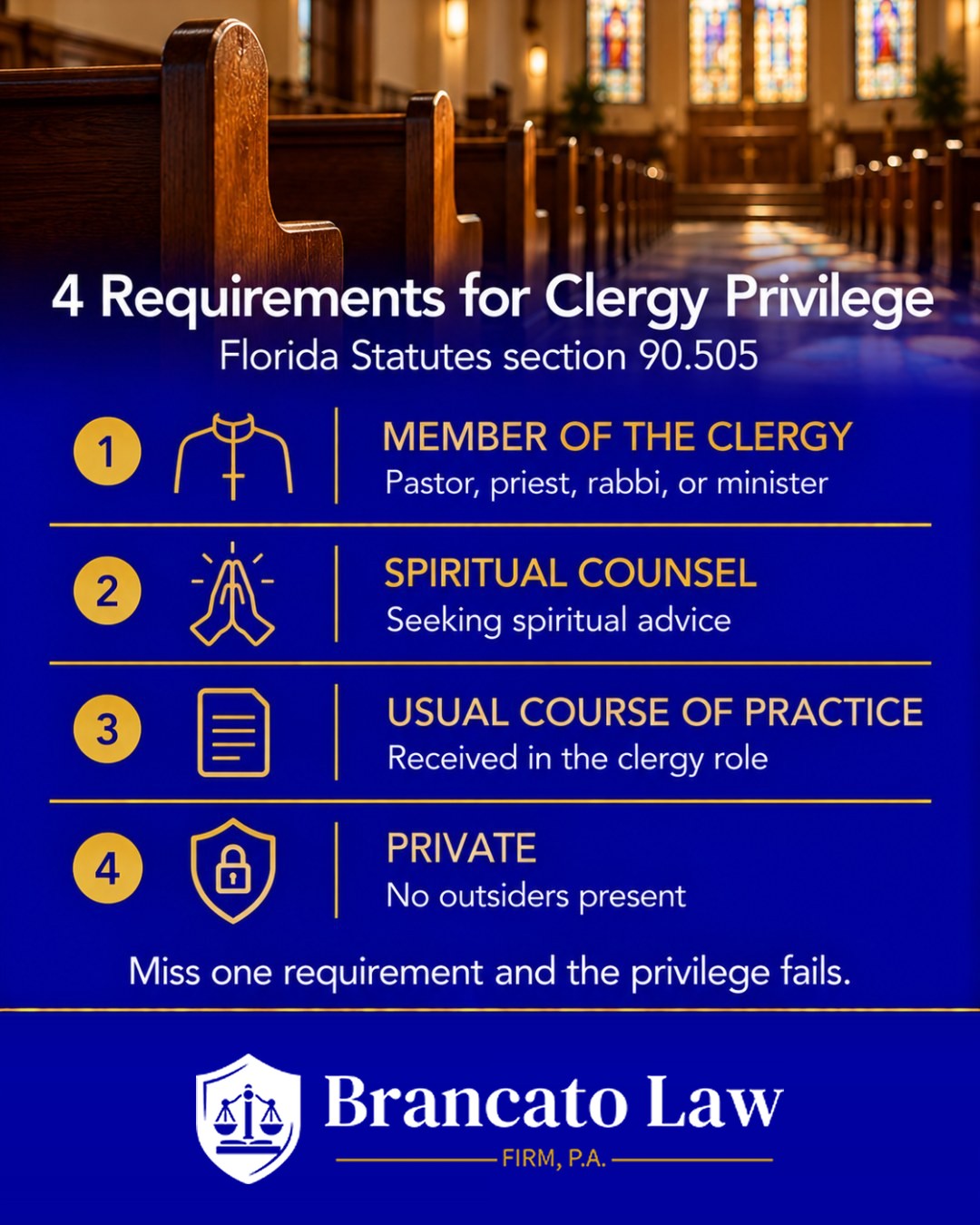
Florida courts apply a four-part test. In Nussbaumer v. State, 882 So. 2d 1067 (Fla. 2d DCA 2004), the Second District Court of Appeal stated the test this way, and appellate courts across Florida still cite it:
- A member of the clergy. The communication must be made to clergy as the statute defines the term, or to someone the person reasonably believed was clergy.
- Spiritual counsel. The person must have been seeking spiritual counseling and advice, not secular help.
- The usual course of practice. The clergy member must have received the communication in the usual course of his or her practice or discipline.
- Private and not for further disclosure. The communication must be made privately and not intended for disclosure, except to others present in furtherance of it.
In Nussbaumer, a man charged with lewd or lascivious molestation of a child had received counseling from a pastor, and the State subpoenaed the pastor’s counseling records. The man testified that he “wanted Christian counseling,” and the sessions took place at the church and centered on prayer and Bible study. The court held that all four requirements were met, ruled the communications and records “privileged as a matter of law,” and quashed the orders compelling disclosure.
| Requirement | Privilege likely applies | Privilege likely fails |
|---|---|---|
| Member of the clergy | Ordained or recognized pastor, priest, rabbi, or minister | Church volunteer or lay leader with no reasonable belief he is clergy |
| Spiritual counsel | Prayer, confession, or pastoral counseling | Church discipline, business, or a casual conversation |
| Usual course of practice | Meeting in the clergy member’s role, often at the church | A social encounter unrelated to the role |
| Private | Only the clergy member present, or family members who are part of the counseling | Other adults present who are not part of the counseling |
The table summarizes how courts have applied the test. Each case turns on its own testimony, which is why our attorneys at The Brancato Law Firm interview the client, and when possible the clergy member, before the privilege hearing.
What Did the Court Decide in Castano v. State?
The Third District Court of Appeal held that a father’s admission to his family’s pastor during family counseling was privileged, and it reversed his child sexual abuse convictions. In Castano v. State, No. 3D2022-2081 (Fla. 3d DCA May 14, 2025), Fernando Castano was tried in Miami-Dade County on eleven counts, including capital sexual battery and lewd and lascivious molestation of a child.
Castano had sought spiritual and pastoral counseling for his family from Lakhi Dadlani, a pastor and certified counselor. At a meeting at his son’s football practice, Castano told the pastor he had sexual encounters with his daughter and that his wife wanted a divorce. The pastor believed Castano wanted him to speak with the wife and daughter to help restore the family, and he then contacted the wife. The trial court found the defense had not proved the conversation was not intended for further disclosure, and the pastor testified at trial.
The appellate court disagreed. It reasoned that “the inclusion of the wife in this communication was in furtherance of the family counseling,” so the disclosure “was simply to another person within that sphere of privilege.” Because the case was a “he said, family said” dispute and the State highlighted the pastor’s testimony in closing, the error was not harmless. The court reversed the eight sexual abuse convictions and affirmed three convictions from a separate domestic incident involving his wife.
The opinion opens with a line that frames the whole decision: “The relationship between a member of the clergy and parishioner is sacred.” At the time of this update, the opinion had not been assigned a Southern Reporter citation.
When Does the Clergy Privilege Not Apply in Florida?
The privilege fails whenever one of the four requirements is missing. In McDermott v. State, 360 So. 3d 1213 (Fla. 5th DCA 2023), a Volusia County man charged with sexual battery of his stepdaughter made admissions to a church member at that man’s home. The Fifth District held the statements were not privileged because the listener “was not a member of the clergy” at the time; he was a lay volunteer who had not been licensed as a minister.
The court added a second reason. The stepdaughter’s mother and the listener’s wife were both present, and the court held their presence was not “in furtherance of the communication,” so the statements were not private. McDermott’s conviction was affirmed.
The contrast with Castano is instructive. A spouse who is part of family counseling can be inside the privilege, but adults who are simply in the room usually are not. These hearings often turn on exactly who was present and why.
Does Clergy Privilege Apply in Child Abuse Cases in Florida?
Yes. Florida abrogates most privileges in child abuse cases but expressly keeps the clergy privilege. Section 39.204, Florida Statutes, provides that the privileges between husband and wife, between professionals and their patients or clients, and “any other privileged communication except that between attorney and client or the privilege provided in s. 90.505” do not apply to communications involving an alleged perpetrator of child abuse.
| Privilege | Still applies in a Florida child abuse case? |
|---|---|
| Attorney-client (s. 90.502) | Yes, preserved by s. 39.204 |
| Clergy (s. 90.505) | Yes, preserved by s. 39.204 |
| Husband-wife (s. 90.504) | No |
| Professional and patient or client, such as a psychotherapist | No |
| Any other privileged communication | No |
That exception has two practical effects. A spouse can usually be compelled to testify about a defendant’s admissions in a child abuse case, as the McDermott court held, but a member of the clergy who received a privileged communication cannot. The same statute says abrogated privileges are not grounds for failing to report abuse under section 39.201, Florida Statutes, which requires any person who knows or suspects child abuse to report it to the central abuse hotline.
Florida’s approach is not universal. Law professor Norman Abrams surveyed all fifty states in Addressing the Tension Between the Clergy-Communicant Privilege and the Duty to Report Child Abuse in State Statutes, 44 B.C. L. Rev. 1127 (2003), and found that a majority of states expressly exempt privileged clergy information from reporting duties, some expressly override the privilege for child abuse reporting, and others do not address the conflict at all.
How Many Child Abuse Investigations Happen in Florida?
Florida conducted 175,314 child protective investigations in fiscal year 2021-2022, according to the Florida Department of Children and Families’ annual performance report on sheriffs performing child protective investigations. The same report states that the Hillsborough County Sheriff’s Office received 11,751 child and special condition reports that year.
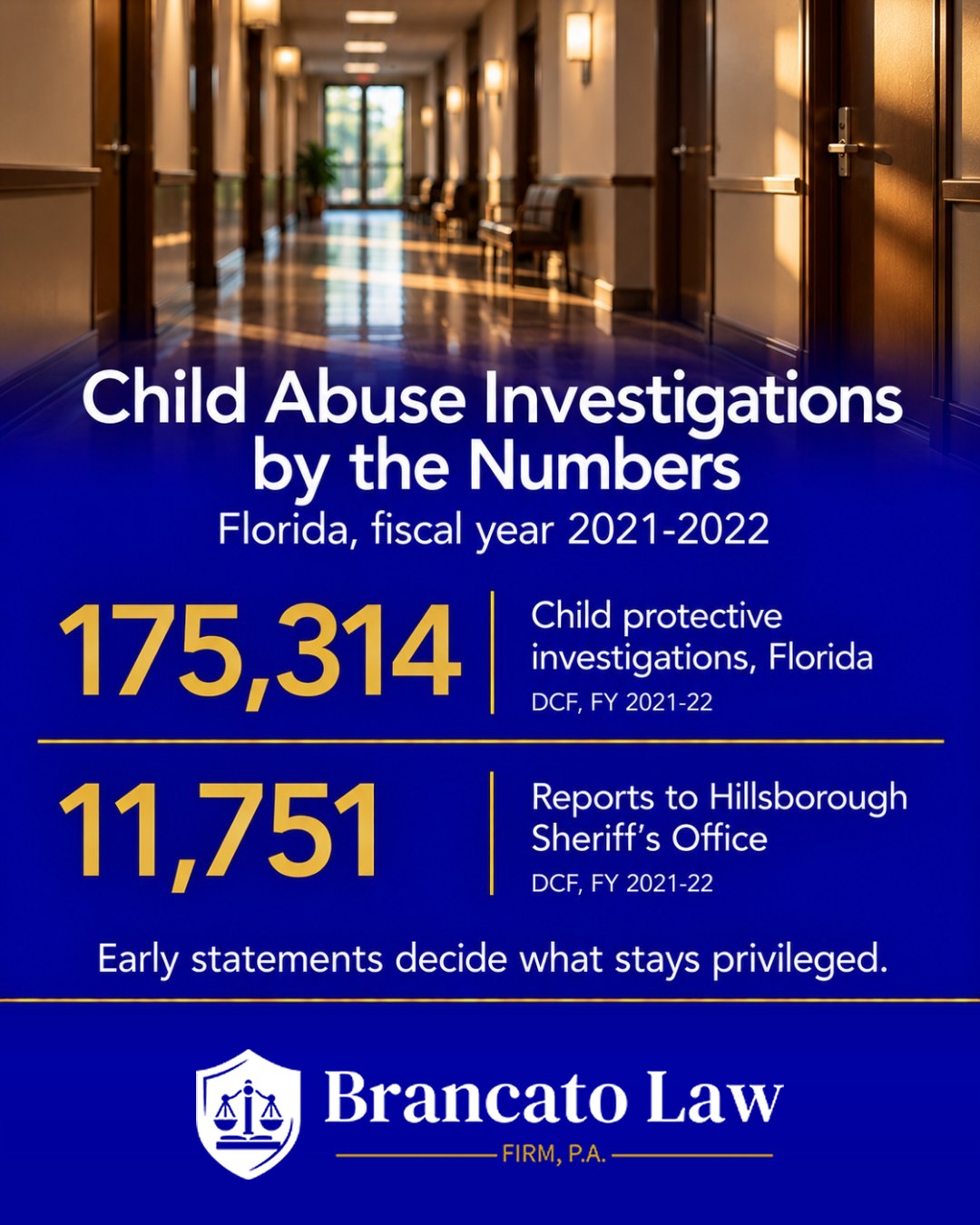
Those numbers matter for privilege questions. Many child abuse cases begin with a hotline report, and an investigator’s first interviews often reach church leaders, counselors, and family members. Statements made in those early weeks become the evidence the State relies on, so our representation before charges are filed focuses on identifying privileged conversations before anyone repeats them to an investigator.
How Do Defense Attorneys Keep a Pastor’s Testimony Out of a Florida Trial?
The defense raises the privilege before trial, usually by a motion in limine or a motion for a protective order, and proves each of the four requirements with testimony. The person claiming the privilege must prove each requirement, which is where the Castano defense initially fell short in the trial court. Our Tampa child abuse attorney page explains how we defend the underlying charges.
These are the steps our attorneys take when a client has spoken with clergy:
- Identify every conversation. We list each talk with a pastor, priest, counselor, or church member, with the date, place, and who was present.
- Establish the clergy member’s status. Ordination, licensing, and the church’s own description of the role help satisfy the first requirement.
- Document the spiritual purpose. Prayer, confession, scripture study, and pastoral counseling support the second and third requirements.
- Explain anyone else’s presence. As Castano shows, a family member who is part of the counseling can fall within the privilege; a bystander usually cannot.
- Move to quash subpoenas for records. As in Nussbaumer, counseling notes held by the church can be protected along with the conversation itself.
- Preserve the issue for appeal. A timely objection and a full record are what allowed the Castano convictions to be reversed.
Privilege rulings often overlap with other evidence fights in sex crime cases, such as the State’s use of prior accusations, which our guide Can Prior Accusations Be Used Against You in a Florida Sex Crime Case? explains.
Frequently Asked Questions About Clergy Privilege in Florida
Can a pastor be forced to testify about a confession in Florida?
Usually not, if the confession was made privately to a member of the clergy for spiritual counsel, because section 90.505 lets the person who confided block the testimony. Our attorneys at The Brancato Law Firm raise the privilege before trial and build the record on all four statutory requirements.
Does the clergy privilege apply to a youth pastor or church volunteer in Florida?
It applies to a youth pastor who is a minister of the church, but usually not to a lay volunteer unless the person reasonably believed the volunteer was clergy, as McDermott shows. The Brancato Law Firm gathers ordination and church role records early, because this question often decides the hearing.
Is a conversation with a pastor privileged if my spouse was there?
It can be, if the spouse was present in furtherance of the counseling, as in family counseling in Castano v. State. Our attorneys at The Brancato Law Firm look closely at why each person was present, since adults who are not part of the counseling can defeat the privilege.
Do Florida clergy have to report child abuse they learn about in confession?
Florida law requires any person who suspects child abuse to report it, but section 39.204 preserves the clergy privilege, so a privileged communication is treated differently from other information. The Brancato Law Firm advises clients and families who are unsure what a conversation with clergy means for a pending investigation; see our child abuse defense page.
Can the State subpoena church counseling records in a Florida criminal case?
The State can issue the subpoena, but records of privileged clergy communications can be protected, as the court held in Nussbaumer v. State. The Brancato Law Firm moves to quash these subpoenas and seeks protective orders before any records are turned over.
Should I talk to my pastor if I am under investigation for a sex crime in Tampa?
Speak with a defense attorney first, because the privilege has strict requirements and a conversation that misses one of them can become trial evidence. Our attorneys at The Brancato Law Firm offer pre-file advocacy for people who learn they are under investigation.
For how this fits into the rest of a case, see our stage-by-stage guide to the Florida criminal case process.
Talk to a Tampa Defense Attorney Before Anyone Repeats Your Words
The best time to protect a conversation with clergy is before the State asks about it, usually in the first weeks of an investigation. Call The Brancato Law Firm, P.A., founded by Tampa Criminal Defense Attorney Rocky Brancato, at (813) 727-7159, and our attorneys will review who you spoke with, what was said, and whether the privilege applies. Call us at any hour. Our firm has Spanish-speaking staff, and attorney Jean-Luc Adrien speaks Spanish, Haitian Creole, and French. Read our guide for criminal defense in Spanish and Haitian Creole in Tampa.
For more about our defense strategies, visit our Tampa Child Abuse Attorney page.
The Brancato Law Firm, P.A.
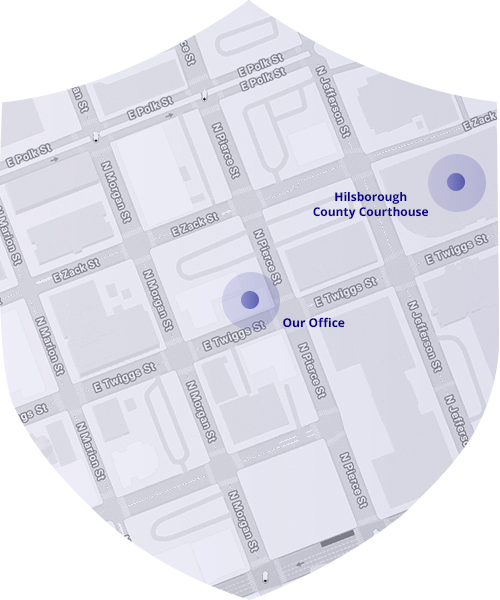
620 E. Twiggs Street, Suite 205, Tampa, FL 33602
(813) 727-7159
Serving Hillsborough, Pinellas, and Pasco Counties
The Brancato Law Firm, P.A. is a Tampa-based criminal defense practice. We are not affiliated with any other Brancato-named law firms.
Visit Us
Tampa, FL 33602
Contact Us Now
Free Legal Consultation (813) 727-7159