- Free Consultation 24/7: (813) 727-7159 Tap Here To Call Us


From First DUI to Death Penalty



Is Video Voyeurism a Felony in Florida? (2026)


Rewrite/update date: November 2, 2026. Originally published in June 2025.
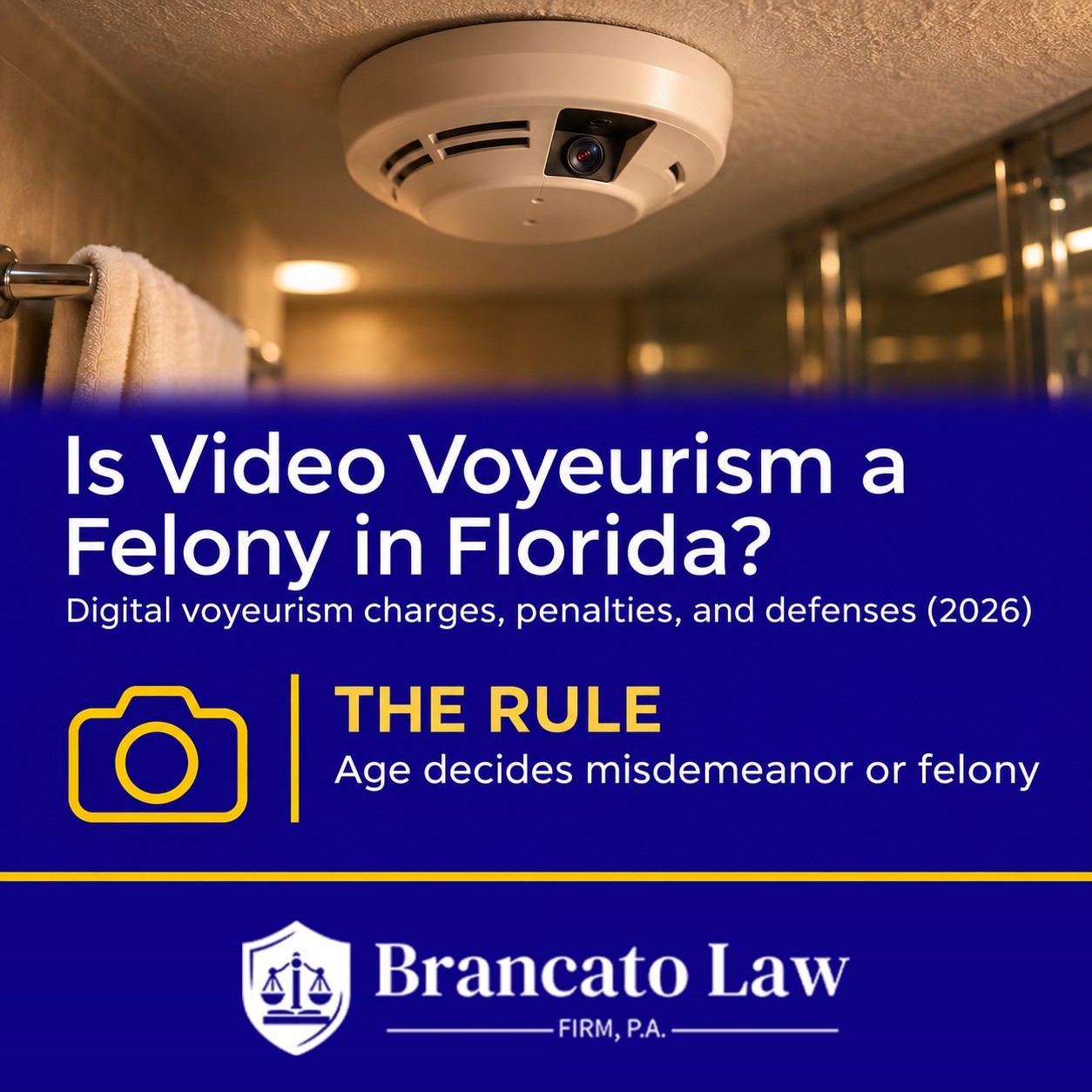
| Yes. Video voyeurism, now called digital voyeurism under section 810.145, Florida Statutes, is a third-degree felony punishable by up to 5 years in prison when the accused is 19 or older, and a first-degree misdemeanor when the accused is under 19. Sharing or selling the recording is a separate third-degree felony, and each image or recording can be charged as its own count. The charge becomes a second-degree felony, and requires sex offender registration, when the person recorded is a child under 16 and the accused is 24 or older or held a caretaker or school role. |
If police took your phone after a complaint from a roommate, a coworker, or a stranger in a store, the case against you is already inside that device. As founder of The Brancato Law Firm, P.A., a Tampa criminal defense firm, I bring to these cases my years in the Major Crimes Unit handling sex crime prosecutions and more than 150 jury trials to verdict. Our attorneys defend digital voyeurism charges in Hillsborough, Pinellas, and Pasco Counties by testing every element the State must prove, starting with what the camera actually captured and where.
What is video voyeurism under Florida law?
Video voyeurism is secretly using a camera or other imaging device to view, record, or broadcast someone who is undressing or exposed in a private place, without that person’s knowledge and consent. Since October 1, 2024, section 810.145, Florida Statutes calls the offense “digital voyeurism.” Chapter 2024-132, Laws of Florida (CS/CS/HB 1389), renamed the crime, added “exploiting” as a prohibited purpose, and created new dissemination offenses. The statute covers three kinds of conduct:
- Secret recording in a private place. Using or installing a device to secretly view, broadcast, or record a person who is dressing, undressing, or privately exposing the body where that person has a reasonable expectation of privacy.
- Permitting someone else to do it. Allowing another person to use or install the device for that person’s gratification or profit.
- Recording under or through clothing. Secretly recording under or through another person’s clothing to view the body or undergarments, often called upskirting. This version does not require a private place, so it reaches stores, escalators, and other public spaces.
The statute defines a reasonable expectation of privacy as circumstances in which a reasonable person would believe he or she could fully disrobe without being watched or recorded, including the inside of a home, a bathroom, a changing or fitting room, a dressing room, or a tanning booth. Our Tampa sex crimes lawyer page explains how our firm defends the full range of sexual offense charges.
Is video voyeurism a felony or a misdemeanor in Florida?
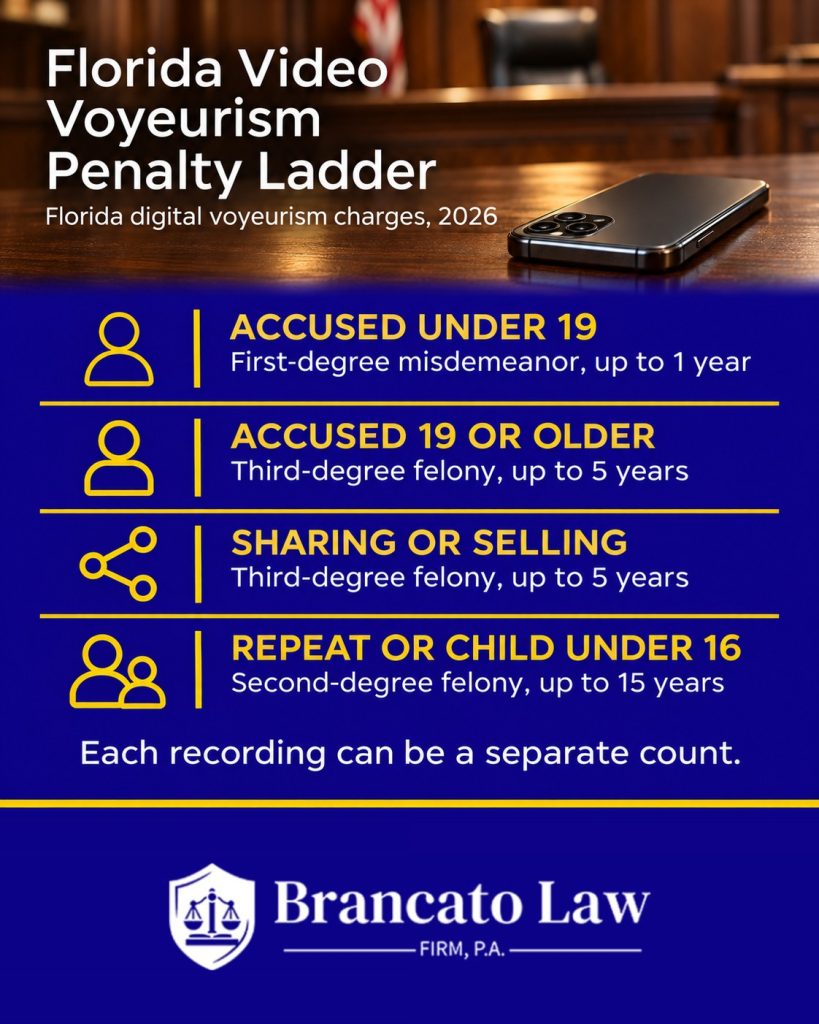
It depends on the accused person’s age, the alleged victim’s age, the relationship between them, and any prior record. For an adult with no prior voyeurism conviction, the base offense is a third-degree felony. These are the degrees under section 810.145 and the maximum penalties under section 775.082, Florida Statutes:
| Offense under s. 810.145 | Degree | Maximum prison | Offense level |
|---|---|---|---|
| Digital voyeurism, accused under 19 | First-degree misdemeanor | 1 year in jail | Not scored as a felony |
| Digital voyeurism, accused 19 or older | Third-degree felony | 5 years | Level 3 |
| Digital voyeurism dissemination (sharing the recording) | Third-degree felony | 5 years | Level 4 |
| Commercial dissemination (selling the recording) | Third-degree felony | 5 years | Level 5 |
| Second or subsequent voyeurism offense | Second-degree felony | 15 years | Level 5 |
| Child under 16 and accused 24 or older, a caretaker, or a school employee (s. 810.145(8)) | Second-degree felony | 15 years | Level 5 (Level 6 if a prior) |
Two more rules drive exposure. First, each instance of viewing, recording, or sharing is a separate offense with a separate penalty, so one phone can produce many counts. Second, when an accused 19 or older is a family or household member of the person recorded, or holds a position of authority or trust such as a coach, caregiver, or employer, the court must reclassify the felony one degree higher. The offense levels come from section 921.0022, Florida Statutes, the offense severity ranking chart on the Criminal Punishment Code scoresheet.
Do you have to register as a sex offender for video voyeurism in Florida?
Only for the child-victim version of the offense. Florida’s registration statute, section 943.0435, Florida Statutes, lists section 810.145(8) as a qualifying offense, not the rest of section 810.145. A conviction for recording an adult, or for sharing an adult’s recording, does not by itself trigger registration. A conviction under subsection (8), which covers victims under 16 and accused persons who are 24 or older, caretakers, or school employees, requires registration as a sexual offender.
That distinction makes the charging decision the most important event in many cases. Whether the State files under subsection (2) or subsection (8), and whether it can prove the alleged victim’s age and the accused person’s role, decides whether a client faces a lifetime of registration. Our overview of sex offender registration in Florida explains what registration requires.
How often do video voyeurism convictions lead to prison in Florida?
For an adult first offense, rarely; for the child-victim version, usually. In fiscal year 2022-23, the Florida Department of Corrections recorded 1 prison admission and 31 supervision admissions for adults 19 or older convicted of video voyeurism, a 3.1% incarceration rate, according to the Office of Economic and Demographic Research impact analysis of the 2024 bill. For second or subsequent offenses the rate was 12.5%, and for the child-victim offenses under subsection (8) it was 71.4%, with 10 prison admissions and 4 supervision admissions.
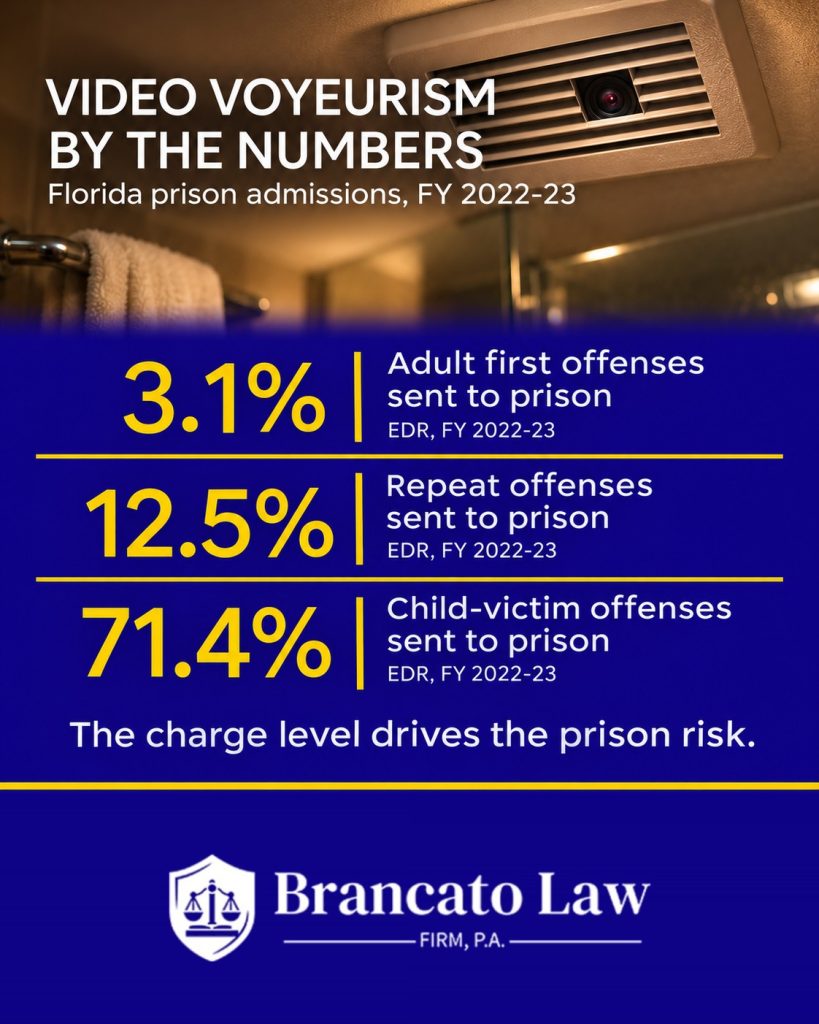
The scoresheet explains the gap. A single Level 3 count scores 16 points, well below the 44 points at which prison becomes the lowest permissible sentence, so a first-offense adult case often resolves with probation. Multiple counts, a Level 5 primary offense, or a prior record can push the score past that line. The same analysis reported 22 misdemeanor video voyeurism arrests statewide in fiscal year 2022-23, a reminder that most of these cases are charged as felonies.
| Fiscal year 2022-23 (Florida DOC) | Prison admissions | Supervision admissions | Incarceration rate |
|---|---|---|---|
| Adult first offense (19 or older) | 1 | 31 | 3.1% |
| Second or subsequent offense | 3 | 21 | 12.5% |
| Child-victim offenses, s. 810.145(8) | 10 | 4 | 71.4% |
How do you fight a video voyeurism charge in Florida?
You fight it by holding the State to each element: a secret recording, of a person undressing or exposed, in a place with a reasonable expectation of privacy, without consent, for a prohibited purpose, by you. Our attorneys build the defense around the elements the evidence does not support:
- Not secret. A camera that was visible, a security system with posted notice, or a device installed so its presence was “clearly and immediately obvious” falls under the statute’s exceptions in subsection (5).
- No reasonable expectation of privacy. A person visible from a street or a public area may not meet the statute’s definition, except in an under-the-clothing case.
- Consent. Recordings made with a partner’s knowledge and agreement are not secret. Text messages and prior conduct often prove consent.
- No prohibited purpose. The State must prove amusement, sexual gratification, profit, or an intent to degrade, exploit, or abuse. A home security camera installed to watch a front door is not voyeurism.
- Identity. Shared phones, cloud accounts, and household devices raise the question of who actually made or viewed the recording.
- Count stacking. Duplicates, thumbnails, and automatic cloud copies of one recording should not become separate charges.
Secrecy is often contested. In J.T.R. v. State, 79 So. 3d 839 (Fla. 1st DCA 2012), a juvenile held a phone over a school bathroom stall and argued the State had not proven the recording was secret because the victim looked up at the camera. The First District affirmed, holding that a victim who notices the camera only after recording starts does not defeat secrecy. The lesson is that secrecy is judged at the moment the recording begins, so the defense must establish what the person knew before then.
Can police make you unlock your phone in a voyeurism case?
In the Second District, which covers Hillsborough, Pinellas, and Pasco Counties, a court can order you to provide a phone passcode when police already hold a warrant for the phone. In State v. Stahl, 206 So. 3d 124 (Fla. 2d DCA 2016), a man was accused of holding an illuminated phone under a shopper’s skirt in a store, then withdrew his consent to search his iPhone. The Second District held that compelling the passcode did not violate the Fifth Amendment because the State already had a warrant and knew the phone was his, calling it “a case of surrender and not testimony.”
Other Florida appellate courts have since disagreed with Stahl, so the issue remains contested. The practical lesson is the same everywhere: do not give consent to search a phone, do not unlock it, and do not explain what is on it. Ask for a lawyer and let your attorney handle any court order. Our article on secretly recording someone in Florida covers the separate audio recording law that often appears alongside these charges.
What happens after a video voyeurism arrest in Hillsborough County?
After an arrest in Hillsborough County, the accused goes before a judge at first appearance at the Orient Road Jail within 24 hours, where bond and release conditions are set. In our experience, judges routinely add a condition barring any contact with the person recorded, and the State asks the court to keep the accused away from the location, such as a workplace or apartment complex, where the camera was found. Violating those conditions can lead to bond revocation, so our attorneys explain them to clients before release.
The phone, laptop, or hidden camera usually goes to a forensic examiner, and that report often takes months. That delay is an opportunity. Before the State files formal charges, our attorneys can present facts about consent, ownership of the device, or the purpose of a camera through pre-file advocacy, which can lead the State to file a lesser charge or no charge at all. Our Hillsborough County criminal defense page describes the local process.
Why does Florida treat upskirting differently?
Florida separately criminalizes recording under or through clothing because older voyeurism laws required a private place, and courts often held there is no expectation of privacy in public. A 2006 study in Criminal Justice Studies, Valerie Bell, Craig Hemmens, and Benjamin Steiner’s Up Skirts and Down Blouses: A Statutory Analysis of Legislative Responses to Video Voyeurism, reviewed 47 state and federal voyeurism statutes and found that most required an invasion of privacy, leaving upskirt recordings in public places uncovered. Florida closed that gap with the under-the-clothing provision, which is why a store or a stadium can be the scene of a felony.
For the defense, the shift moves the fight from where the recording happened to what it shows and why it was made. Our attorneys examine the actual footage frame by frame, because a recording that does not capture the body or undergarments under the clothing does not meet this version of the offense.
Frequently asked questions about video voyeurism in Florida
Is it illegal to have a hidden camera in your own home in Florida?
Not by itself. A camera becomes digital voyeurism when it secretly records someone undressing or exposed in a private area, such as a guest bathroom or a tenant’s bedroom, for a prohibited purpose. The Brancato Law Firm examines where each camera pointed and why it was installed, because a security camera covering a door or driveway is lawful.
Can video voyeurism charges be dropped in Florida?
Yes. Charges can be dropped or reduced when the evidence does not show secrecy, a private place, a prohibited purpose, or who made the recording, or when a search was unlawful. Our attorneys at The Brancato Law Firm raise these issues with prosecutors early, often before charges are filed, through representation before charges are filed.
Is sharing a secret recording a separate crime in Florida?
Yes. Since October 1, 2024, sending a recording you know or have reason to believe was made by digital voyeurism is digital voyeurism dissemination, a third-degree felony, and selling it is commercial dissemination. The Brancato Law Firm looks at whether the client knew how the recording was made, an element the State must prove for sharing charges.
Does recording a partner during sex count as video voyeurism?
It can, if the partner did not know about or consent to the recording. Consent to sex is not consent to be recorded, but consent to recording can be shown through messages, a visible device, or past practice. Our attorneys at The Brancato Law Firm gather that evidence early, and our article on revenge porn charges in Florida covers later sharing of intimate images.
Is a teenager who records a classmate charged with a felony?
Usually not as an adult felony. An accused under 19 commits a first-degree misdemeanor under section 810.145(2)(b), and most cases involving minors go to juvenile court. The Brancato Law Firm works to keep these cases in diversion programs that avoid a permanent record.
Will I have to register as a sex offender if the person I recorded was 17?
Not under section 810.145(8) unless the person was under 16, or you were a caretaker or school employee of a student. Registration applies only to subsection (8) convictions, so the age of the person recorded and your role decide the question. Our sex crimes defense attorneys at The Brancato Law Firm challenge the State’s proof of both facts.
Speak with our attorneys before the forensic report comes back
The weeks after a phone or camera is seized are when the defense can shape the charge, before a prosecutor decides between a misdemeanor, a third-degree felony, or a registrable offense. Tampa Criminal Defense Attorney Rocky Brancato founded The Brancato Law Firm, P.A. to defend people in exactly this position, and our attorneys can review the warrant, the device report, and the facts about consent. Call us at any hour at (813) 727-7159 for a confidential consultation. Our firm has Spanish-speaking staff, and attorney Jean-Luc Adrien speaks Spanish, Haitian Creole, and French. Read our guide for Spanish-speaking criminal defense clients in Tampa.

For more about our defense strategies, visit our Sex Crimes page.
The Brancato Law Firm, P.A.
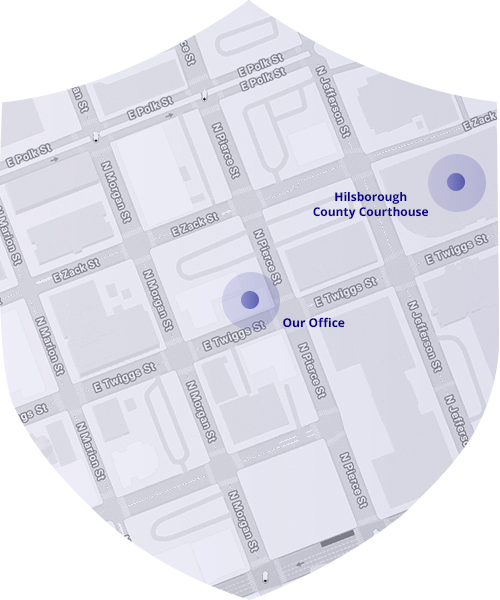
620 E. Twiggs Street, Suite 205, Tampa, FL 33602
(813) 727-7159
Serving Hillsborough, Pinellas, and Pasco Counties
The Brancato Law Firm, P.A. is a Tampa-based criminal defense practice. We are not affiliated with any other Brancato-named law firms.
Visit Us
Tampa, FL 33602
Contact Us Now
Free Legal Consultation (813) 727-7159